


Who Pays Closing Costs in a Real Estate Transaction

Both sides pay: the buyer covers loan and prepaid costs, and the seller covers agent compensation, deed taxes and any mortgage payoff. Who pays closing costs on each line comes down to the purchase contract. Florida deed stamps run 70 cents per $100 of the price. The sections below show the split, the Florida customs, and the limits on seller help.
Key Takeaways
- Buyers and sellers each pay a different set of closing costs, and the purchase contract assigns the shared items.
- Florida sellers customarily pay the deed stamp tax of 70 cents per $100, and buyers pay the mortgage taxes.
- Owner's title policy payment follows county custom, and the contract can change it.
- Seller concessions have caps: 3%, 6% or 9% on conventional loans, 6% on FHA loans, and 4% on VA loans.
- The Closing Disclosure shows the final split at least three business days before closing.
Who Pays Closing Costs, Buyer or Seller?
Who pays closing costs depends on the line item, because buyers and sellers each pay a different set of fees. The buyer pays for the loan, the lender's title policy, and prepaid items. The seller pays for agent compensation, deed taxes, and any mortgage payoff. The purchase contract assigns the shared items.
The Consumer Financial Protection Bureau (CFPB) says a buyer generally pays all purchase costs. A contract or state law can move a cost to the seller. Our purchase closing services follow that contract-first rule.
Florida adds its own taxes and county customs to that contract-first rule, so the next section sorts the fees by payer.
Who Usually Pays Closing Costs on a House?
Who pays closing costs on a house depends on the fee. The buyer pays loan-related and prepaid costs, and the seller pays deed taxes and payoffs by custom. Both parties split prorated items such as property taxes. A cash buyer skips the loan fees but still pays title and escrow charges.
The table below shows who pays for closing costs by fee, using the customary payer in a Florida sale. Contract terms override every custom listed.
| Cost | Customary payer | Reason |
|---|---|---|
| Loan origination and underwriting fees | Buyer | The lender charges them for the new loan |
| Appraisal and credit report | Buyer | The lender orders them for the loan decision |
| Lender's title policy | Buyer | The policy protects the lender's mortgage |
| Mortgage stamp and intangible taxes | Buyer | The taxes attach to the new note and mortgage |
| Deed stamp tax | Seller | The seller signs the deed that carries the tax |
| Existing mortgage payoff | Seller | The payoff clears the old lien at closing |
| Owner's title policy | Seller or buyer by county | Local custom decides, and the contract can change it |
| Agent compensation | Negotiated | Each side negotiates its own agent's pay |
| Prorated taxes and HOA dues | Both | The closing date splits the cost |
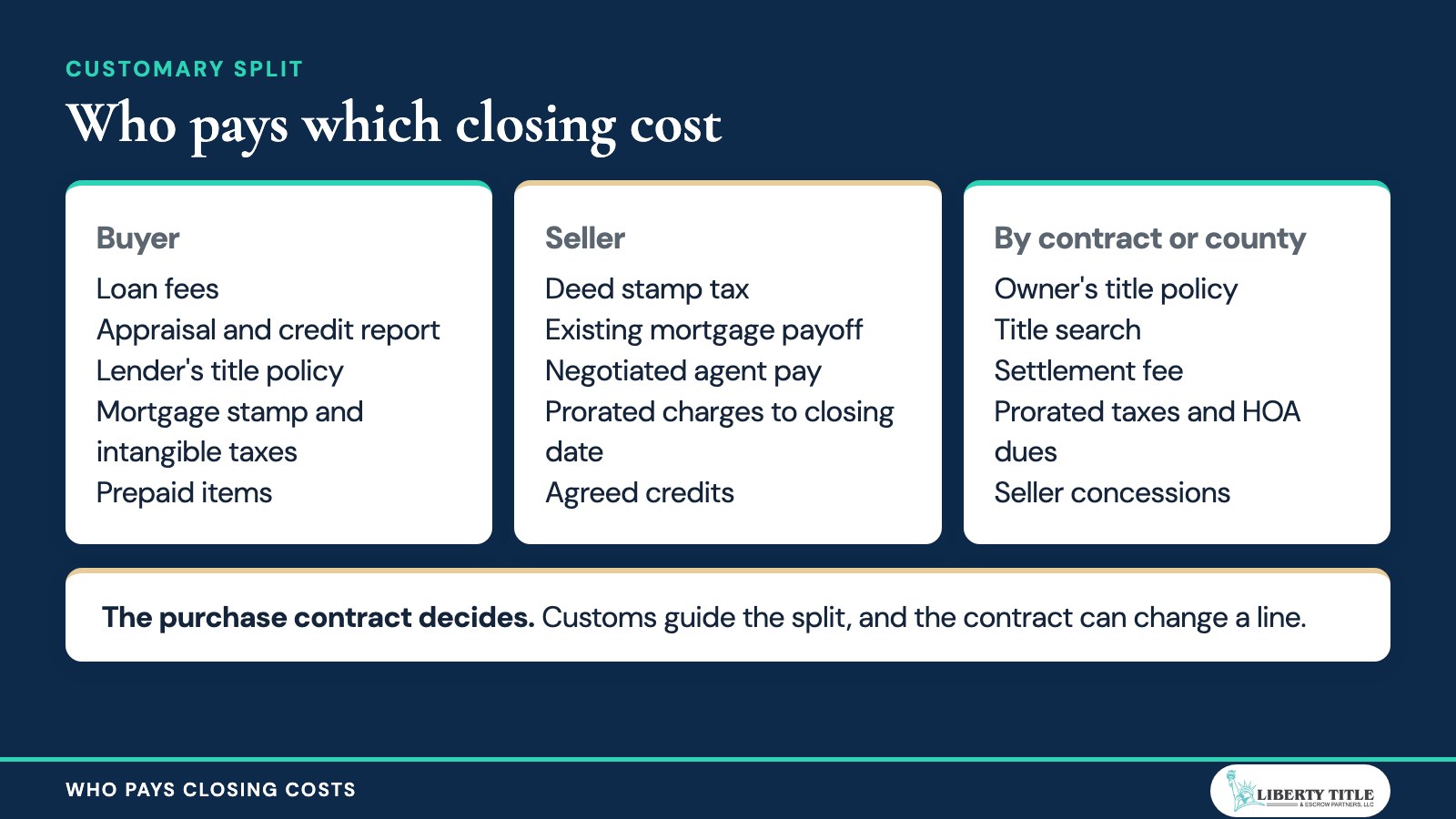
That table shows the main split, and the graphic below groups the same fees by buyer, seller, and contract. Florida law sets the tax rates behind several rows.
Who Pays Closing Costs in Florida?
Who pays closing costs in Florida follows the same buyer and seller split, and the purchase contract controls every line item. State law sets three taxes that land on specific sides by custom. The seller pays the deed tax, and the buyer pays the taxes tied to the new mortgage.
Section 201.02 of the Florida Statutes sets the deed stamp tax at 70 cents per $100 of consideration. Section 201.08 sets the tax on notes and mortgages at 35 cents per $100. Section 199.133 sets the intangible tax on mortgage-secured notes at 2 mills.
These rates produce real dollar amounts, so the next sections apply them to each side.
What Does the Buyer Pay at Closing in Florida?
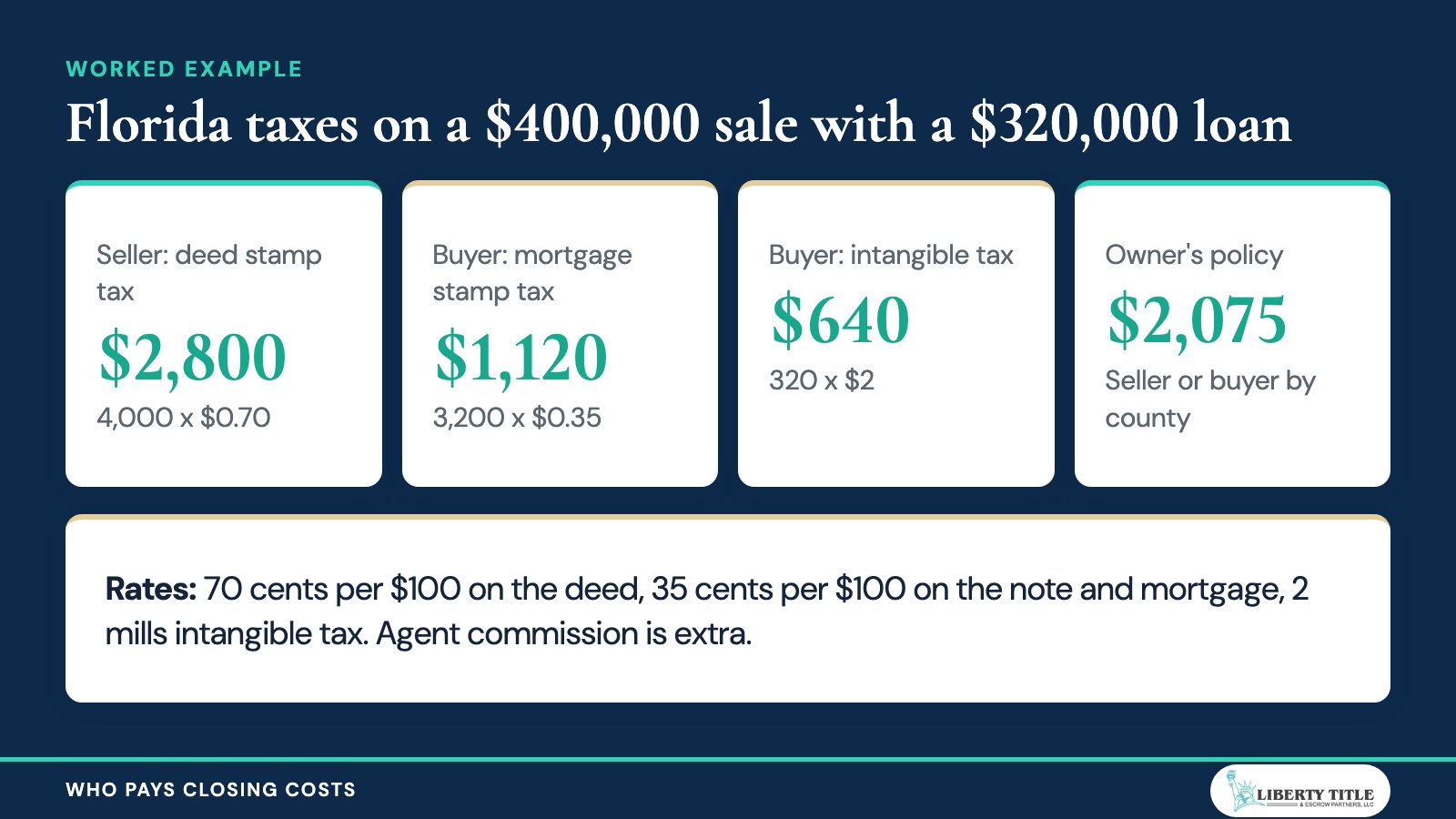
A Florida buyer pays the lender fees, the lender's title policy, the mortgage taxes, prepaid items, and the buyer's own recording charges. The mortgage taxes alone equal $1,760 on a $320,000 loan. That total adds $1,120 in stamp tax and $640 in intangible tax.
The math follows the statutes: 3,200 units of $100 at 35 cents, plus 320 units of $1,000 at $2. A buyer also pays for inspections and a survey ordered during the contract period. Our title premium calculator estimates the title portion of that bill.
The seller carries a different set of costs, starting with the deed tax.
What Does the Seller Pay at Closing in Florida?
A Florida seller pays the deed stamp tax, negotiated agent compensation, any mortgage payoff, and prorated charges through the closing date. The deed tax equals $2,800 on a $400,000 sale. That figure comes from 4,000 units of $100 at 70 cents.
The payoff amount comes from the seller's lender. Florida Statutes Section 701.04 requires a mortgagee to deliver a payoff letter within 10 days of a written request. The closing agent then subtracts the payoff and other seller costs from the sale proceeds.
One title cost splits the state in two, which the next section explains.
Who Pays for the Owner's Title Policy in Florida?
The owner's title policy payer depends on county custom, and no Florida law assigns the premium to either side. The seller customarily pays in the majority of Florida's 67 counties. In a handful of South Florida and Gulf Coast counties, the buyer customarily pays instead.
Miami-Dade is one of four buyer-pays counties, together with Broward, Sarasota, and Collier. Our guide on the owner's policy payer shows the county split in full.
Florida Administrative Code 69O-186.003 sets the promulgated rate at $5.75 per $1,000 up to $100,000. The rule adds $5.00 per $1,000 from $100,000 to $1 million. On a $400,000 policy, that math equals $2,075.
Where the seller pays, the premium reduces seller proceeds. Our explanation of the seller-paid owner's policy covers that custom. The same contract that names the policy payer also names the commission payer, which changed recently.
Who Pays Real Estate Agent Commissions at Closing?
Each side now negotiates its own agent's pay, because buyer agent compensation became a separate negotiation. A 2024 National Association of Realtors settlement ended the automatic seller obligation to pay both agents. A seller can still offer to cover the buyer's agent in the contract.
The listing agreement and the buyer's representation agreement set each rate. Commission is not part of the lender's closing cost estimate, and it appears on the settlement statement at closing. Our agent resources explain how title and escrow fit into those files.
Agent pay is only one negotiated line, and the contract can reassign other costs as well.
How Do You Settle Who Pays Closing Costs in the Contract?
Settle the split by writing each shared fee and its payer into the purchase contract before signing. The Closing Disclosure later confirms the result. Five steps keep the split clear:
- Ask your agent or closing agent which party customarily pays each fee in the county.
- Name the payer for the owner's policy, title search, and settlement fee in the contract.
- State any seller concession as a dollar amount or a percentage of the price.
- Compare the Loan Estimate against the contract terms after the lender issues it.
- Review the Closing Disclosure, which lenders must provide three business days before closing, line by line.
The Closing Disclosure lists seller credits as Seller Credit or Seller Paid line items, so each step leads to one final page. A seller credit moves a buyer cost to the seller, and it has its own limits.
What Are Seller Concessions and How Do They Work?
Seller concessions are credits that the seller gives the buyer toward closing costs, and each loan program caps the amount. The seller pays the credit from sale proceeds at closing. The buyer uses it only for allowed costs, which lowers the cash needed at closing.
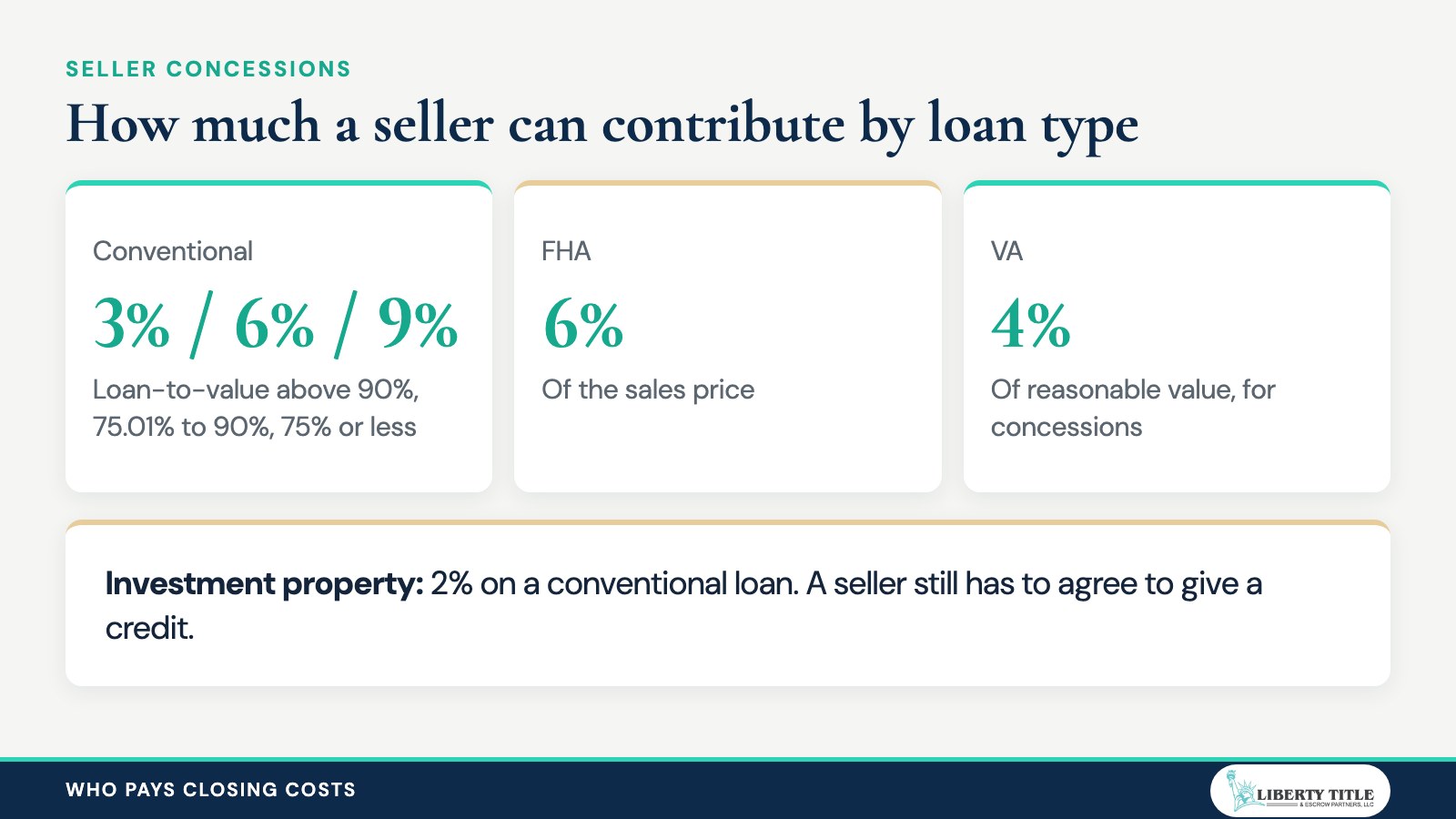
The CFPB notes a seller may ask for a higher price in return for a credit. The table below shows the caps by loan type. Our purchase escrow services record the credit on the settlement statement.
| Loan type | Contribution limit | Source |
|---|---|---|
| Conventional, loan-to-value 75% or less | 9% | Fannie Mae Selling Guide B3-4.1-02 |
| Conventional, loan-to-value 75.01% to 90% | 6% | Fannie Mae Selling Guide B3-4.1-02 |
| Conventional, loan-to-value above 90% | 3% | Fannie Mae Selling Guide B3-4.1-02 |
| Conventional, investment property | 2% | Fannie Mae Selling Guide B3-4.1-02 |
| FHA | 6% of the sales price | HUD notice, October 2023 |
| VA | 4% of reasonable value, for concessions | Department of Veterans Affairs |
Each cap limits the credit, but a seller still has to agree to give one.
Can a Seller Refuse to Pay Closing Costs?
Yes, a seller can refuse to pay closing costs, because no rule forces a seller to give a credit. The seller owes only the costs the signed contract assigns. A buyer can request a credit, raise the offer price, or accept the seller's terms.
The CFPB says a seller may require a higher price in exchange for a credit. A credit therefore moves cost within the deal and does not remove it. A buyer and seller agree on the final terms in writing.
Market conditions shape that negotiation, which is the next question.
Who Pays Closing Costs in a Seller's Market?
In a seller's market, the buyer may offer to pay more of the closing costs to strengthen an offer. High demand gives the seller room to decline credits. A slower market lets a buyer ask the seller for help instead.
Either side can adjust costs in the contract, and the loan caps in the table above still apply. A buyer who waives a credit request can compete on terms other than price. Recent survey data shows how many sellers still give credits.
Who Pays Closing Costs on an FHA Loan?
On an FHA loan, a seller can pay up to 6% of the sales price toward the buyer's closing costs. The Department of Housing and Urban Development (HUD) sets that limit. On a $300,000 sale, 6% equals $18,000. The contract must name the credit.
A lender confirms the limit for a specific loan. The next section covers how those closing costs are paid.
How Are Closing Costs Usually Paid?
Buyers pay closing costs with a wire transfer or cashier's check, and sellers pay from the sale proceeds. The closing agent collects the buyer's funds and subtracts seller costs from the proceeds. The settlement statement then shows every deposit and disbursement.
Our guide to settlement agents explains who handles those funds. The Closing Disclosure total excludes the down payment, per the CFPB.
Funds move differently when no lender is involved, as in a cash deal.
Who Pays Closing Costs on a Cash Sale?
On a cash sale, the same buyer and seller split applies, and the buyer skips the lender fees. The seller still pays the deed tax and any payoff. The buyer still pays title, escrow, and recording charges named in the contract.
No mortgage means no mortgage stamp tax and no intangible tax. Cash deals also skip the Loan Estimate and appraisal, unless the buyer orders one. The contract governs the rest.
What Else Should You Know About Who Pays Closing Costs?
Who Pays Closing Costs on a Foreclosure?
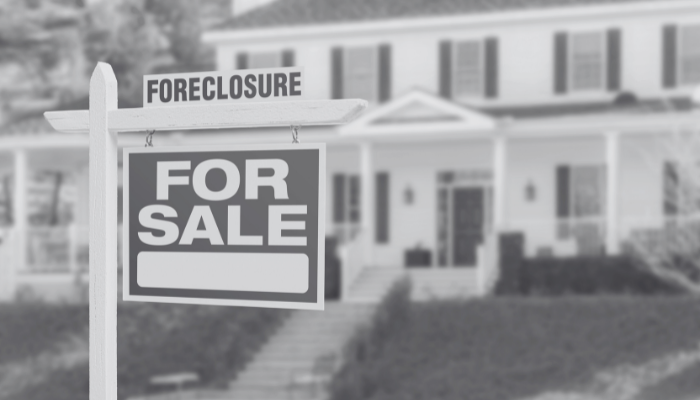
The contract decides the payer on a foreclosure, and a bank seller can set its own terms. A buyer should read the addendum closely. Our REO closings page covers bank-owned sales.
Who Pays Closing Costs on Commercial Property?
The commercial purchase contract decides the payer on commercial property. Commercial terms vary more than residential custom. Our commercial transactions follow the signed agreement.
Who Pays Closing Costs When a Home Sells Without an Agent?
The same contract-first rule applies to a for-sale-by-owner deal. The buyer and seller write the split into the agreement. Neither side owes agent commission unless the contract says so.
Who Chooses the Closing Agent?
The party who pays for the owner's policy customarily chooses the closing agent in Florida. Our page on closing agent selection covers the contract language.
Who Pays for the Appraisal Fee?
The buyer pays the appraisal fee at the time of service, according to Zillow. Redfin lists appraisals at $300 to $500. Local prices vary by property and lender.
Who Pays Prorated Taxes and HOA Fees?
Both sides share prorated taxes and HOA dues, split at the closing date. A Florida HOA estoppel certificate is due within 10 business days of a request. The fee cap is $250 when no amounts are delinquent, under Section 720.30851.
Frequently Asked Questions
How Much Would the Closing Cost Be on a $300,000 Home?
Redfin reports buyers usually pay 2% to 5% of the purchase price. On a $300,000 home, that range equals $6,000 to $15,000. Costs vary by county and loan.
How Much Are Closing Costs on a $400,000 House in Florida?
Bankrate puts closing costs at 2% to 5% of the loan amount. On a $400,000 loan, that range equals $8,000 to $20,000. Local costs vary.
How Much Would I Need for a 20% Down Payment on a $300,000 House?
A 20% down payment on a $300,000 house equals $60,000. The down payment is separate from closing costs. Buyers add the closing costs on top.
Who Pays Closing Costs on an Investment Property?
The purchase contract decides who pays closing costs on an investment property. Fannie Mae limits interested party contributions to 2% on investment properties. A lender confirms the limit for a specific loan.
What Is the Typical Closing Cost for a Seller in Florida?
Redfin reports seller closing costs of 1% to 3% of the sale price, before agent compensation. Florida sellers also pay the deed stamp tax of 70 cents per $100.
Who Pays Closing Costs on a VA Loan?
A seller can pay a VA buyer's closing costs through concessions, and the VA caps those concessions at 4% of reasonable value. The contract names which party pays each charge. A lender explains the VA rules for a specific loan.
How Does Liberty Title Help Buyers and Sellers Settle Closing Costs?
Closing day runs on clear numbers. Our Liberty Title escrow team prepares the settlement statement, collects funds, and records each credit the contract names. We serve buyers, sellers, realtors and lenders in English and Spanish from our Miami office. Call +1 (305) 530-8998 to ask about a file.
Closing cost splits follow the contract, state tax rules, and lender caps. Talk to your title agent, real estate attorney, lender, or tax advisor about a specific sale.


You May Also Like
Who Pays Closing Costs in a Real Estate Transaction

Are There Closing Costs on a Home Equity Loan

Can You Roll Closing Costs into a Mortgage

Do Sellers Pay Closing Costs and How Much

What a Warranty Deed Is and How It Protects the Buyer
How Much Closing Costs Are and What They Include

















How Long to Close After Title Search for Homebuyers

How To Safely Wire Money to a Title Company

What Documents Does a Title Company Need

How Much a Title Company Charges and What You Get
How Long a Title Company Can Hold Funds After Closing

How To Do a Title Search on Property Yourself

Title Insurance in Real Estate and How It Protects You
How Long a Title Search Takes and What Causes Delays
How a Title Search Works and What It Reveals

What a Title Company Does and Why It Matters at Closing

What Is Title Insurance and Why Do You Need It