


What a Warranty Deed Is and How It Protects the Buyer

A warranty deed is a legal document that transfers real estate ownership and promises the buyer that the seller holds clear title. The seller, called the grantor, agrees to defend the buyer against ownership claims. The Florida form pledges to defend the title against "the lawful claims of all persons whomsoever", per Section 689.02. Two types exist, general and special, and they differ in how far back the promise reaches.
Key Takeaways
- A warranty deed transfers ownership and carries the grantor's written promises about the title.
- A general warranty deed covers the full ownership history, and a special warranty deed covers only the grantor's own period.
- Florida Statute 689.02 sets a short statutory form, and Section 689.03 gives that form full common-law covenants.
- A warranty deed is a claim against the grantor, while owner's title insurance is a policy from an insurer.
- Florida deeds need two witnesses, a notary acknowledgment and the grantee's mailing address before recording.
What Is a Warranty Deed?
A warranty deed transfers property and promises the title is clear of defects, liens and competing claims. The grantee is the buyer who receives ownership. The grantor's written promises are called covenants, and they give the buyer a legal claim if a hidden problem surfaces later.
A warranty deed is signed at the closing table, so the document links directly to the sale. Our team handles that paperwork for home buying closings and for sellers who convey the property. The next question is what the deed actually does for the buyer.
What Does a Warranty Deed Do for the Buyer?
A warranty deed gives the buyer legal recourse against the seller if a title defect appears after closing. The buyer can look to the grantor for a hidden lien, unpaid debt or ownership dispute the covenants cover. Without those covenants, the buyer would carry the loss alone.
The protection works through the deed's covenants, so the next step is to see what the grantor actually promises.
What Promises Does a Warranty Deed Contain?
A warranty deed contains six common-law covenants, which are written promises about the property and the title. Florida Statute 689.03 says a deed in the statutory form carries full common-law covenants and binds the grantor and the grantor's heirs. The covenants are listed below.
- Seisin: the grantor owns the property being conveyed. Seisin is the old legal word for possession of land as an owner.
- Right to convey: the grantor has legal authority to transfer the property.
- Against encumbrances: no undisclosed liens, mortgages or easements burden the property.
- Quiet enjoyment: no one with a better claim will disturb the buyer's possession.
- Warranty forever: the grantor will defend the title against lawful claims.
- Further assurances: the grantor will sign any extra document needed to perfect the title.
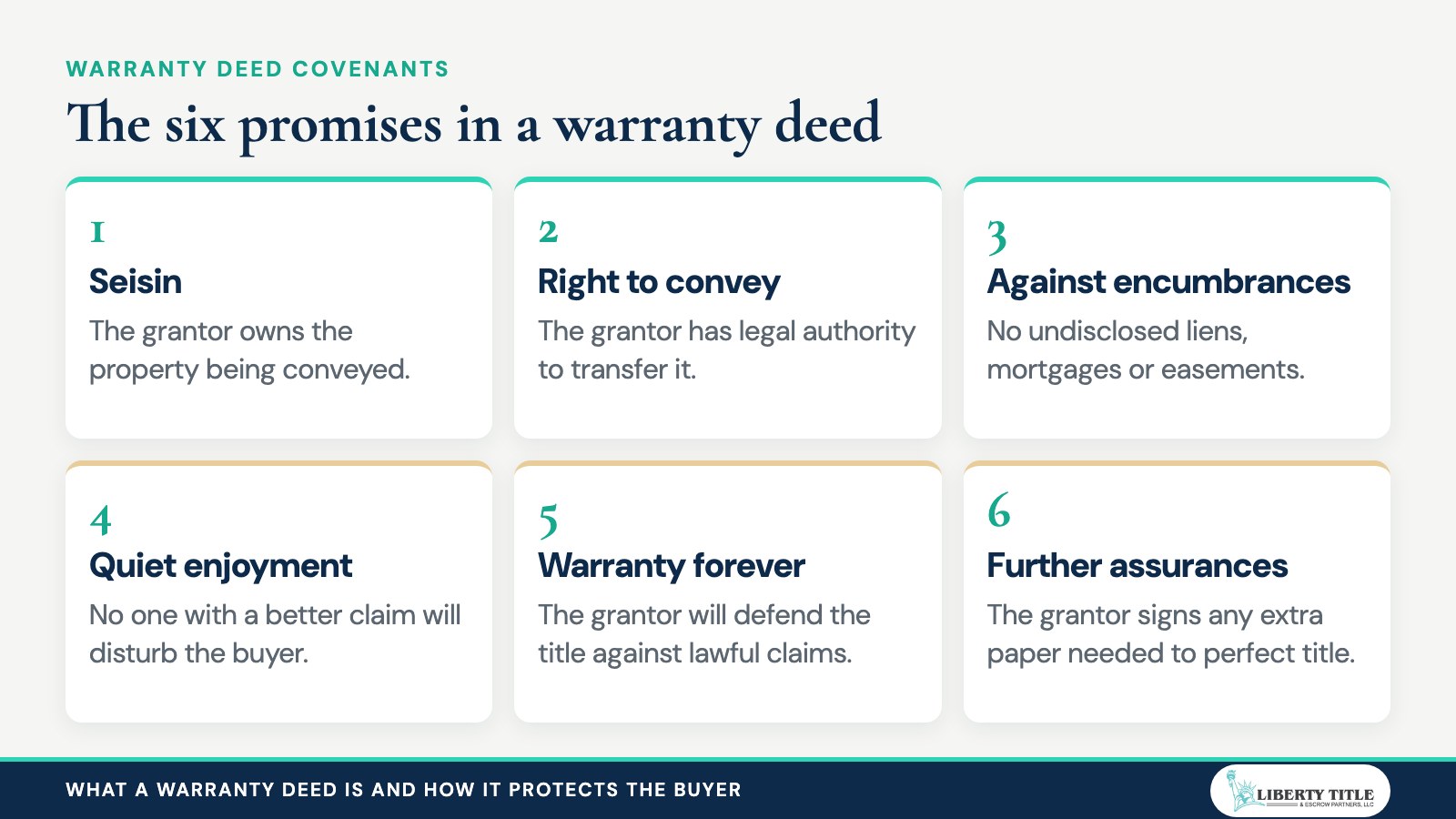
The diagram above shows the six covenants in order. The statutory form puts the central promise in one sentence, which Florida Statute 689.02 words as a full warranty of the title. The reach of that promise depends on the deed type, so the next section starts with the broadest one.
What Is a General Warranty Deed?
A general warranty deed makes the grantor cover the entire history of the title. The cover includes problems that began before the grantor owned the property. The grantor promises to defend the buyer against any defect or claim from any point in the property's past. Lenders and buyers treat this deed as the highest level of protection a deed offers.
The purpose of a general warranty deed is to give the buyer the full benefit of every covenant. A seller who signs one accepts liability for earlier owners' mistakes. The narrower alternative is the special warranty deed.
What Is a Special Warranty Deed?
A special warranty deed makes the grantor warrant the title only for the grantor's own ownership period. The grantor promises that no liens, claims or defects arose during that time. The grantor makes no promise about problems that existed before the grantor took title.
Other names for the same deed include limited warranty deed, covenant deed and grant deed. A special warranty deed in Florida works the same way, and Florida law does not prescribe a separate statutory form for it. The deed type must match what the sales contract requires, and the contract language explains why sellers choose it.
Why Would You Use a Special Warranty Deed?
A seller uses a special warranty deed to limit liability to the seller's own ownership period. The seller cannot vouch for owners before them, so the seller promises only what the seller controls. Banks and other institutions that acquired a property recently have no knowledge of its earlier history.
Special warranty deeds appear in foreclosure sales, bank-owned homes and commercial transactions. The buyer in those sales relies on a title search and a policy for the earlier history. The two main deeds differ in several ways, which the table below compares.
What Is the Difference Between a General and Special Warranty Deed?
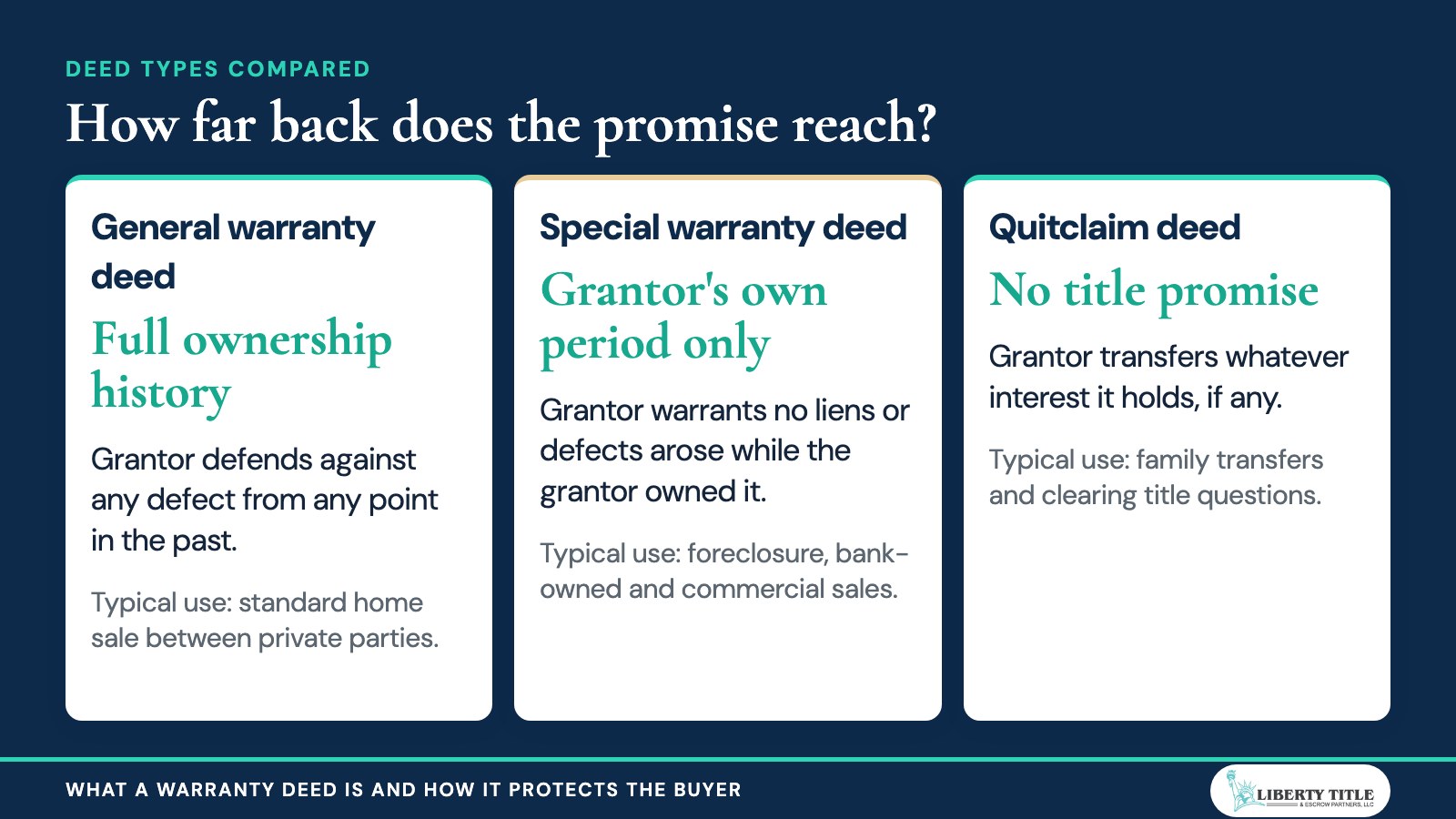
The difference between a general and special warranty deed is the reach of the promise: whole history versus the grantor's own period. Both deeds transfer ownership and carry covenants. The table adds the quitclaim deed, which makes no title promise at all.
| Deed type | Title promise | Typical use |
|---|---|---|
| General warranty deed | Covers the full ownership history | Standard home sale between private parties |
| Special warranty deed | Covers only the grantor's ownership period | Foreclosure, bank-owned and commercial sales |
| Quitclaim deed | Transfers whatever interest the grantor has, with no promise | Family transfers and clearing title questions |
The table shows each deed type, its title promise and its usual setting. A buyer who receives a special warranty deed should lean more on the title search and owner's policy. The red-flag question follows from that.
Is a Special Warranty Deed a Red Flag?
No, a special warranty deed is not a red flag by itself. The deed type reflects what the seller can promise. A bank that foreclosed on a home cannot vouch for earlier owners. The risk is real only when the buyer skips the title search and owner's policy.
A thorough title examination checks the record for earlier problems that the deed does not cover. Buyers should ask the title agent or a real estate attorney how a special warranty deed affects a specific purchase.
What Is the Difference Between a Warranty Deed and a Quitclaim Deed?
A warranty deed promises clear title, while a quitclaim deed promises nothing about the title. The quitclaim deed passes only the interest the grantor holds, if any. A buyer in an arm's-length sale expects a warranty deed for that reason.
That makes the quitclaim deed the weakest form of deed for the receiving party. Next, the Florida rules explain how a warranty deed gets signed and recorded.
What Is a Warranty Deed in Florida?
A warranty deed in Florida follows Florida Statute 689.02, where the grantor fully warrants the title and will defend it. Section 689.03 says a deed in substantially that form carries full common-law covenants. The form also includes a blank for the property appraiser's parcel identification number.
A missing or incorrect parcel number does not affect validity or recordability, according to Section 689.02. The legal description still controls the property conveyed. Several other formal requirements apply before the clerk accepts the deed.
What Does a Florida Warranty Deed Need to Be Valid and Recorded?
A Florida warranty deed needs a signed writing with two witnesses, which Section 689.01 requires for a conveyance of freehold land. Witnesses may be present through audio-video communication technology under that same section. Recording adds more requirements, listed below.
- Each witness name legibly printed, typewritten or stamped on the deed, per Section 695.26.
- Each signer's name printed immediately beneath the signature.
- The name and post-office address of each grantee on the instrument.
- An acknowledgment before a notary public, which Section 695.03 requires for recording.
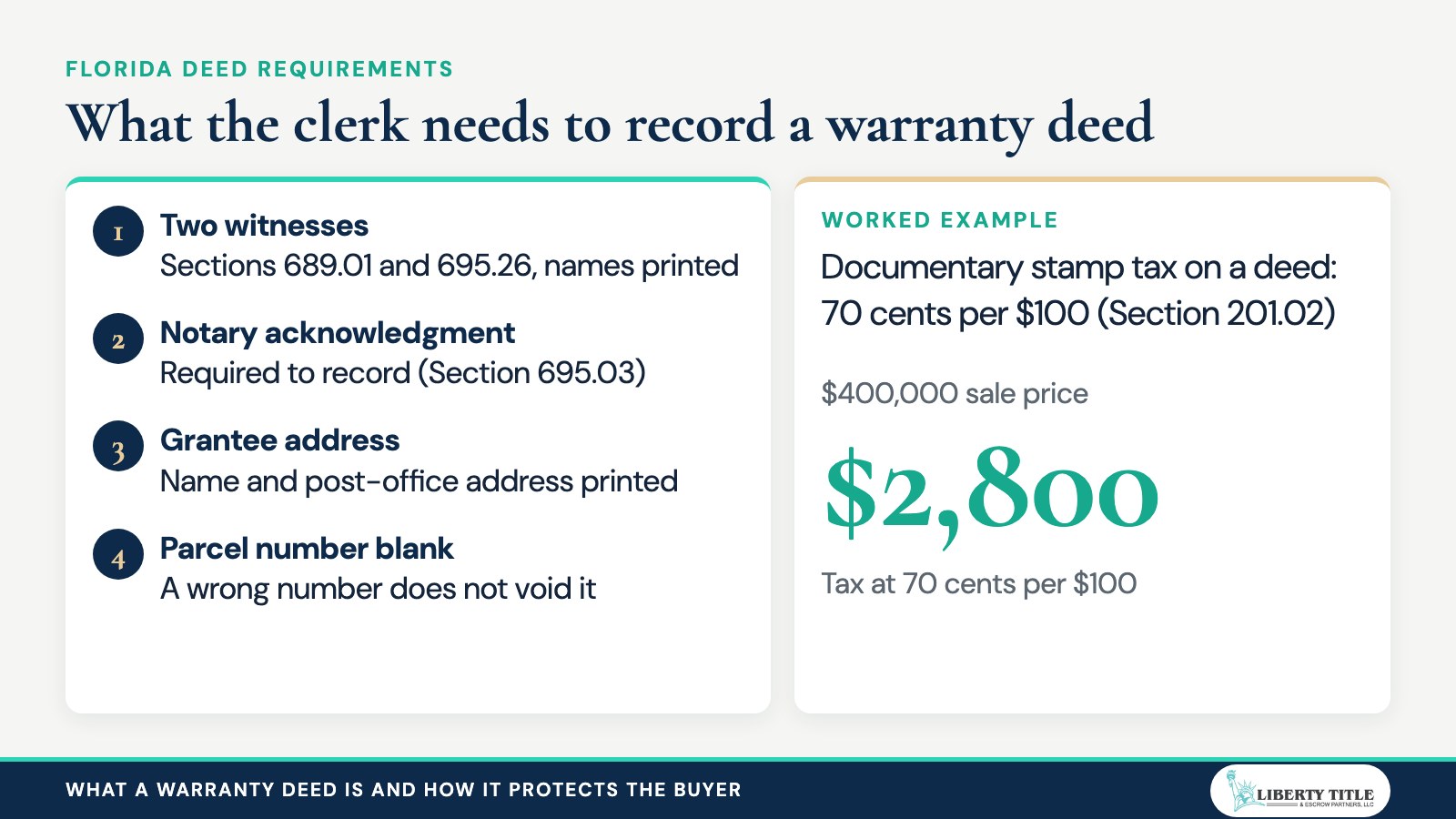
The checklist graphic above summarizes the formal elements. A title agent reviews these items before the deed goes to the county clerk. That review is part of our purchase closing support. The deed also moves through a set order at closing.
How Does a Warranty Deed Work at Closing?
A warranty deed works at closing by passing title from the grantor to the grantee once the sale funds. The seller signs the deed, the buyer's funds are disbursed and the deed is sent for recording. The steps below show the usual order.
- The title agent searches the public record and issues a title commitment.
- The seller signs the warranty deed before witnesses and a notary.
- The buyer signs loan papers, and funds are disbursed through escrow.
- The deed is delivered to the buyer and sent to the clerk.
- The clerk records the deed in the county's official records.
Recording makes the transfer part of the public record. Our article on deed recording explains who sends the deed to the clerk. Recording does not remove every title risk, as the next section shows.
Does a Warranty Deed Replace Title Insurance?
No, a warranty deed does not replace title insurance. The deed is only as strong as the grantor who gave the promise. A buyer must pursue the grantor to enforce a covenant, and the grantor may be unreachable or unable to pay. Title insurance puts an insurer behind the title.
The Consumer Financial Protection Bureau (CFPB) says owner's title insurance protects the homeowner when someone sues over a pre-purchase claim. The CFPB also says lender's title insurance does not protect the buyer's equity in the home. The policy and the deed work together.
A buyer can review covered claims before closing to see what a policy pays for. The policy and the deed then work as a pair. A buyer who asks what is a warranty deed should also ask who stands behind the title.
Florida sales follow their own custom on who pays, which our guide to owner's premium rules explains for sellers and buyers alike. The grantor's promise and the premium cover different risks.
A buyer who skipped coverage at closing has another route, described in our article on after-closing coverage for homeowners.
Can a Warranty Deed Be Contested?
Yes, a warranty deed can be contested in court on grounds such as fraud, forgery, duress or incapacity. A person who claims the deed is invalid must prove the ground. Florida Statute 689.01 itself leaves those challenges open for witnessing questions.
A buyer can also sue the grantor for a breach of covenant when a covered defect appears. A title company works to remove liens before closing, as explained in our guide on lien clearing. Any specific dispute needs a real estate attorney.
Does a Warranty Deed Expire?
No, a warranty deed does not expire, and the transfer stays effective once the deed is delivered and recorded. The grantor's covenants can become hard to enforce as time passes and records change. A buyer should act promptly on any title problem.
Florida's Marketable Record Title Act gives marketable record title to an estate vested of record for 30 years or more. Section 712.02 sets that period. Listed exceptions apply, so title agents review each record. Next comes the question of who gains from the deed.
Who Benefits From a Warranty Deed?
The buyer benefits from a warranty deed because the deed gives the buyer written promises backed by the grantor. A lender benefits indirectly, since a clear title protects the loan collateral. The seller benefits from a clean, recorded transfer.
A general warranty deed carries the greatest burden for the seller. A seller of a commercial property may negotiate a special warranty deed instead. The contract sets the deed type in commercial deals.
What Else Should You Know About Warranty Deeds?
How Much Does a Warranty Deed Cost?
The main state cost is documentary stamp tax, which Florida Statute 201.02 sets at 70 cents per $100 of consideration. A $400,000 sale price produces $2,800 in tax on that rate. Recording charges and preparation fees vary, so ask the title agent for a total.
Who Signs a Warranty Deed?
The grantor signs a warranty deed before two witnesses and a notary public. The grantee does not need to sign for the deed to transfer title. Every owner named as a grantor should sign.
Can You Sell a House With a Warranty Deed?
Yes, an owner who holds title by warranty deed can sell the house. The new buyer receives whichever deed the sales contract calls for. The earlier warranty deed stays in the chain of title.
Is a Warranty Deed the Same as a Title?
No, a warranty deed is the document, while title is the legal right of ownership. The deed transfers title and carries promises about it. Title insurance protects the title itself.
What Is a General Warranty Deed With Survivorship?
A general warranty deed with survivorship names two or more grantees and expressly gives the survivor the whole property. Florida Statute 689.15 says multiple grantees hold as tenants in common unless the deed expressly provides survivorship. Spouses may hold as tenants by the entirety, which has its own rules.
How Do You Fill Out a Warranty Deed?
Fill out a warranty deed with the full names of grantor and grantee, the legal description, the parcel number and the consideration. Follow the Section 689.02 form and add witness and notary blocks. A title agent or attorney should review the draft before signing.
Frequently Asked Questions
What Is a Statutory Warranty Deed?
A statutory warranty deed is a warranty deed written in the short form a state statute prescribes. Florida's version appears in Section 689.02. The statute supplies the full covenants, so the deed does not need to list them.
What Is a Limited Warranty Deed?
A limited warranty deed is another name for a special warranty deed. The grantor warrants the title only for the period of the grantor's own ownership. Earlier defects fall outside the promise.
What Is a Corporate Warranty Deed?
A corporate warranty deed is a warranty deed in which a company is the grantor. An authorized officer signs for the company. The title agent checks that the signer has authority.
What Is a Non Warranty Deed?
A non warranty deed transfers an ownership interest without any promise about the title. A quitclaim deed is the usual example. The receiving party takes the interest as it stands.
Can You Sell a Property Without Signing a Warranty Deed Over?
Yes, a seller can use another deed type if the buyer accepts it in the sales contract. Many buyers and lenders expect a warranty deed in an arm's-length sale. The contract controls the deed type.
What Does a Warranty Deed Promise?
A warranty deed promises that the grantor owns the property, can convey it and will defend the title. The scope depends on whether the deed is general or special. The promise is a claim against the grantor.
How Does Liberty Title Help Buyers Review a Warranty Deed?
Liberty Title reviews the deed, the title commitment and the recording details with the buyer before closing. We serve buyers, sellers, realtors and lenders in English and Spanish. Call +1 (305) 530-8998 to discuss a pending purchase.
The full closing team at Liberty Escrow Partners prepares the deed for recording and coordinates the escrow funds. Buyers should talk to their title agent, real estate attorney, lender or tax advisor about their own deed and title questions.


You May Also Like

Do Sellers Pay Closing Costs and How Much

What a Warranty Deed Is and How It Protects the Buyer

How Much Closing Costs Are and What They Include



























How Long to Close After Title Search for Homebuyers

How To Safely Wire Money to a Title Company

What Documents Does a Title Company Need

How Much a Title Company Charges and What You Get

How Long a Title Company Can Hold Funds After Closing

How To Do a Title Search on Property Yourself

Title Insurance in Real Estate and How It Protects You
How Long a Title Search Takes and What Causes Delays

How a Title Search Works and What It Reveals

What a Title Company Does and Why It Matters at Closing

What Is Title Insurance and Why Do You Need It