


What a Quitclaim Deed Is and When to Use One
A quitclaim deed is a legal document that moves the ownership interest a grantor holds in real estate to a grantee. The deed makes no promise about the title. The grantor may hold full ownership, only a partial share or nothing at all. Florida requires two witnesses and a notary, and the county clerk should record the deed to make the transfer public.
Key Takeaways
- A quitclaim deed passes only the interest the grantor actually holds and carries no warranty of clear title.
- Family transfers, divorce settlements, trust funding and name corrections are the usual reasons to use one.
- A quitclaim deed does not remove anyone from a mortgage, so the loan stays in the borrower's name.
- Florida deed tax is 70 cents per $100 of consideration, and the mortgage balance counts as consideration.
- Recording starts at $5.00 for the first page and adds $4.00 for each extra page.
What Is a Quitclaim Deed?
A quitclaim deed is a deed in which the grantor gives up any claim held to a property with no promise. The grantor is the person who signs the deed. The grantee is the person who receives the interest.
The deed works like a handoff of rights, not an assurance of ownership. A grantor with a flawed title passes the flaw along, and a grantor with no interest passes nothing. Our property transfer closings show how deeds move through the closing table, and the next section explains what this deed accomplishes.
What Does a Quitclaim Deed Do?
A quitclaim deed releases the grantor's interest and gives it to the grantee. The deed can add a person to the title, remove a person or move the property to a trust or company. The grantee holds the same rights the grantor held, no more.
The deed changes who is named on the title, which answers the basic question of what is a quitclaim deed in practice. The deed does not change the loan, the property taxes or the legal description. Whether that change counts as ownership is the next question.
Does a Quitclaim Deed Transfer Ownership?
Yes, a quitclaim deed transfers ownership, but only the ownership the grantor really has. A grantor who owns the home outright passes full ownership to the grantee. A grantor who owns half passes half.
The deed becomes effective against outside parties after recording. Florida Statute 695.01 says an unrecorded conveyance is not effective against creditors or later buyers who pay value without notice. The steps below show how the transfer happens.
How Does a Quitclaim Deed Work?
A quitclaim deed works in five steps from drafting to recording. The grantor signs, the signature is witnessed and acknowledged, and the clerk records the deed. Each step appears below in order.
- The parties agree on the transfer and confirm who holds title today.
- The deed is drafted with the legal description, the grantor and the grantee.
- The grantor signs before two witnesses and a notary public.
- The deed is delivered to the grantee.
- The deed is recorded with the county clerk, which makes the transfer public.
Delivery matters because a deed that the grantor keeps in a drawer has not transferred anything. Our guide to deed filing shows who sends the paper to the clerk after a sale. Knowing the mechanics leads to the purpose.
What Is a Quitclaim Deed Used For?
A quitclaim deed is used for transfers between people who already trust each other, mostly without a sale. Knowing when to use a quitclaim deed comes down to the relationship between grantor and grantee. The common uses are listed below.
- Moving a home to a spouse, child or other family member.
- Transferring a share of the home between spouses in a divorce settlement.
- Adding a new spouse or partner to the title.
- Placing the home in a living trust for estate planning.
- Correcting a misspelled name or similar defect in an earlier deed.
Every use on that list involves a grantee who knows the property and accepts its risks. Divorce is the familiar version, so it comes next.
Can You Use a Quitclaim Deed in a Divorce?
Yes, a quitclaim deed is a standard way to move a spouse's share of the home in a divorce. The court order or settlement agreement sets who keeps the home. The deed carries out that agreement on the public record.
Florida Statute 201.02(7)(a) exempts a marital home transfer between spouses or former spouses in a dissolution action from deed tax. Timing matters, so the spouses should talk to a family law attorney before signing. The mortgage raises a separate issue.
Does a Quitclaim Deed Remove Someone From a Mortgage?
No, a quitclaim deed does not remove anyone from a mortgage. The deed changes title, while the mortgage is a separate contract between the borrower and the lender. A person who signs away the title still owes the loan.
The lender releases a borrower only through a refinance, a payoff or a formal release. A spouse who wants the loan in one name can ask a lender about a loan refinancing. The federal Garn-St Germain Act bars a lender from calling the loan due when a spouse or child becomes an owner. The same law protects a transfer into a living trust where the borrower stays a beneficiary.
How Do You Get a Person Off a Deed?
Get a person off a deed by having that person sign a new deed that conveys the interest to the remaining owners. A quitclaim deed is the common tool because it needs no title warranty from the departing owner. The new deed must be witnessed, notarized and recorded.
The departing owner must be a named owner on the current deed. A person who is only on the mortgage has no deed interest to remove. Florida Statute 689.15 makes two or more grantees tenants in common unless the deed says otherwise. The new deed should state the remaining shares clearly.
What Is the Difference Between a Quitclaim Deed and a Warranty Deed?
The difference between a quitclaim deed and a warranty deed is the promise about the title. A warranty deed promises clear title, and a quitclaim deed promises nothing. The quitclaim deed vs warranty deed comparison appears in the table below.
| Feature | Quitclaim deed | Warranty deed |
|---|---|---|
| Title promise | None | Grantor promises clear title |
| What passes | Only the interest the grantor holds | Full title, with covenants |
| Recourse for the grantee | None against the grantor for title defects | Claim against the grantor for covered defects |
| Typical use | Family, spouse, trust and name-correction transfers | Sales between unrelated parties |
The table shows why a buyer in an arm's-length sale expects a warranty deed. A bargain and sale deed sits between the two. That deed implies the grantor holds title but makes no promise about liens. Our title team reviews the deed type named in the contract before closing.
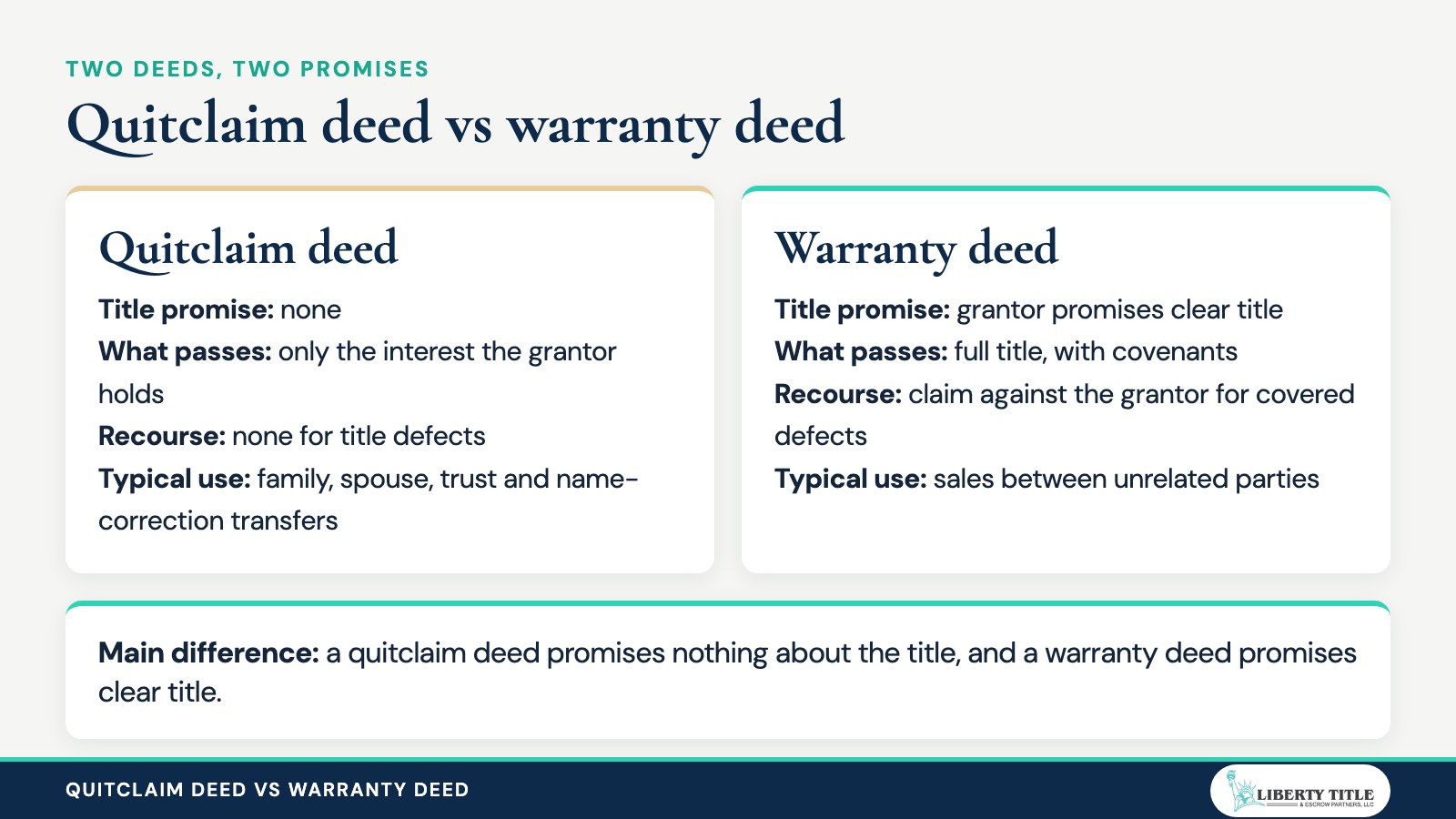
The comparison panel above summarizes the gap. That gap is also the main danger of the quitclaim form.
Why Is a Quitclaim Deed Risky?
A quitclaim deed is risky because the grantee receives no warranty and no recourse if the title has a defect. A hidden lien, an unpaid tax bill or a missing co-owner stays with the property. The grantee cannot sue the grantor for a title problem the deed never promised to cover.
The risk shrinks with a title search before the transfer. A search of the public record shows liens, judgments and earlier owners. Our article on ownership search results explains what the record reveals.
A lien found early can be paid off before the deed is signed, which protects the grantee from a surprise debt. Payoff is handled through escrow when a sale is involved. The steps for lien removal appear in our guide for homebuyers.
Can You Sell a House With a Quitclaim Deed?
Yes, an owner who holds title by quitclaim deed can sell the house, and the buyer still needs a clean title. The owner signs a new deed to the buyer, usually a warranty deed. A buyer and a lender will want a title search and an owner's policy.
A quitclaim deed in the chain of title can slow a sale when the earlier transfer left questions. A title agent traces the chain and flags any gap. Realtors can bring in a title agent early through our realtor partners page.
A policy lists what it pays for in writing, and those terms differ by policy form and by insurer. A buyer should read them before closing. Our guide to covered title risks explains those terms for homebuyers.
How Do You File a Quitclaim Deed in Florida?
File a quitclaim deed in Florida by signing before two witnesses and a notary, then recording it with the county clerk. Anyone learning how to file a quitclaim deed should follow the statutory order below.
- Get the legal description and parcel number from the current recorded deed.
- Draft the deed with the full names and mailing addresses of grantor and grantee.
- Print the preparer's name and address on the deed, as Section 695.26 requires.
- Sign the deed before two witnesses, as Section 689.01 requires, and before a notary.
- Pay deed tax if consideration applies, then submit the deed to the clerk for recording.
Section 695.26 also requires each signer's name and address printed beneath the signature. Section 695.03 requires an acknowledgment before the clerk will record. Recording is filed in the county where the property sits, which for a home here means the Miami-Dade Clerk. Our list of transfer documents shows what a title agent collects before a deed is prepared.
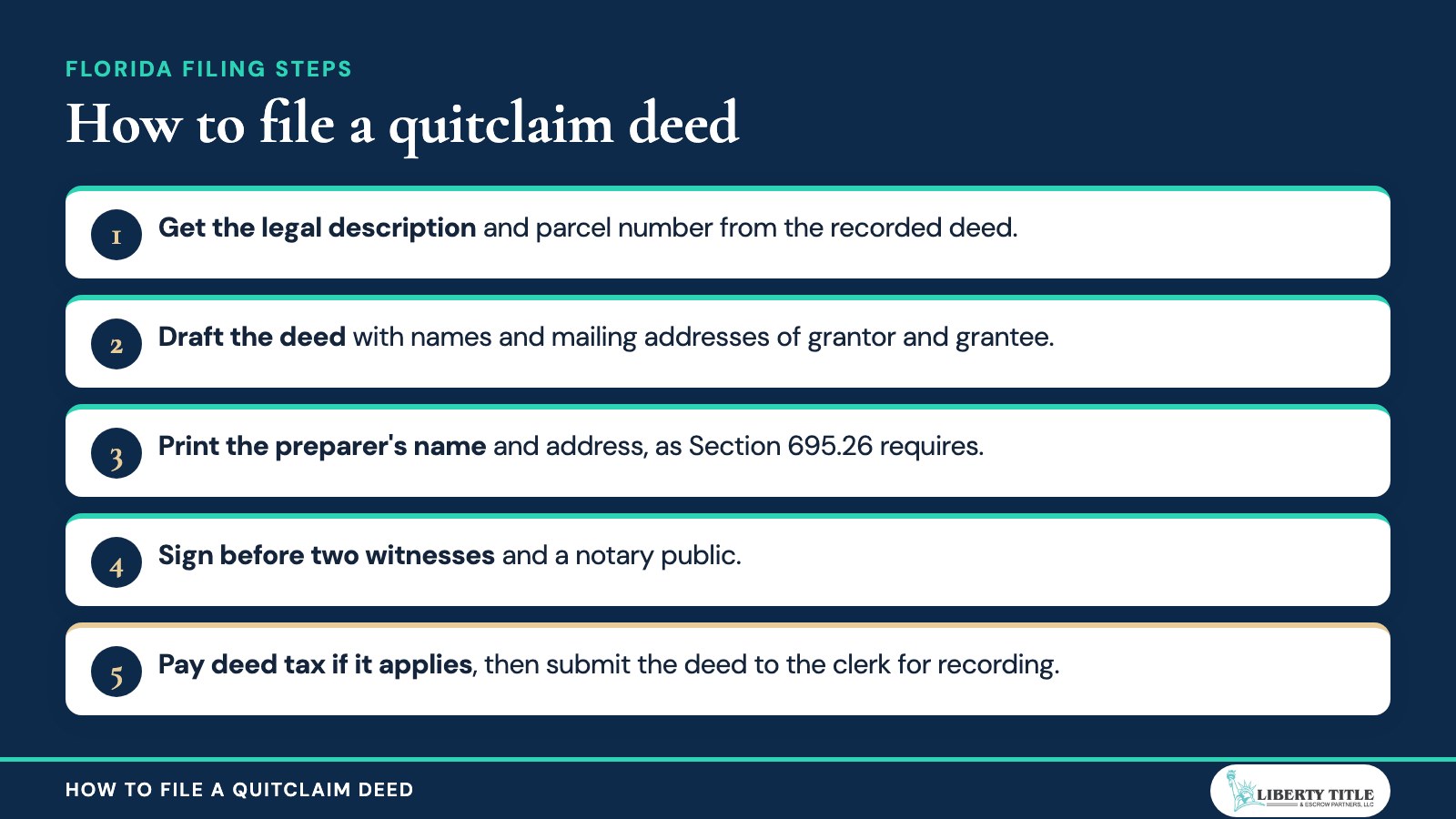
The process graphic above lists the five steps in order. A lawyer question usually comes next.
Do You Need a Lawyer for a Quitclaim Deed?
No, Florida does not require a lawyer for a quitclaim deed, but an attorney review is wise for a mortgage or divorce. The law requires accurate content, correct signatures and a preparer's name on the deed. A mistake can cloud the title for years.
A real estate attorney can confirm the deed fits the goal, whether that goal is tax, divorce or estate planning. A title agent can check the legal description against the record. Cost is the next concern.
How Much Does a Quitclaim Deed Cost?
A quitclaim deed costs at least $5.00 to record in Florida, plus deed tax when consideration applies and any preparation fee. Florida Statute 28.24 sets the clerk's recording charge at $5.00 for the first page and $4.00 for each additional page. A two-page deed carries $9.00 in those charges.
Section 28.24 caps the clerk's charges, and attorney or title fees vary by provider. The table below lists the fixed government items, and a title agent can quote the total. The title agent costs article explains what a title company charges.
| Item | Amount | Source |
|---|---|---|
| Recording, first page | $5.00 | Fla. Stat. 28.24(13)(a) |
| Recording, each added page | $4.00 | Fla. Stat. 28.24(13)(b) |
| Deed tax on consideration | 70 cents per $100 | Fla. Stat. 201.02(1)(a) |
The table shows that recording is small and deed tax is the variable. Attorney and preparation fees are separate and not set by statute. Tax gets a closer look next.
Who Pays Taxes on a Quitclaim Deed?
The parties to the deed settle the Florida deed tax, which is 70 cents per $100 of consideration under Section 201.02. Consideration includes money paid and the amount of any mortgage on the property, whether or not the debt is assumed. A gift with no mortgage carries no consideration.
A $200,000 mortgage balance on a quitclaim transfer produces $1,400 in deed tax at that rate. Section 201.02(7)(b) exempts a homestead transfer between spouses when the only consideration is the mortgage or lien. Gifts raise a federal question, since the IRS annual gift tax exclusion is $19,000 per recipient for 2026. A tax advisor can say how a gift of a home share applies to a specific family.
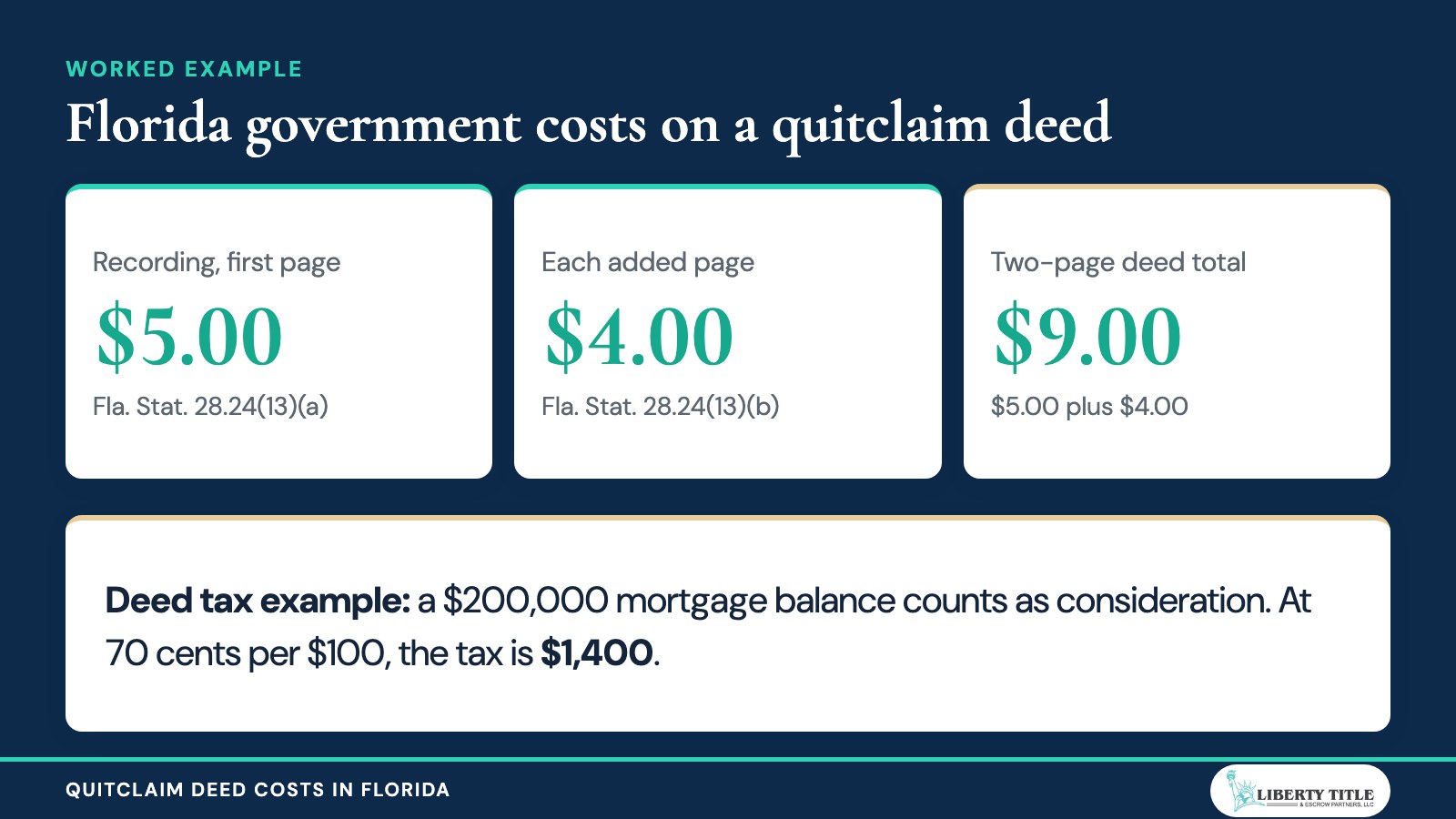
The cost card above works the numbers for a two-page deed. Families ask a follow-up question about avoiding tax altogether.
Can You Transfer a House to a Family Member Without Paying Taxes?
A family transfer by quitclaim deed carries no Florida deed tax when no consideration exists, including no mortgage. A parent who gives a debt-free home to a child pays no deed tax under Section 201.02. A mortgage changes that result, because the loan balance counts as consideration.
The federal gift rules apply separately. A gift above the annual exclusion usually needs a gift tax return, though the tax itself depends on the donor's lifetime exemption. Talk to a tax advisor before the transfer, since the deed cannot be undone for tax reasons alone.
What Is Better Than a Quitclaim Deed?
A warranty deed is better when the grantee needs a title promise, and a living trust is better for estate planning. The right tool depends on the goal, the family and the mortgage. A quitclaim deed fits only when both parties accept the title as it stands.
A special warranty deed offers a middle option for a recent owner. A trust or will can pass the home at death without a lifetime transfer. A real estate attorney can compare these routes for a specific property.
Can a Quitclaim Deed Be Reversed?
A quitclaim deed can be reversed only if the grantee signs a new deed that conveys the property back. The original grantor cannot cancel a recorded deed alone. The new deed must be witnessed, notarized and recorded.
A court can set a deed aside for fraud, forgery, duress or incapacity. A person who raises those grounds must prove them. Anyone who thinks a deed was obtained improperly should speak to a real estate attorney quickly.
What Else Should You Know About Quitclaim Deeds?
Does a Quitclaim Deed Need to Be Notarized and Recorded?
Yes, a Florida quitclaim deed needs two witnesses and a notary acknowledgment before the clerk will record it. Recording is the step that makes the transfer public and effective against later buyers. Skipping it leaves the grantee exposed.
Where Can You Get a Quitclaim Deed Form?
Get a quitclaim deed form from an attorney, a title company or a legal form provider. Florida has no single mandatory form, but the deed must meet the signing and recording rules above. A drafted deed can be reviewed through our title questions page.
Can You Do a Quitclaim Deed Online?
Yes, parts of the process can run online, including drafting and remote witnessing. Section 689.01 allows witnesses present through audio-video technology. The deed still must be recorded with the clerk.
How Long Does a Quitclaim Deed Take?
Drafting and signing can happen in one sitting, while recording time depends on the clerk's office. The transfer is effective as to outside parties after recording. Ask the clerk for current turnaround.
Can a Title Company Do a Quitclaim Deed?
A title company can check the legal description, search the record and handle recording for a transfer. Legal advice on whether to use the deed comes from an attorney. Our team can start a file when you request title work for a property.
Does a Quitclaim Deed Affect Title Insurance?
The policy terms decide whether coverage continues after a transfer. An owner's policy protects the insured owner named in it. Read the policy or ask the insurer before signing, and review policy protection basics first.
Frequently Asked Questions
Is a Quitclaim Deed Legal?
Yes, a quitclaim deed is a legal way to transfer real estate interests when it meets the state's signing and recording rules. Florida requires two witnesses, a notary and recording. A deed that skips these steps risks being rejected.
What Does Quitclaim Mean?
Quitclaim means to give up a claim. The grantor releases whatever interest the grantor holds and makes no promise about it. The word describes the lack of any title warranty.
Does a Quitclaim Deed Override a Will?
A recorded quitclaim deed takes the property out of the owner's estate, so the will no longer controls it. The deed takes effect when delivered, while a will takes effect at death. An attorney should review any transfer that may conflict with estate plans.
How Does a Quitclaim Deed Differ From a Bargain and Sale Deed?
A bargain and sale deed implies the grantor owns the property, while a quitclaim deed implies nothing. Neither promises against liens the way a warranty deed does. The wording of each deed spells out its limits.
Can You Add Someone to a Deed With a Quitclaim Deed?
Yes, an owner can sign a quitclaim deed that names the owner and a new person as grantees. Florida Statute 689.15 makes multiple grantees tenants in common unless the deed provides survivorship. Adding a name does not add that person to the mortgage.
Who Can Sign a Quitclaim Deed?
Only a named owner with legal capacity can sign a quitclaim deed for that owner's interest. Every owner who transfers an interest should sign. A person acting for an owner needs proper legal authority.
How Does Liberty Title Help With a Quitclaim Deed Transfer?
Our team helps with a quitclaim deed transfer by checking the record before the deed is signed. We search the title, confirm the legal description and handle recording for deeds that move through our offices. Call +1 (305) 530-8998 to talk about a property.
The deed closings that follow a sale use the same recording steps as a family transfer. An owner can ask what is a quitclaim deed for a specific property and get a plain answer.
Our Liberty Title staff can explain what a title agent can and cannot do for a family transfer. Talk to a real estate attorney, lender or tax advisor about legal and tax questions for a specific case.


You May Also Like
What a Quitclaim Deed Is and When to Use One


How to Calculate Closing Costs Before You Close

What Is Included in Closing Costs for a Home Purchase

Who Pays Closing Costs in a Real Estate Transaction

Are There Closing Costs on a Home Equity Loan

Can You Roll Closing Costs into a Mortgage

Do Sellers Pay Closing Costs and How Much

What a Warranty Deed Is and How It Protects the Buyer

How Much Closing Costs Are and What They Include


























How Long to Close After Title Search for Homebuyers

How To Safely Wire Money to a Title Company

What Documents Does a Title Company Need

How Much a Title Company Charges and What You Get

How Long a Title Company Can Hold Funds After Closing

How To Do a Title Search on Property Yourself

Title Insurance in Real Estate and How It Protects You
How Long a Title Search Takes and What Causes Delays

How a Title Search Works and What It Reveals

What a Title Company Does and Why It Matters at Closing

What Is Title Insurance and Why Do You Need It