


What Closing Costs Include for Both Buyers and Sellers

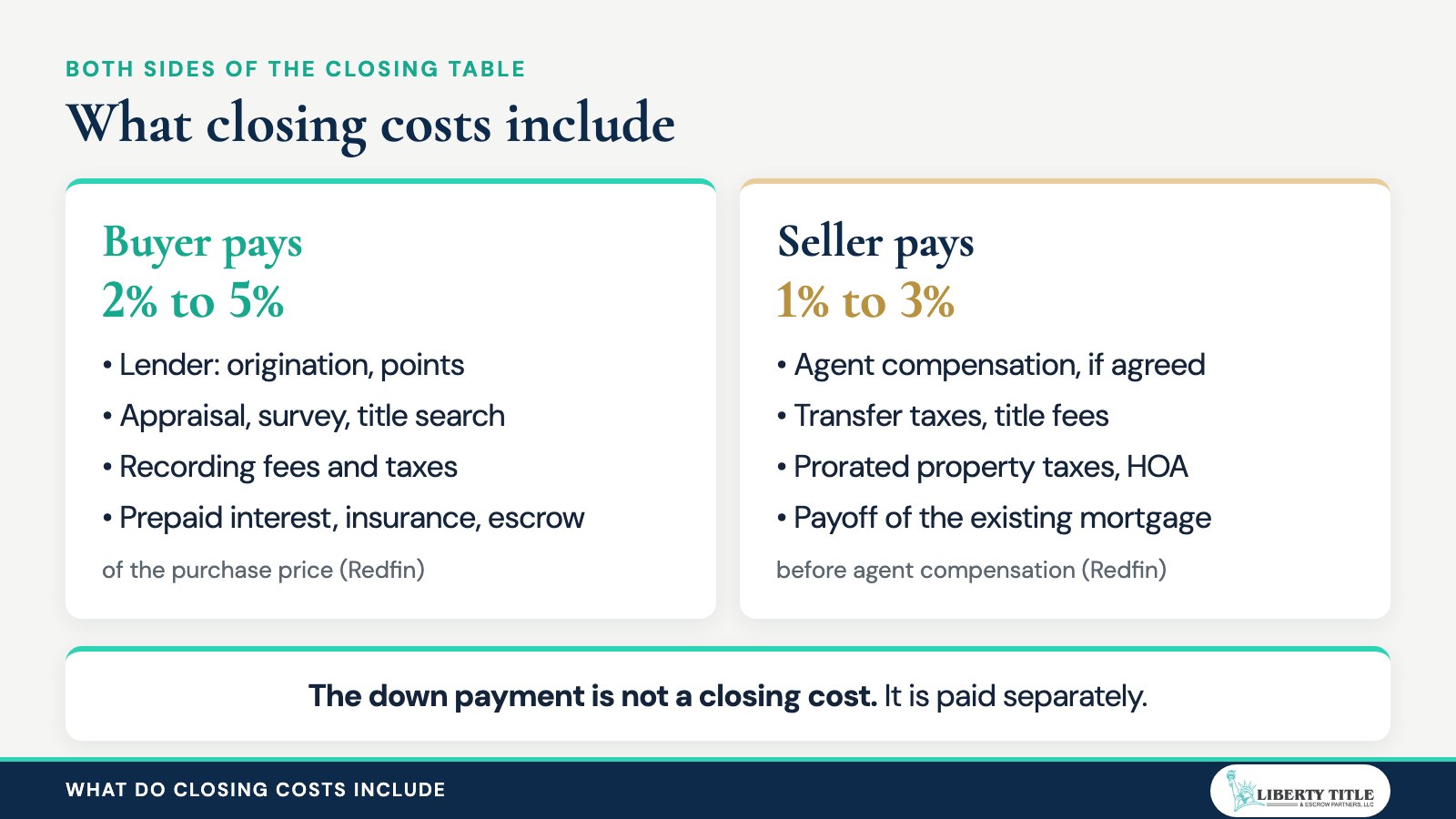
Closing costs include lender fees, title and escrow charges, appraisal fees, taxes, and prepaid items for buyers. Sellers pay agent commission, transfer taxes, and payoff costs. Each charge prints on the settlement statement. Redfin says buyers usually pay 2% to 5% of the purchase price. Sellers pay 1% to 3% before agent compensation. The down payment is separate.
Key Takeaways
- Buyer closing costs cover lender fees, third-party services, government charges, and prepaid items.
- Seller closing costs cover agent compensation, transfer taxes, title charges, prorated taxes, and any loan payoff.
- The down payment is not a closing cost, but cash to close adds both amounts together.
- Annual percentage rate (APR) counts points and loan fees but leaves out most title and appraisal charges.
- Florida adds documentary stamp tax and intangible tax, so state charges differ from national averages.
What Do Closing Costs Include for Buyers and Sellers?
Closing costs include every fee and tax paid to finish a home sale. Buyers and sellers each pay a different set of charges. Buyers mainly cover lender and loan-related fees. Sellers mainly cover agent compensation and transfer costs. Wells Fargo makes the same split between lender-related and home-related costs.
A closing agent lists both sets on the settlement statement. Buyers see a Closing Disclosure, and sellers see a seller-side statement. Our closing help covers both sides of the same file.
| Cost group | Buyer side | Seller side |
|---|---|---|
| Loan charges | Origination, application, points, credit report | Payoff of the existing mortgage |
| Services | Appraisal, survey, flood certification, title search | Title fees, attorney fees where used |
| Government charges | Recording fees, mortgage taxes | Transfer taxes, such as deed stamps |
| Prepaid and prorated | Prepaid interest, insurance, escrow deposit | Prorated property taxes, HOA dues |
| Agent compensation | Only when the buyer agrees to pay an agent | Commission, when the seller agrees to pay it |
The table shows where the two lists overlap and where they split. The next sections price each side, starting with the national percentages.
How Much Do Closing Costs Include on a $250,000 House or a $400,000 Mortgage?
Closing costs on a $250,000 house run $5,000 to $12,500 at the 2% to 5% range Redfin reports for buyers. Bankrate applies a 2% to 5% range to the loan amount, which gives $8,000 to $20,000 on a $400,000 loan. Local costs vary by lender, loan type, and county.
The same range puts a $300,000 home at $6,000 to $15,000, according to Redfin. Real totals sit lower in some counties and higher in others. National Mortgage News reports a 2025 national average of $4,528 from LodeStar quotes. The median was $2,993 before recording fees and taxes. Our estimate tool prices the title portion for a specific property.
A percentage only sizes the total. The fee groups below show what fills it, starting with the buyer side.
What Do Closing Costs Include for Buyers?
Buyer closing costs include four groups: lender charges, third-party services, government fees and taxes, and prepaid items. Wells Fargo sorts them the same way into origination charges, service provider fees, taxes and government fees, and mortgage and insurance costs. Each group appears as its own section on the Closing Disclosure.
The Consumer Financial Protection Bureau (CFPB) says the Closing Disclosure total excludes your down payment. Lenders must provide it three business days before closing. The lender also sends a Loan Estimate within three business days of application. The Closing Disclosure sections read as follows.
- Origination Charges: upfront lender charges for making the loan.
- Services You Cannot Shop For and Services You Can Shop For: third-party providers.
- Taxes and Other Government Fees: transfer and mortgage registration costs.
- Prepaids: items such as interest between closing and the end of that month.
- Initial Escrow Payment at Closing: the opening balance of the escrow account.
Origination Charges sit at the top of the page, so lender fees come first below.
What Lender Fees Do Closing Costs Include for a Mortgage?
Lender fees in closing costs include the origination fee, the application fee, discount points. SCU Credit Union says the origination fee covers processing the loan and is often a percentage of the loan amount. Redfin notes that an application fee can run upwards of $500.
Discount points are optional charges that lower the interest rate, and one point typically costs 1% of the loan, per SCU. Wells Fargo adds courier costs of about $30 and mortgage insurance for some loans. Federal Housing Administration (FHA) mortgage insurance premiums run 0.15% to 0.75% of the loan amount, according to Wells Fargo.
Lender fees are only one group. Third-party and government charges make up the next group.
What Third-Party and Government Charges Do Closing Costs Include?
Third-party charges include the appraisal, credit report, survey, flood certification, and title search, while government charges include recording fees and taxes. Redfin puts appraisals at $300 to $500, credit reports at $10 to $100, and surveys at $400 to $1,000. Wells Fargo lists flood certification at $15 to $25 and recording at about $125.
A title search costs upwards of $200, according to Redfin. Title insurance is a separate premium, and these title company costs appear in the same section of the statement. Florida adds two taxes on top of these items.
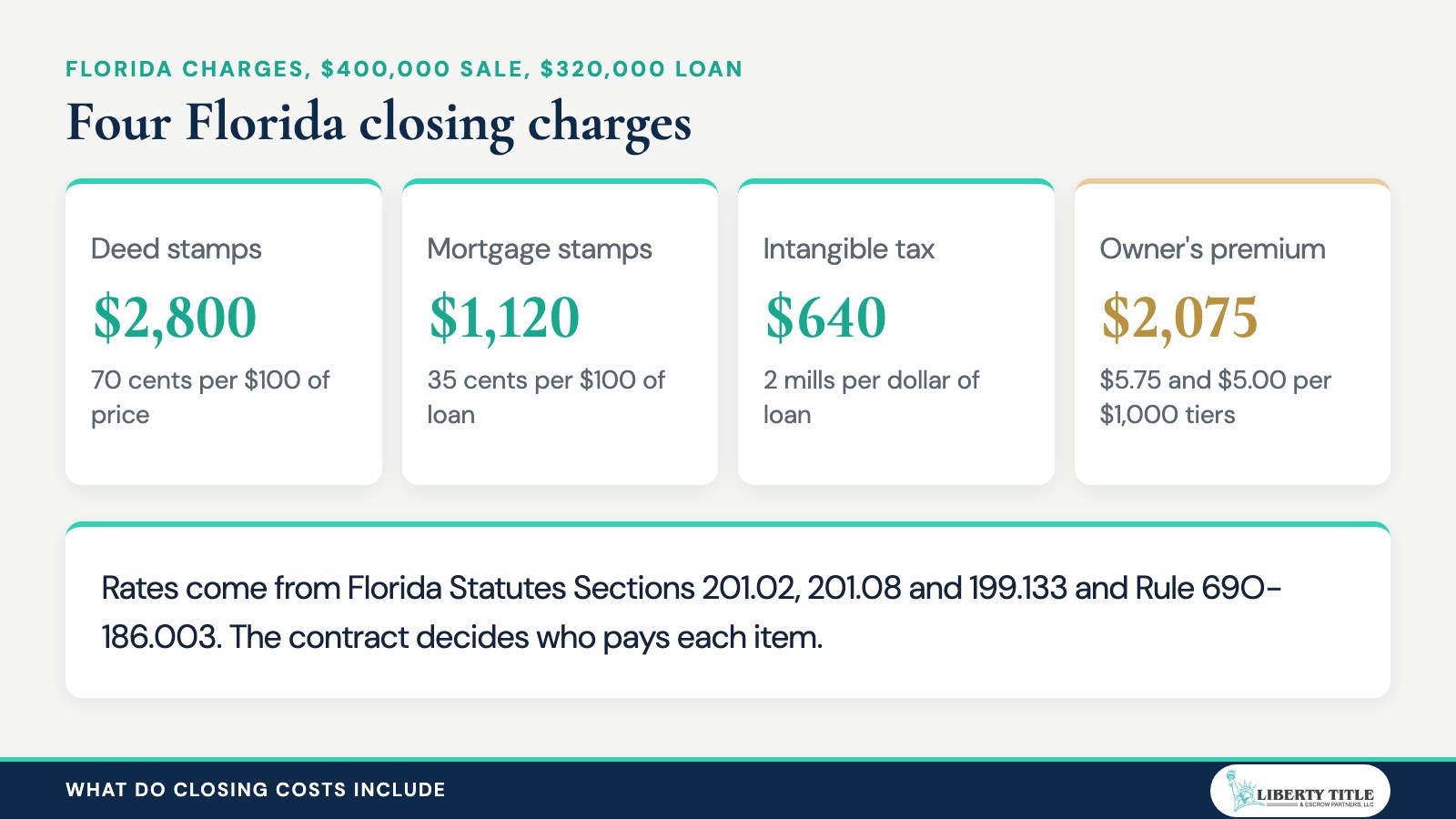
Florida Statutes Section 201.02 sets deed documentary stamp tax at 70 cents per $100 of consideration. Section 201.08 sets mortgage stamp tax at 35 cents per $100 of indebtedness. Section 199.133 sets the intangible tax at 2 mills per dollar on the mortgage. The table below applies these to a $400,000 purchase with a $320,000 loan.
| Charge | Rule | Amount |
|---|---|---|
| Deed documentary stamps | 70 cents per $100 of price | $2,800 |
| Mortgage documentary stamps | 35 cents per $100 of loan | $1,120 |
| Intangible tax | 2 mills per dollar of loan | $640 |
| Owner's title premium | $5.75 per $1,000 to $100,000, plus $5.00 per $1,000 above | $2,075 |
The amounts above come from arithmetic on the statute rates and the promulgated owner's premium in Florida Administrative Code 69O-186.003. The contract decides which party pays each item. Title coverage responds to claims tied to the property's past.
Do Closing Costs Include Escrow?
Yes, closing costs include the initial escrow deposit and the closing agent's escrow fee, but not your ongoing monthly escrow payments. The CFPB says the Initial Escrow Payment at Closing establishes the starting balance in your escrow account. Wells Fargo adds that closing fees go to an escrow company or attorney.
Prepaid items fund that account, and Rocket Mortgage says prepaid taxes and insurance make up a sizable portion of the total. The escrow account then pays taxes and insurance as they come due. The escrow work at closing also includes holding funds until every condition is met.
Escrow shows up in the costs, but other expenses never do. The next section covers items that stay outside closing costs.
Do Closing Costs Include Inspection?
No, a home inspection is usually not a closing cost, because Farmers Insurance describes it as usually optional. Zillow says buyers pay inspection and appraisal fees at the time of service, so the money leaves before the closing table. The appraisal differs, since Wells Fargo lists it among service provider charges.
A buyer can still ask the closing agent where each charge sits. A buyer can ask which charges were paid before closing day. The next section separates the down payment from closing costs.
Does a Down Payment Include Closing Costs?
No, a down payment does not include closing costs, because the CFPB defines total closing costs as excluding the down payment. The down payment buys equity in the home. Closing costs pay lenders, title providers, and governments. Wells Fargo calls the down payment a separate payment made at the same time.
A 20% down payment on a $300,000 house is $60,000, and closing costs of $6,000 to $15,000 sit on top. The two amounts total $66,000 to $75,000 before credits. Earnest money, about 1% to 3% of the price per Redfin, counts toward the amount due. Earnest money deposits go to the title company.
Both amounts come together in one figure at closing, so the next question is cash to close.
Does Cash to Close Include Closing Costs?
Yes, cash to close includes closing costs, plus the down payment, minus deposits and credits already applied. The CFPB describes cash to close as the actual amount you pay at closing. Closing costs are one input to that number, not the whole figure.
Take a $400,000 purchase with 20% down. The down payment is $80,000, assumed closing costs of 3% are $12,000, and an assumed earnest deposit of 2% is $8,000. Cash to close is $84,000. The CFPB says cash to close is typically paid by cashier's check or wire transfer, so confirm wire instructions by phone first.
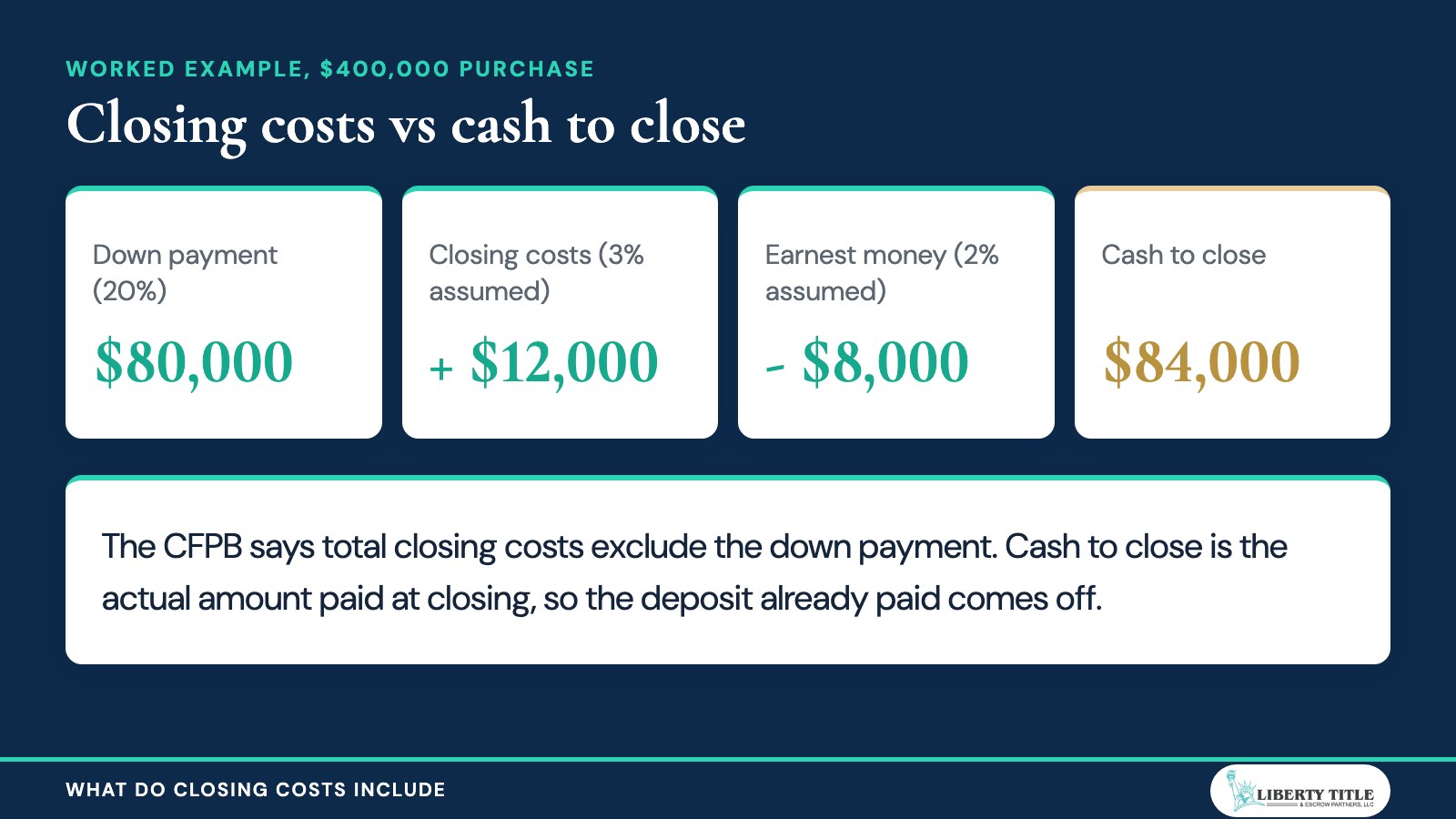
The graphic above lays out that arithmetic. Seller costs work differently, since proceeds are paid out instead.
What Do Closing Costs Include for Sellers?
Seller closing costs include agent compensation, transfer taxes, title fees, attorney fees where used, and prorated property taxes. Redfin puts seller closing costs at 1% to 3% of the sale price before agent compensation. Wells Fargo says these costs are typically deducted from the proceeds of the sale.
The seller also repays the existing mortgage from proceeds. Florida Statutes Section 701.04 requires a mortgagee to deliver a payoff letter within 10 days of a written request. A seller in a homeowners association (HOA) may need an estoppel certificate. Section 720.30851 caps that fee at $250 when nothing is owed, plus up to $100 for rush delivery within 3 business days.
Concessions to the buyer add another line. Zillow reports that 23% of buyers had sellers agree to pay some closing costs and 44% had sellers agree to pay all. Our settlement work includes the seller-side statement and payoff. Commission is the next seller line.
Do Closing Costs Include Commissions?
Yes, commissions are paid at closing and appear on the settlement statement, but they are usually not counted as buyer closing costs. Redfin says agent fees are paid at closing yet typically treated as a separate transaction cost. For sellers, commission is a deduction from proceeds.
Redfin reports total commissions of 5% to 6% of the sale price. A 5.5% commission on a $400,000 home equals $22,000, usually split between the listing and buyer's agents. Realtor.com explains that National Association of Realtors rules effective August 17, 2024 require written disclosure of buyer-agent compensation offers.
Realtor.com says commissions are negotiable and no federal or state law fixes the rate. A buyer who hires an agent may agree to pay that agent directly. Realtor support from the title side includes explaining how each fee prints on the statement. Commission belongs to the sale, while APR concerns the loan only.
Does APR Include Closing Costs?
Yes, APR includes some closing costs, such as points, loan fees, and mortgage broker fees. It leaves out title and appraisal charges. Regulation Z, at 12 CFR 1026.4, counts points and loan fees as finance charges. The same rule excludes bona fide, reasonable real-estate fees from the finance charge.
The excluded fees include title examination, title insurance, survey, document preparation, notary, credit report, and appraisal fees. Amounts paid into escrow are also excluded. The table below sorts these items.
| Counted in APR | Left out of APR |
|---|---|
| Points and loan fees | Title examination and title insurance |
| Mortgage broker fees | Property survey and notary fees |
| Similar lender charges | Credit report and appraisal fees |
| Other charges imposed as a condition of the loan | Escrow deposits for taxes and insurance |
The table shows why two loans with equal APRs can carry different closing costs. A buyer should compare the Loan Estimate cost lines as well as the APR.
What Else Should You Know About What Closing Costs Include?
Can You Include Closing Costs in a Mortgage?
Yes, a refinance can finance closing costs. Fannie Mae allows a limited cash-out refinance to finance closing costs, points, and prepaid items. Wells Fargo says no-closing-cost loans roll costs into the loan amount, which may raise the interest rate.
Do Closing Costs Include a Survey?
Yes, a survey counts as a closing cost when the contract or lender requires one. A survey costs $400 to $1,000, per Redfin. The same section lists the title search, and a buyer or seller can compare the search charges on the statement.
Is Owner's Title Insurance Included in Closing Costs?
Yes, the owner's policy premium is a closing cost listed on the statement. The CFPB says owner's title insurance protects the homeowner if someone sues over a claim from before purchase. In Florida, the party paying is set by contract, and owner's coverage payers vary.
What Does a Settlement Agent Do With Closing Costs?
The settlement agent collects funds, pays each charge, and records the documents. A title company can act in that role. The settlement agent duties explain who signs off on each payment.
How Do You Pay Cash to Close Safely?
Pay cash to close by cashier's check or wire transfer, per the CFPB. Call a known number to confirm wire instructions before sending funds. Good wire safety means verifying any emailed change by phone.
Frequently Asked Questions
Who Pays the Most Closing Costs?
Sellers who pay agent compensation add it to their closing costs. Adding Redfin's 1% to 3% to a 5% to 6% commission gives 6% to 9%. Buyers pay 2% to 5%, so the seller side can total more.
Is 3% a Good Realtor Fee?
Commission rates are negotiable, and no law sets them. A 3% fee per agent adds to 6%, the top of the 5% to 6% total Redfin reports. The fee reflects the agreement between the client and the agent.
Do All Lenders Show Closing Costs the Same Way?
Yes, all lenders use the same standard Loan Estimate form, according to the CFPB. The form groups loan costs, other costs, and cash to close in set sections. A buyer can place two Loan Estimates side by side and compare each line.
How Do You Get Closing Costs Waived?
A buyer can lower closing costs with lender credits, which the CFPB says trade a higher interest rate for lower upfront costs. A buyer can also negotiate seller concessions in the contract. Fannie Mae caps these at 3%, 6%, or 9% depending on loan-to-value, and 2% for an investment property.
Do Closing Costs Include Recording Fees?
Yes, closing costs include the clerk's recording fee for the deed and any mortgage. Florida Statutes Section 28.24 sets the maximum charge at $5.00 for the first page and $4.00 for each added page. The fee appears with the government charges on the statement.
Can Gift Money Pay Closing Costs?
Yes, Redfin says buyers can use monetary gifts from friends and family for closing costs. Wells Fargo says the lender confirms whether the chosen loan allows gifts. Redfin notes that gift letter rules apply.
How Does Liberty Title Help Buyers and Sellers See What Closing Costs Include?
Liberty Title helps both sides see what closing costs include by walking through each title, escrow, and recording line before closing day. Buyers, sellers, realtors, and lenders can work with our team in English or Spanish. Call +1 (305) 530-8998 to review a statement with an escrow officer.
The Liberty Title group is an ALTA member certified to ALTA Best Practices. General information here does not replace advice from your title agent, real estate attorney, lender, or tax advisor.


You May Also Like

Closing Costs When Buying a House and What to Expect

What a Quitclaim Deed Is and When to Use One

How to Calculate Closing Costs Before You Close

What Is Included in Closing Costs for a Home Purchase
What Closing Costs Include for Both Buyers and Sellers

Who Pays Closing Costs in a Real Estate Transaction

Are There Closing Costs on a Home Equity Loan

Can You Roll Closing Costs into a Mortgage

Do Sellers Pay Closing Costs and How Much

What a Warranty Deed Is and How It Protects the Buyer

How Much Closing Costs Are and What They Include

























How Long to Close After Title Search for Homebuyers

How To Safely Wire Money to a Title Company

What Documents Does a Title Company Need

How Much a Title Company Charges and What You Get

How Long a Title Company Can Hold Funds After Closing

How To Do a Title Search on Property Yourself

Title Insurance in Real Estate and How It Protects You
How Long a Title Search Takes and What Causes Delays
How a Title Search Works and What It Reveals

What a Title Company Does and Why It Matters at Closing

What Is Title Insurance and Why Do You Need It