


How to Estimate Closing Costs in Real Estate

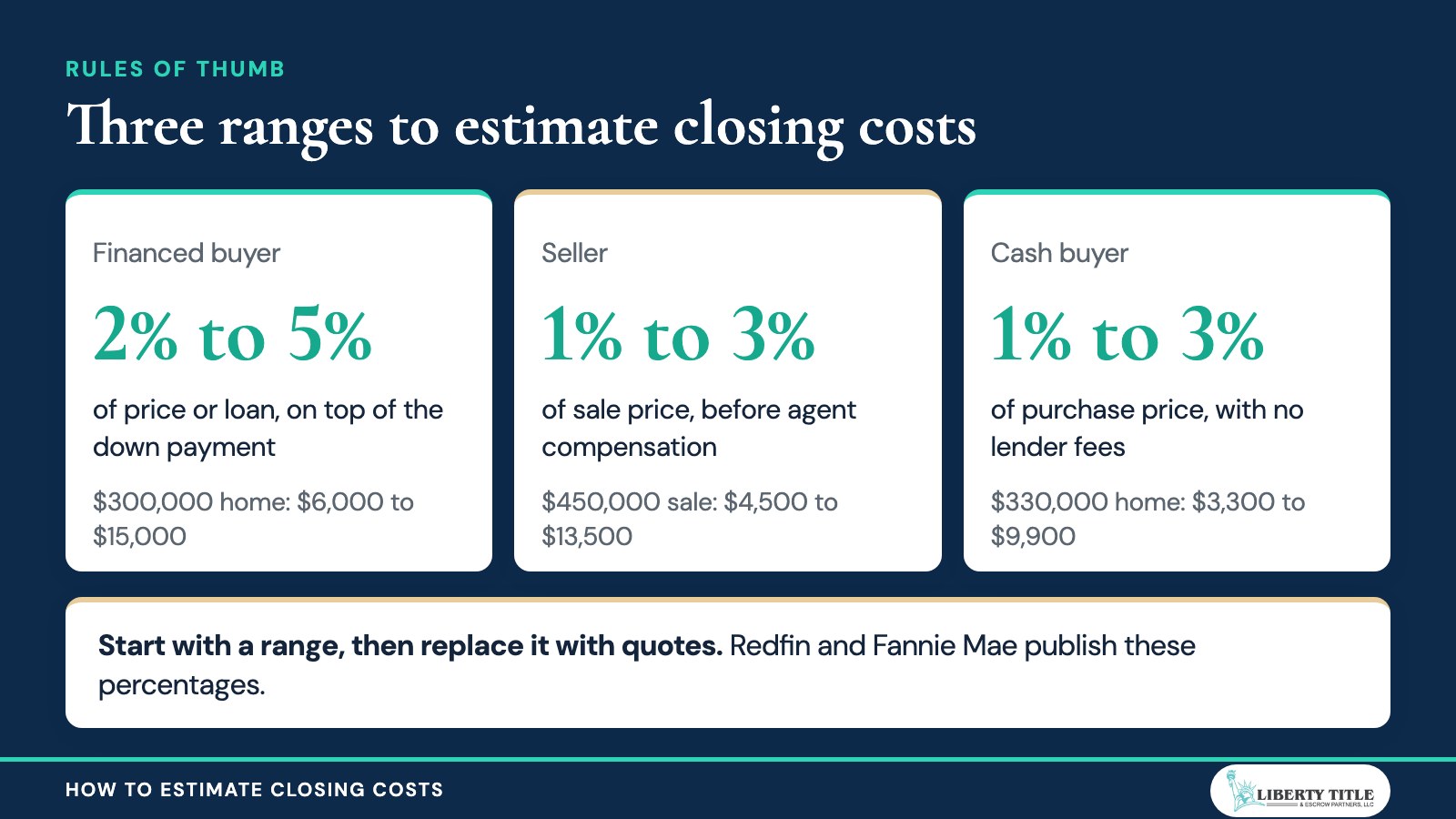
How to estimate closing costs starts with a percentage. Redfin says buyers pay 2% to 5% of the purchase price, so a $300,000 home runs $6,000 to $15,000. Sellers pay 1% to 3% before agent compensation. Cash buyers pay about 1% to 3%. Each range below comes with a worked example. A lender's Loan Estimate then replaces that range with itemized numbers you can check line by line.
Key Takeaways
- Buyers multiply the purchase price by 2% and 5% to set a low and high budget.
- Sellers use 1% to 3% of the sale price, then add agent compensation.
- The Loan Estimate arrives within three business days of a mortgage application.
- Some fees can rise 10% in total, and others cannot rise at all.
- Cash buyers skip lender fees but still pay title, escrow and recording charges.
How to Estimate Closing Costs on a House?
Multiply the purchase price by 2% and by 5% to estimate closing costs on a house. Treat the two results as your low and high budget. Redfin uses the same range. Fannie Mae adds that closing costs sit on top of your down payment. The table applies the range to three prices.
| Purchase price | Low estimate (2%) | High estimate (5%) |
|---|---|---|
| $300,000 | $6,000 | $15,000 |
| $350,000 | $7,000 | $17,500 |
| $500,000 | $10,000 | $25,000 |
The $6,000 to $15,000 spread on a $300,000 home is wide because local taxes and loan terms differ. A free title estimate narrows the title portion of that spread early. The graphic below compares the three percentage ranges that buyers, sellers and cash buyers use.
Should You Estimate From the Purchase Price or the Loan Amount?
Estimate from the loan amount when you finance, because Fannie Mae states its 2% to 5% range against mortgage value. Bankrate also applies the range to the loan amount, while Redfin applies it to the purchase price. Cash purchases have no loan, so the price becomes the base.
Take a $400,000 home with 10% down. The loan is $360,000, so the loan-based range runs $7,200 to $18,000. The price-based range runs $8,000 to $20,000, which is a gap of $800 to $2,000.
Both bases are planning ceilings, not quotes. National Mortgage News reported LodeStar data averaging $4,528, or 1.04% of the sales price, in 2025. Its $2,993 median left out recording fees and taxes. A Loan Estimate shows which number applies to your loan.
How Do You Estimate Closing Costs With a Loan Estimate?
Use the Loan Estimate, the standard form lenders must send within three business days of application, to see itemized charges. All lenders use the same layout. That layout lets you compare offers line against line.
Work through the form in this order.
- Read the Loan Costs table for origination charges, services you can shop for and services you cannot.
- Read the Other Costs table for taxes, government fees, prepaid items and initial escrow deposits.
- Find Estimated Cash to Close, which equals your down payment plus closing costs, minus your deposit, credits and adjustments.
- Check the lender credits and points lines, because credits lower costs now in exchange for a higher interest rate.
- Repeat the steps with a second lender's form and compare the totals.
Buyers preparing purchase transactions can request the form as soon as they apply. Written estimates that arrive earlier carry a warning. Regulation Z requires them to state that your actual rate, payment and costs could be higher. The Loan Estimate is the version that carries legal weight, which brings up the term good faith.
What Is a Good Faith Estimate of Closing Costs?
A good faith estimate of closing costs is the lender's early statement of your fees. The Loan Estimate form now fills that role on a purchase loan. Regulation Z, Section 1026.19(e)(3), sets the legal test. An estimate counts as good faith when your final charge does not exceed the amount first disclosed.
The rule has limited exceptions for specific charges. A changed circumstance, such as a different loan amount, lets the lender issue a revised estimate. Those exceptions explain how much your final bill can move.
How Much Can Closing Costs Change From the Estimate?
Closing costs can change by any amount, by 10% in total, or not at all, depending on the charge. The Consumer Financial Protection Bureau (CFPB) describes the same three groups. The table shows them under Regulation Z.
| Charge group | Allowed change | Examples |
|---|---|---|
| Charges outside the exceptions | None | Lender origination charges |
| Third-party services and recording fees you can shop for | Up to 10% in total | Title services from the lender's list, recording fees |
| Charges based on best information available | Any amount | Prepaid interest, insurance premiums, escrow deposits, property taxes |
The 10% limit applies to the group total, not to each fee. A group estimated at $4,000 can reach $4,400 within the rule. Prepaid interest and escrow deposits move with your closing date and tax bill, so budget a cushion for them.
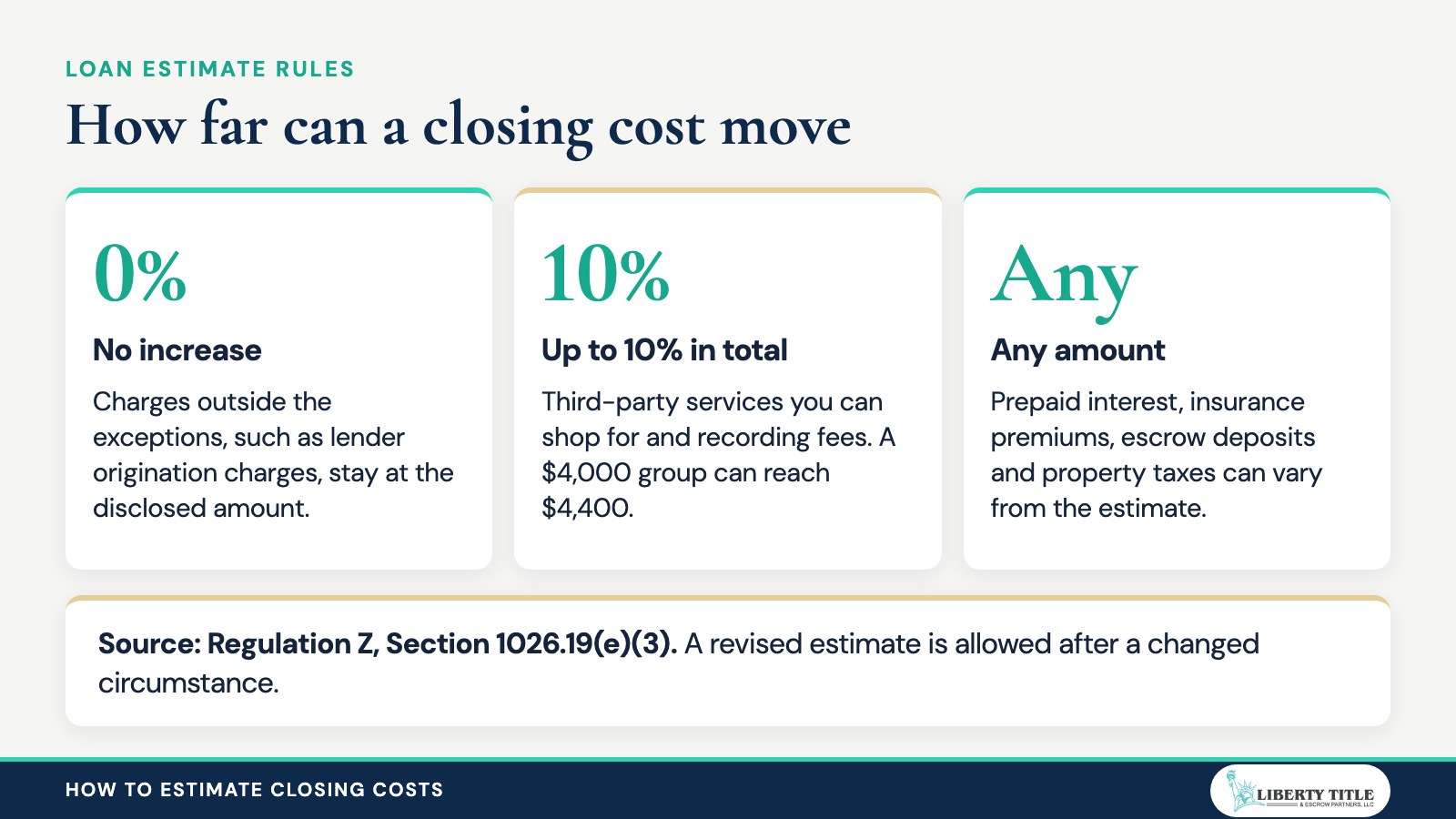
The graphic summarizes the three groups. Florida buyers add state taxes to those groups, and the next section shows the arithmetic.
How Do You Estimate Closing Costs in Florida?
Estimate closing costs in Florida by calculating state taxes exactly and adding quoted third-party fees. Learning how to estimate closing costs in Florida is easier because three charges follow fixed formulas. Take a $425,000 purchase with $85,000 down and a $340,000 loan.
- Mortgage documentary stamps: Florida Statutes Section 201.08 sets 35 cents per $100 of the note, so $340,000 produces $1,190.
- Intangible tax: Section 199.133 sets 2 mills per dollar, so $340,000 produces $680.
- Owner's policy: the promulgated rate under Florida Administrative Code 69O-186.003 gives $2,200 on $425,000.
- Third-party fees: Redfin lists appraisals at $300 to $500, credit reports at $10 to $100 and surveys at $400 to $1,000.
The promulgated rate is $5.75 per $1,000 up to $100,000 and $5.00 per $1,000 above that. The loan taxes total $1,870. The percentage range on a $340,000 loan runs $6,800 to $17,000, so the fixed charges fill only a share of it.
Ask which party pays the owner's policy, since the contract and county custom decide the premium payer. Miami-Dade County also adds its own surtax on deeds, so ask your title agent for the county figure. That deed tax falls on the seller side of the estimate.
How Do You Estimate Seller Closing Costs?
Estimate seller closing costs by taking 1% to 3% of the sale price, then adding agent compensation. Redfin gives the 1% to 3% range before agent compensation. HomeLight reports an average of about 1.8% of the sale price, or $8,100 on a $450,000 home.
That is how to estimate seller closing costs before listing. HomeLight puts the average listing agent fee near 2.82% and the buyer's agent fee near 2.75%. On $450,000, those fees come to $12,690 and $12,375. Commission terms are negotiable, so replace the averages with your signed listing terms.
How Much Do Deed Stamps Add to a Seller's Estimate?
Deed stamps add 70 cents per $100 of the sale price to a seller's estimate when the seller pays the tax. Florida Statutes Section 201.02 sets that rate for deeds. On a $450,000 sale, deed stamps equal $3,150.
The contract names which party pays the tax, so confirm the payer before totaling the estimate. A net sheet then shows how these costs reduce proceeds.
How Does a Seller Net Sheet Estimate Your Proceeds?
A seller net sheet estimates your proceeds by subtracting commissions, taxes, title charges and your mortgage payoff from the sale price. Your listing agent or title agent can prepare one before you accept an offer. Request a written payoff figure. A mortgage servicer must deliver a payoff letter within 10 days of a written request under Florida Statutes Section 701.04.
| Line item | Basis | Amount |
|---|---|---|
| Sale price | Contract | $450,000 |
| Listing agent fee | 2.82% | -$12,690 |
| Buyer's agent fee | 2.75% | -$12,375 |
| Deed documentary stamps | 70 cents per $100 | -$3,150 |
| Owner's policy | Promulgated rate | -$2,325 |
| Mortgage payoff | Assumed | -$210,000 |
| Estimated proceeds | Before prorations | $209,460 |
The table shows one sample sale. The payoff is an assumed number, and the sheet leaves out county surtax, prorations and association fees. Sellers who plan to cover the policy can read why seller-paid policies are common in some markets.
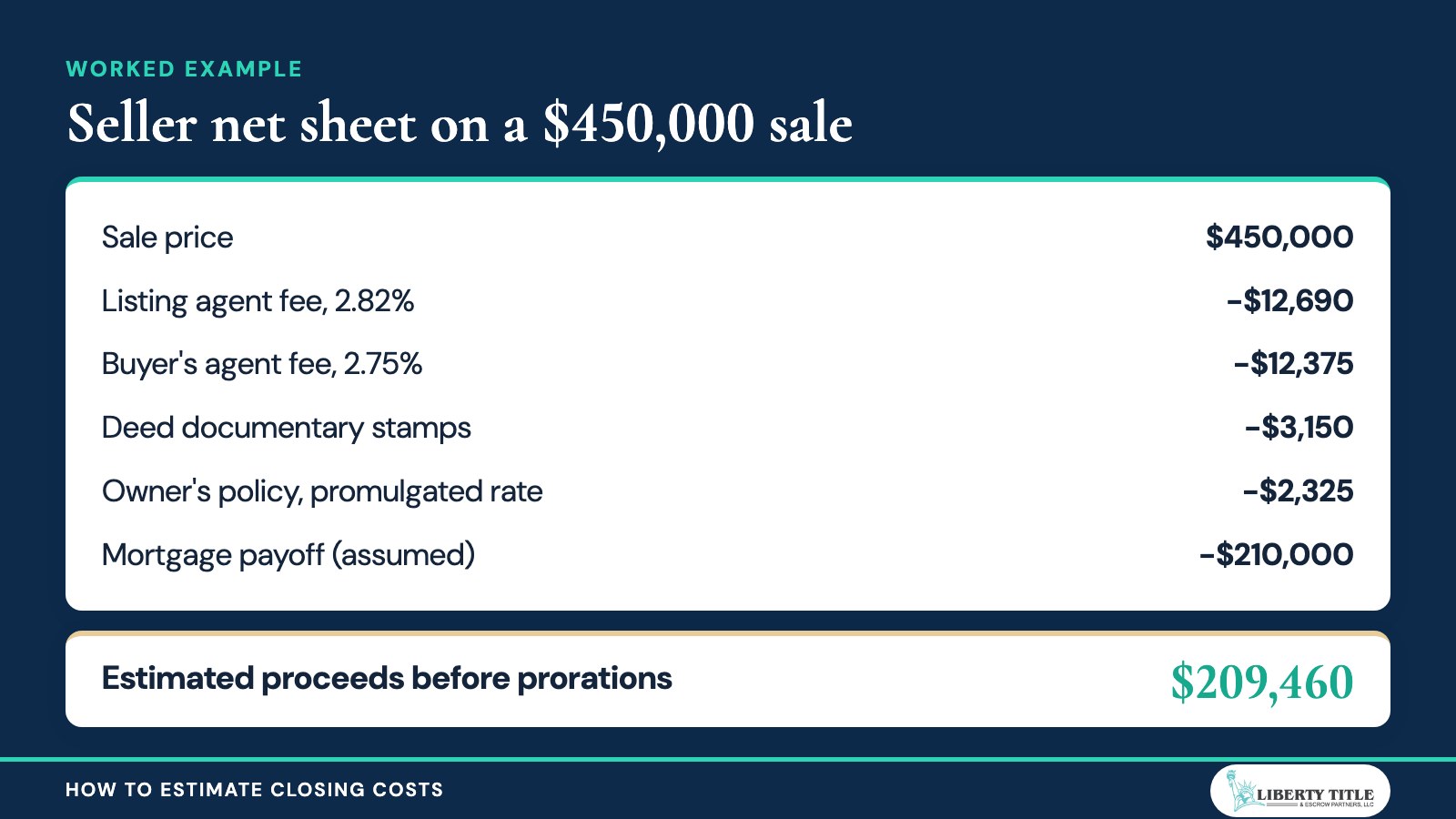
The graphic repeats the same math for quick review. Cash buyers face a different list, covered next.
How Do You Estimate Closing Costs When Paying Cash?
Estimate closing costs when paying cash by taking 1% to 3% of the purchase price, as Redfin does. Then replace that range with quoted title, escrow and recording fees. A cash purchase has no lender, so it has no Loan Estimate. Your title agent supplies the quotes instead.
Learn how to estimate closing costs when paying cash with a $330,000 Florida purchase. Closing costs when paying cash drop because lender fees disappear. Yet these charges remain.
- Owner's policy: the promulgated rate gives $1,725 on $330,000.
- Title search: Total Mortgage lists $100 to $250 for title search work.
- Recording: a three-page deed costs up to $13 under Florida Statutes Section 28.24.
- Survey and inspection: Redfin lists $400 to $1,000 and $300 to $500, and buyers pay inspectors when the work is done.
Those lines total $2,538 to $3,488 before escrow and settlement fees. The 1% to 3% range on this price is $3,300 to $9,900. Quoted fees therefore land near the low end of the percentage range.
Cash investors can review investment buyers support before setting a rental budget. Rental purchases carry the same title, escrow and recording lines as a home purchase, so the same estimate steps apply.
Cash buyers also need a safe way to move funds, so review secure wire transfers before the closing date.
What Tools Help You Estimate Closing Costs Early?
Four tools help you estimate closing costs early. Each one fits a different stage of the purchase or sale.
- Fannie Mae's Closing Costs Calculator takes a state, county, price and down payment, then returns a low-to-high range.
- The Loan Estimate gives itemized lender and third-party charges after you apply.
- A title agent's estimate prices the policy, search and recording fees.
- A seller net sheet projects proceeds after commissions, taxes and payoff.
Fannie Mae's tool draws on closed transactions for conventional loans. A title company's premium calculator prices the policy portion for your property value. Those tools set up the final step, which is tightening the numbers.
How Do You Make a Closing Cost Estimate More Accurate?
Make a closing cost estimate more accurate by replacing each percentage with a written quote before you sign the contract. Start with the fees that move with your closing date. Prepaid interest depends on the day you close. The CFPB says the first 6 to 12 months of homeowner's insurance is usually paid at or before closing.
Next, lock your rate. The rule on changed circumstances lets points and lender credits change when the rate was not locked. Then add association charges, since a Florida homeowners' association estoppel certificate fee is capped at $250 when no delinquency exists.
Finally, compare settlement charges across providers you are allowed to choose. Shopping applies only to services the lender lets you pick, so confirm which ones qualify.
What Else Should You Know About Estimating Closing Costs?
Is 4% Closing Cost High?
No, 4% falls inside the 2% to 5% range that Redfin and Fannie Mae publish. On a $300,000 home, 4% equals $12,000. Compare it with the itemized Loan Estimate before judging your own number.
Are Closing Costs Cheaper When Paying Cash?
Yes, cash purchases cost less in closing fees. Redfin puts cash buyers near 1% to 3% against 2% to 5% for financed buyers. Lender charges, such as origination and appraisal, drop out of the bill. Title, escrow and recording charges stay.
Is $20,000 a Good Down Payment on a $400,000 House?
A $20,000 down payment on a $400,000 house equals 5% down and leaves a $380,000 loan. Closing costs at 2% to 5% of the loan run $7,600 to $19,000. Total cash needed is $27,600 to $39,000, so confirm the loan program's requirements with your lender.
Do Seller Credits Lower Your Closing Cost Estimate?
Yes, a seller credit lowers your cash to close, and Fannie Mae caps credits at 3%, 6% or 9% by loan-to-value ratio. Investment properties are capped at 2%, and FHA allows up to 6% of the sales price. Zillow's 2025 survey found sellers agreed to pay all closing costs in 44% of accepted offers. A listing agents team can explain how credits appear on the Closing Disclosure.
What Happens When a Loan Estimate Expires?
A Loan Estimate expires 10 business days after delivery unless your lender sets a longer period. Regulation Z ties that window to when you indicate intent to proceed. Ask the lender for a refreshed estimate after the deadline.
Frequently Asked Questions
How Early Can You Get a Closing Cost Estimate?
You can get a rough estimate before you apply by using the percentage ranges. A lender must send the Loan Estimate within three business days after your application. Earlier written estimates must warn that actual costs could be higher.
How Much Are Closing Costs on a $350,000 House?
Closing costs on a $350,000 house run $7,000 to $17,500 at 2% to 5% of the price. Cash buyers at 1% to 3% would see $3,500 to $10,500. The Loan Estimate replaces both ranges with exact charges.
How Does Shopping for Services Change a Closing Cost Estimate?
Shopping for services changes a closing cost estimate, because the borrower picks the provider for some third-party charges. A third-party estimate stays in good faith when the total exceeds the disclosed amount by no more than 10 percent. Regulation Z, 12 CFR 1026.19, sets that rule for borrowers who may shop and providers outside the lender's affiliates.
Does an HOA Estoppel Fee Belong in a Seller Estimate?
Yes, an HOA estoppel fee belongs in a seller estimate when the property sits in an association. Florida Statutes Section 720.30851 caps the fee at $250 when no delinquency exists. A rush fee of up to $100 more applies for delivery within 3 business days. The association must issue the certificate within 10 business days.
Is a Closing Cost Estimate the Same as the Closing Disclosure?
No, the estimate comes early and the Closing Disclosure shows final numbers. Lenders must deliver the Closing Disclosure three business days before closing. Compare it with your Loan Estimate line by line.
How Does Liberty Title Help You Estimate Closing Costs?
We help buyers, sellers, realtors and lenders price the title and escrow side of a closing early. The Liberty Title company is an ALTA member, certified to ALTA Best Practices, and we serve clients in English and Spanish. Send us the property address and price, and we explain the title, escrow and recording lines you should expect.
Pairing our Liberty Title company estimate with your lender's Loan Estimate gives you both halves of the picture. Call +1 (305) 530-8998 to talk through your numbers before you sign a contract. We provide general education here, so confirm tax and lending details with your lender, real estate attorney or tax advisor.


You May Also Like

How Closing Costs Are Calculated Step by Step

How to Estimate Closing Costs in Real Estate

Closing Costs When Buying a House and What to Expect
What a Quitclaim Deed Is and When to Use One

How to Calculate Closing Costs Before You Close

What Closing Costs Buyers Should Expect to Pay

What Is Included in Closing Costs for a Home Purchase

What Closing Costs Include for Both Buyers and Sellers

Who Pays Closing Costs in a Real Estate Transaction

Are There Closing Costs on a Home Equity Loan

Can You Roll Closing Costs into a Mortgage

Do Sellers Pay Closing Costs and How Much

What a Warranty Deed Is and How It Protects the Buyer

How Much Closing Costs Are and What They Include























How Long to Close After Title Search for Homebuyers

How To Safely Wire Money to a Title Company

What Documents Does a Title Company Need

How Much a Title Company Charges and What You Get

How Long a Title Company Can Hold Funds After Closing

How To Do a Title Search on Property Yourself

Title Insurance in Real Estate and How It Protects You
How Long a Title Search Takes and What Causes Delays
How a Title Search Works and What It Reveals

What a Title Company Does and Why It Matters at Closing

What Is Title Insurance and Why Do You Need It