


How to Calculate Closing Costs Before You Close

Multiply the loan amount by 2% to 5% to estimate closing costs. Then replace that estimate with the itemized fees on your Loan Estimate. Bankrate puts the range at $8,000 to $20,000 on a $400,000 loan. Sellers add the commission, deed taxes, and loan payoff to their total. This guide shows how to calculate closing costs with worked buyer and seller examples.
Key Takeaways
- Fannie Mae says closing costs run 2% to 5% of the mortgage amount, paid on top of the down payment.
- Florida's formulas are exact: on a $320,000 loan, mortgage stamps are $1,120 and intangible tax is $640.
- Cash to close equals the down payment plus closing costs, minus your deposit, seller credits, and adjustments.
- A seller's net proceeds equal the sale price minus the loan payoff and every selling cost.
- The Closing Disclosure, due three business days before closing, replaces every estimate with final figures.
How Do You Calculate Closing Costs on a House?
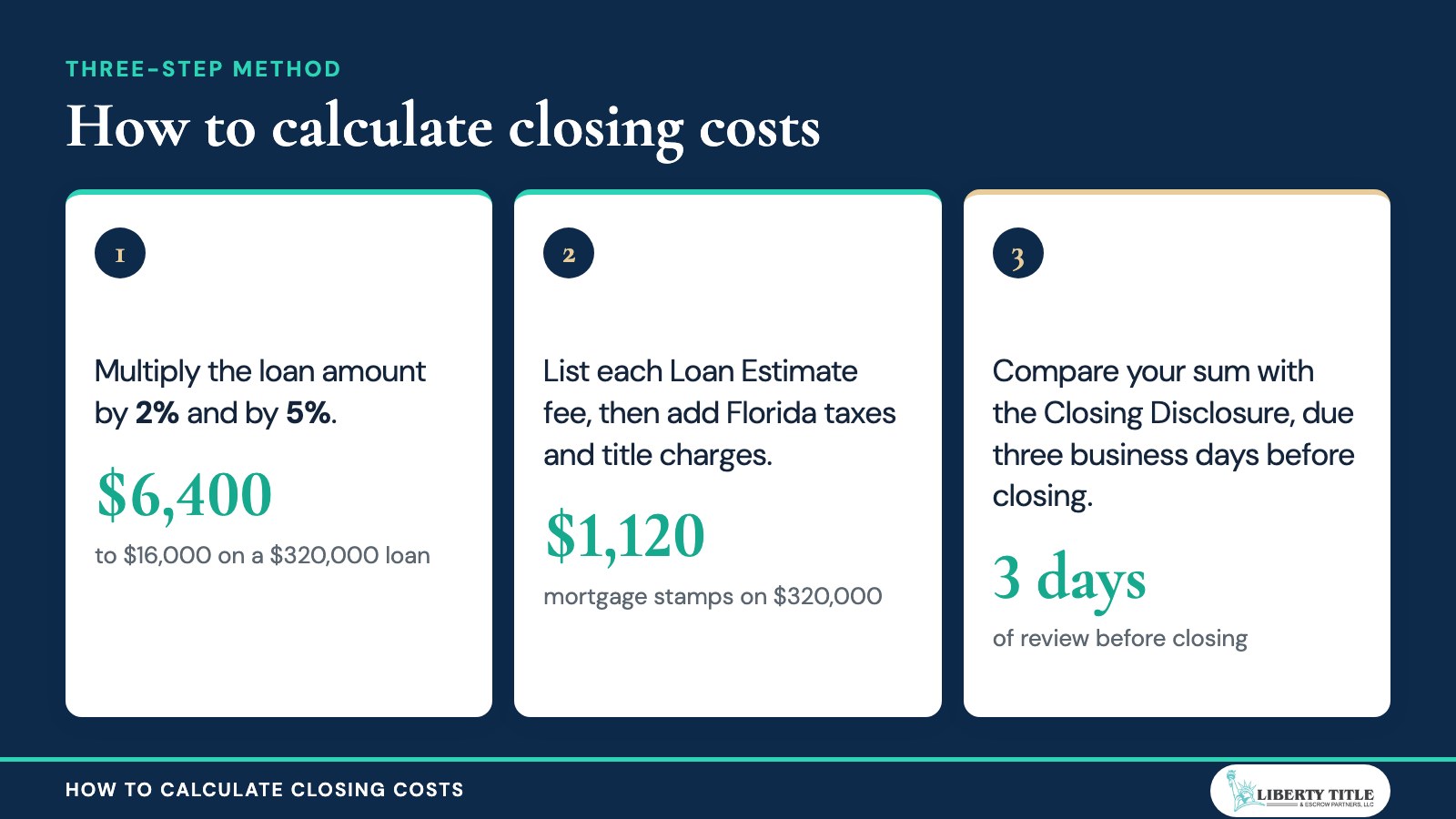
Calculate closing costs on a house in three steps: estimate, itemize, and confirm. Estimate with a percentage, itemize each fee, and confirm the total on your lender's forms. The percentage gives a planning number, and the itemized math gives a budget you can use at the table.
A title insurance closing cost calculator handles the premium line, while the Loan Estimate supplies the lender lines. Together they cover the full bill. The steps below follow that order.
- Multiply the loan amount by 2% and by 5% to set a low and high estimate.
- List every fee from the Loan Estimate, then add Florida taxes and title charges.
- Add the lines and compare the sum with the Closing Disclosure.
The first step needs only a price, so the next section runs it on common home prices.
How Much Are Closing Costs on a $250,000, $300,000, or $400,000 House?
Closing costs on a $250,000 house run $5,000 to $12,500 at 2% to 5% of the price. The same math gives $6,000 to $15,000 on a $300,000 home, a figure Redfin publishes. A $400,000 home lands at $8,000 to $20,000.
The table below applies the 2% and 5% rates to four home prices. Lenders usually base the percentage on the loan amount, so a larger down payment lowers the result.
| Home price | At 2% | At 5% |
|---|---|---|
| $250,000 | $5,000 | $12,500 |
| $300,000 | $6,000 | $15,000 |
| $350,000 | $7,000 | $17,500 |
| $400,000 | $8,000 | $20,000 |
These ranges are planning figures, and local costs vary by county, lender, and loan type. A narrower number needs the itemized method that follows the rule of thumb.
What Is a Good Rule of Thumb for Closing Costs?
A good rule of thumb for closing costs is 2% to 5% of the mortgage amount, excluding the down payment. Fannie Mae publishes that range in its closing costs calculator.
A second benchmark covers the title, settlement, and government side only. LodeStar's 2025 data show an average of 1.04% of the sales price, or $4,528 nationally. Lender fees and prepaid items then raise the total toward the 2% to 5% band.
The percentage band has an upper half, so the next question is whether a figure near the top is normal.
How Much Homeowner's Insurance Belongs in Your Closing Costs?
The first 6 to 12 months of homeowner's insurance are usually paid at or before closing, according to the CFPB. That premium counts as a prepaid line on the Loan Estimate. Add it to your total with the other prepaid items.
The Loan Estimate shows the premium under Other Costs. A lender may also ask for proof of coverage before closing. The next section builds a buyer's total from those lines.
How Do You Calculate Closing Costs for a Buyer?
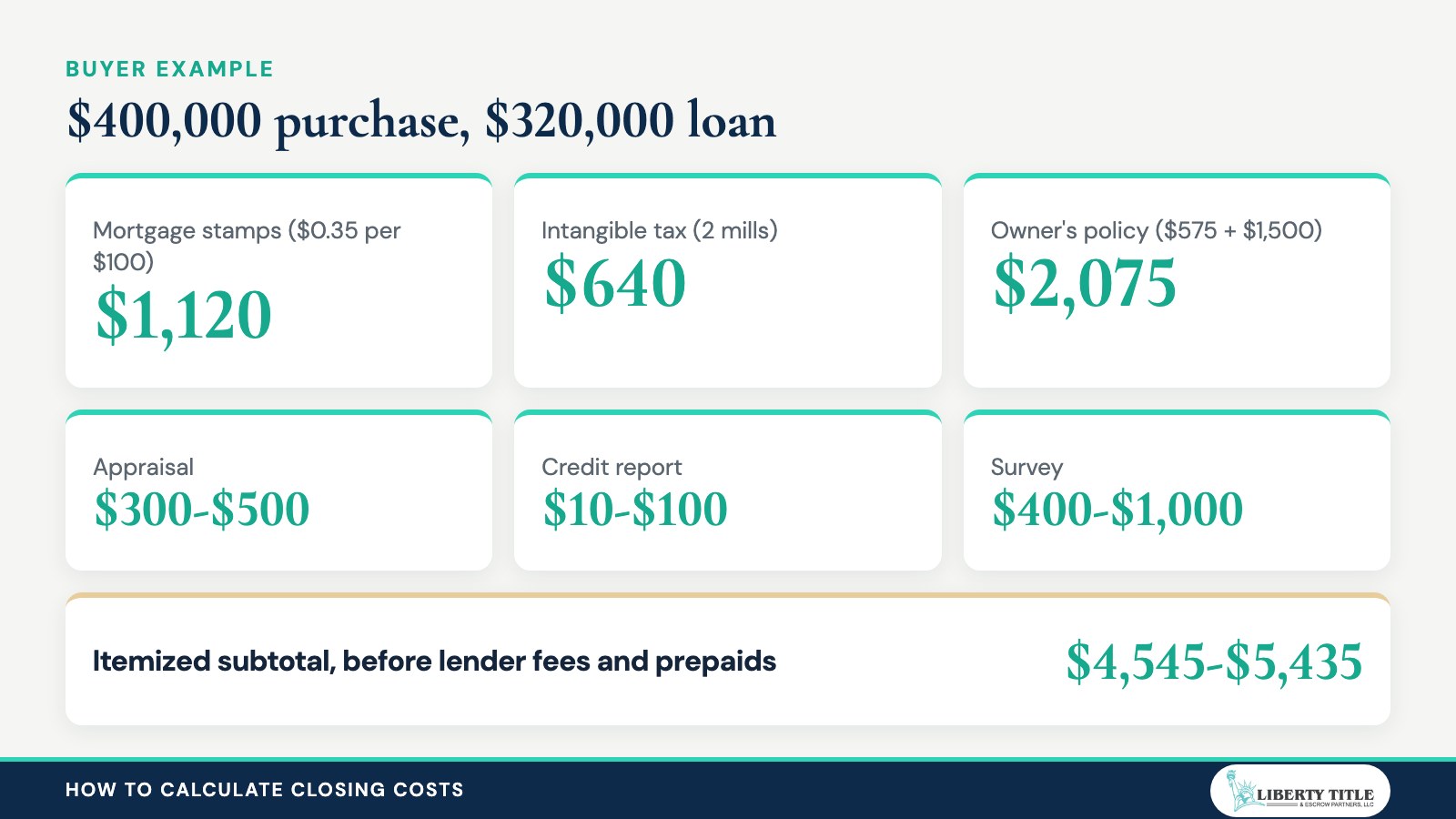
Calculate closing costs for a buyer by adding four fee groups, then comparing with 2% to 5% of the loan. The groups are lender fees, third-party fees, government taxes, and prepaid items. A $400,000 purchase with 20% down means an $80,000 down payment and a $320,000 loan.
The Florida lines come from fixed formulas. Mortgage stamps are 35 cents per $100 of debt, and intangible tax is 2 mills per dollar. The owner's policy follows the promulgated rate of $5.75 per $1,000 for the first $100,000 and $5.00 per $1,000 above it.
| Cost line | Formula | Amount |
|---|---|---|
| Mortgage stamps | $320,000 x $0.35 per $100 | $1,120 |
| Intangible tax | $320,000 x 0.002 | $640 |
| Owner's policy | $575 + $1,500 | $2,075 |
| Appraisal | Redfin range | $300 to $500 |
| Credit report | Redfin range | $10 to $100 |
| Survey | Redfin range | $400 to $1,000 |
| Subtotal | Sum of the lines above | $4,545 to $5,435 |
The table shows a subtotal of $4,545 to $5,435. That sum sits below the $6,400 floor of the percentage range, because lender charges and prepaids are still missing.
The CFPB says to compare origination charges as a total, since lenders itemize them differently. The same agency says buyers usually pay the first 6 to 12 months of homeowners insurance at or before closing. Add both lines from the Loan Estimate.
The example places the owner's policy on the buyer, which is the custom in Miami-Dade County. The sales contract decides the payer, and our guide to the Florida owner's policy explains the county customs.
How Do You Calculate Cash to Close?
Calculate cash to close by adding your down payment to closing costs, then subtracting your deposit, seller credits, and adjustments. The CFPB describes the Estimated Cash to Close on the Loan Estimate in exactly those terms.
Total closing costs on the Closing Disclosure exclude the down payment, so the two figures differ. The list below applies the formula to the $400,000 example. The example assumes $9,000 in closing costs and an $8,000 earnest money deposit.
- Down payment: $80,000.
- Closing costs from the Loan Estimate: plus $9,000 (assumed).
- Earnest money already paid: minus $8,000 (2% of the price).
- Seller credit: $0 in this example.
- Cash to close: $81,000.
The CFPB says buyers typically pay this amount by cashier's check or wire transfer. A call to the title agent confirms the amount, and our safe wire steps protect the transfer.
How Do You Calculate Closing Costs for a Seller?
Calculate closing costs for a seller by adding the commission, Florida deed stamps, the owner's policy, and payoff-related fees. The total comes out of the sale proceeds at closing.
The $400,000 example uses a 5% commission, which is an assumption for illustration. Deed stamps are 70 cents per $100 of price. The HOA estoppel certificate fee is capped at $250 when no delinquency exists.
| Cost line | Formula | Amount |
|---|---|---|
| Agent commission | 5% of $400,000 (assumed) | $20,000 |
| Deed stamps | $400,000 x $0.70 per $100 | $2,800 |
| Owner's policy | $575 + $1,500 | $2,075 |
| HOA estoppel certificate | Statutory cap | $250 |
| Total | 6.28% of the price | $25,125 |
Redfin puts seller costs at 1% to 3% of the price before agent compensation. The three non-commission lines total $5,125, or 1.28%, which fits that range.
Sellers who want the numbers before listing can ask a title agent for a net sheet through our sale closing services. The net sheet turns those lines into a take-home figure.
How Do You Calculate What a Seller Takes Home?
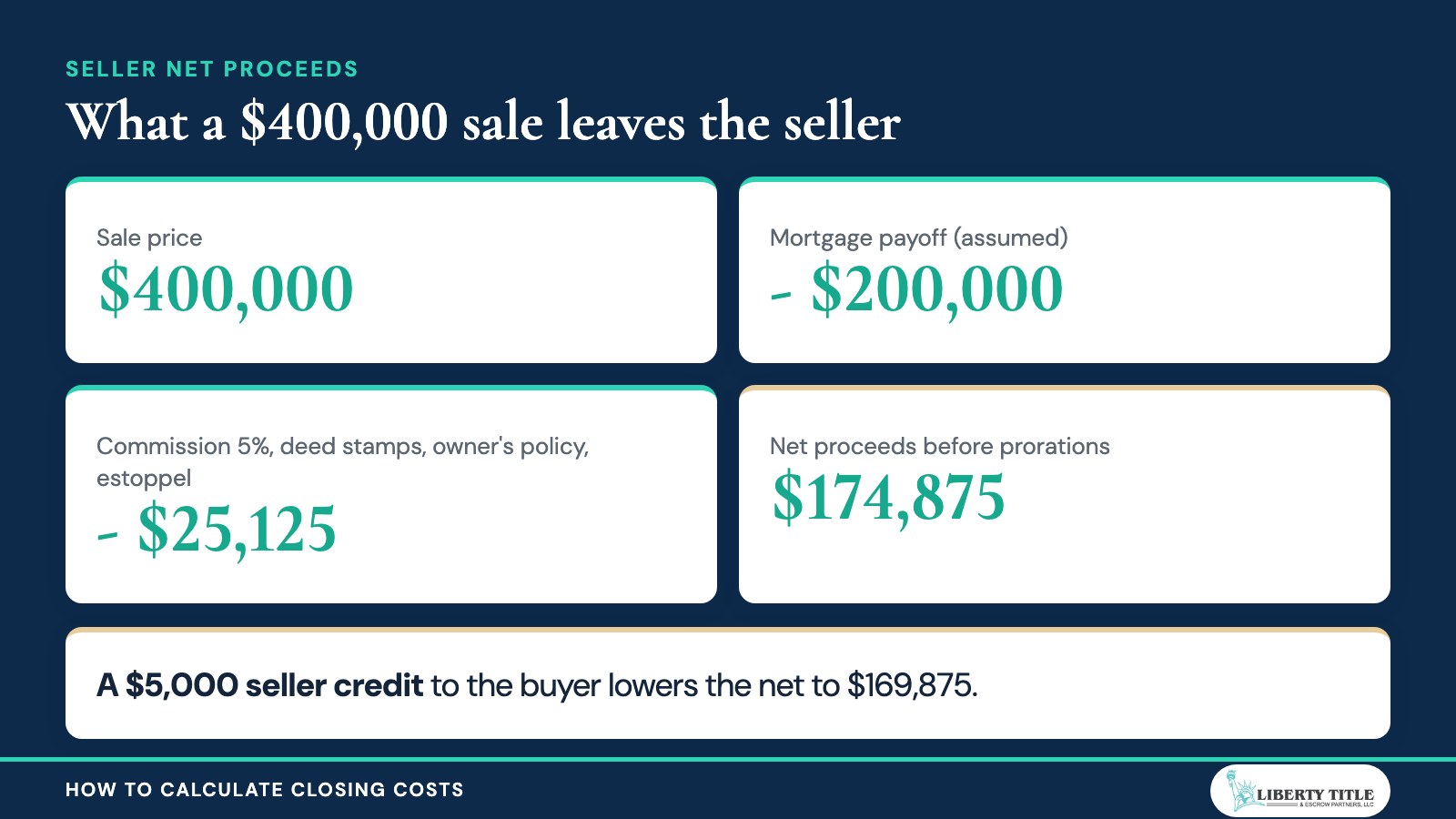
Calculate seller net proceeds by subtracting the mortgage payoff and all selling costs from the sale price. The settlement statement shows the final figure.
The $400,000 example assumes a $200,000 loan payoff. Selling costs of $25,125 leave $174,875. A $5,000 seller credit to the buyer would lower the result to $169,875.
Florida Statutes Section 701.04 requires a lender to deliver a payoff letter within 10 days of a written request. IRS Publication 523 treats selling expenses as a reduction of the amount realized. Ask a tax advisor how that applies to your sale.
How Do You Calculate Closing Costs in Florida?
Calculate closing costs in Florida by adding four state-set formulas to your lender and title fees. Deed stamps, mortgage stamps, intangible tax, and the promulgated title premium follow fixed rates. The list below gives each one.
- Deed stamps: 70 cents per $100 of consideration, under Section 201.02.
- Mortgage stamps: 35 cents per $100 of debt, under Section 201.08.
- Intangible tax: 2 mills per dollar of the secured note, under Section 199.133.
- Owner's premium: $5.75 per $1,000 up to $100,000, plus $5.00 per $1,000 up to $1 million.
Clerks also charge recording fees of up to $5.00 for the first page and $4.00 for each added page. A three-page deed therefore costs up to $13. A premium estimate removes the guesswork from the title line.
How Do You Calculate Closing Costs for a Cash Buyer?
Calculate closing costs for a cash buyer by dropping every loan charge and keeping only the title, tax, and recording lines. Redfin says cash buyers still pay property taxes, notary and recording fees, and local or state fees.
The $400,000 example drops $1,760 in Florida loan taxes, which is $1,120 in mortgage stamps plus $640 in intangible tax. The owner's policy and recording charges remain.
How Do You Calculate Closing Costs for a Refinance?
Calculate closing costs for a refinance by applying the same percentage and fee math to the new loan amount. Fannie Mae's 2% to 5% range applies to the mortgage amount, not the old purchase price.
A new $320,000 loan gives $6,400 to $16,000 at 2% to 5%. Florida's note and intangible taxes also apply to the new loan, which means $1,120 and $640 on that amount. Talk to your title agent about any exemptions.
Fannie Mae allows a limited cash-out refinance to finance closing costs, points, and prepaid items. Our refinance closing team prepares the title work behind that math.
What Tools Help You Calculate Closing Costs?
Four tools help you calculate closing costs: the Loan Estimate, the Closing Disclosure, a net sheet, and a title calculator. Each tool covers a different stage. Knowing how to calculate closing costs means matching the tool to the stage.
- The Loan Estimate arrives within three business days of your application, on a standard form every lender uses.
- The Closing Disclosure shows final figures and arrives three business days before closing.
- The seller net sheet projects proceeds from the price, payoff, and costs.
- An online estimate tool prices the title policy for your home value.
Fannie Mae also offers a calculator that returns cost ranges by state, county, price, and down payment. Its data come from closed conventional loans. Estimates from any tool still need a final check, as the next section shows.
Can Final Closing Costs Differ From Your Calculation?
Yes, final closing costs can differ from your calculation. The CFPB says some fees can rise by any amount, some up to 10 percent, and some not at all.
Compare the Closing Disclosure with your Loan Estimate and your own math. A gap in Cash to Close deserves a question to the lender. Our closing questions page covers other common title and escrow topics.
What Else Should You Know About Calculating Closing Costs?
How Does a Seller Credit Appear on the Closing Disclosure?
A seller credit appears on the Closing Disclosure as a Seller Credit or Seller Paid line item, according to the CFPB. The credit lowers the buyer's Cash to Close. A buyer's agent drafts the credit into the contract, and our realtor desk supports agents.
How Can You Lower Your Calculated Closing Costs?
Lower closing costs by comparing Loan Estimates, because the CFPB advises buyers to request multiple estimates from different lenders. A lender credit also lowers upfront costs, but the CFPB notes it may raise the interest rate. Add a title fee comparison to that review.
How Do You Calculate Prepaid Interest and Escrow Deposits?
Calculate prepaid interest by multiplying the loan by the annual rate, dividing by 365, and multiplying by the days owed. An assumed 6.5% rate on $320,000 gives $56.99 per day, or about $855 for 15 days. The closing date changes the day count, and the closing duration affects the schedule.
Do Some Closing Costs Add to a Home's Cost Basis?
Yes, some closing costs add to a home's cost basis, according to IRS Publication 551. Settlement fees and closing costs for buying the property count, while loan costs do not. A tax advisor can confirm which fees apply to your return.
How Does Earnest Money Fit Into the Math?
Earnest money fits into the math as a credit, because the deposit reduces your cash to close. Redfin puts the deposit at about 1% to 3% of the price. These earnest money steps show how to send it to the escrow agent.
Frequently Asked Questions
How Much Does It Cost to Close on a $350,000 House?
Closing costs on a $350,000 house run $7,000 to $17,500 at 2% to 5% of the price. A lower loan amount shrinks the result. The Loan Estimate gives the exact figure.
How Can I Estimate My Closing Costs?
Estimate closing costs by multiplying the loan by 2% and 5%, then swapping in the lines from your Loan Estimate. Florida stamps and the title premium follow fixed formulas.
Do Lender Credits Lower the Total You Calculate?
Yes, lender credits lower the closing costs you calculate. The CFPB says they cut costs up front in exchange for a higher interest rate. Subtract the credit line on the Loan Estimate from your total. Compare the rate and the credit together.
When Do I Get My Final Closing Cost Numbers?
Lenders must provide the Closing Disclosure three business days before the scheduled closing. The form lists every final cost for both sides. Compare it with the Loan Estimate.
Do Seller Closing Costs Include the Agent Commission?
Yes, a seller's total costs include the agent commission. Redfin's 1% to 3% seller range excludes it, so the commission adds to that percentage. The listing agreement sets the rate.
How Does Liberty Title Help You Calculate Closing Costs?
Liberty Title helps buyers and sellers calculate closing costs by pricing the title and escrow lines early. We also reconcile every figure on the settlement statement. Service is available in English and Spanish.
Knowing how to calculate closing costs lets you plan cash to close before the Closing Disclosure arrives. To review a number with a title agent, get in touch or call +1 (305) 530-8998. We answer questions about each line before closing day, so the final statement holds no surprises.
Buyers, sellers, realtors, and lenders can all request a line-by-line walkthrough from the team at Liberty Title LLC. Our work covers residential and commercial closings, title searches, title insurance, and escrow.


You May Also Like
How to Calculate Closing Costs Before You Close


What Is Included in Closing Costs for a Home Purchase

Who Pays Closing Costs in a Real Estate Transaction

Are There Closing Costs on a Home Equity Loan

Can You Roll Closing Costs into a Mortgage

Do Sellers Pay Closing Costs and How Much

What a Warranty Deed Is and How It Protects the Buyer

How Much Closing Costs Are and What They Include
























How Long to Close After Title Search for Homebuyers

How To Safely Wire Money to a Title Company

What Documents Does a Title Company Need

How Much a Title Company Charges and What You Get

How Long a Title Company Can Hold Funds After Closing

How To Do a Title Search on Property Yourself

Title Insurance in Real Estate and How It Protects You
How Long a Title Search Takes and What Causes Delays
How a Title Search Works and What It Reveals

What a Title Company Does and Why It Matters at Closing

What Is Title Insurance and Why Do You Need It