


How Much Closing Costs Are and What They Include

Buyers pay 2% to 5% of the purchase price in closing costs, according to Redfin. That equals $8,000 to $20,000 on a $400,000 home. Sellers pay 1% to 3% before agent compensation. Title and settlement charges alone average 1.04% of the price in 2025 purchase quotes. Lender fees, taxes, and prepaid items move the final bill, and the down payment stays outside the total.
Key Takeaways
- Buyer closing costs run 2% to 5% of the purchase price, or $6,000 to $15,000 on a $300,000 home.
- Seller closing costs run 1% to 3% of the sale price before agent compensation.
- The down payment is not a closing cost, according to the Consumer Financial Protection Bureau (CFPB).
- Florida adds mortgage stamps of 35 cents per $100 and intangible tax of 2 mills per dollar of the loan.
- The Closing Disclosure arrives three business days before closing and shows the final figures.
How Much Are Closing Costs for a Home Buyer?
Closing costs for a home buyer run 2% to 5% of the purchase price, according to Redfin. That range covers lender charges, title and settlement fees, government taxes, and prepaid items. The figure excludes the down payment, which the buyer pays separately.
Buyers who want help reading each line can lean on our residential closing support before signing day. Costs shift with the lender, the loan type, and the contract terms. Those drivers explain why the next section turns the percentages into dollar amounts.

How Much Are Closing Costs on a House at Different Prices?
Closing costs on a house run $6,000 to $15,000 at a $300,000 price, according to Redfin's 2% to 5% range. The graphic above shows four price points. The table below applies the same percentages to five purchase prices.
| Purchase price | Low end (2%) | High end (5%) |
|---|---|---|
| $200,000 | $4,000 | $10,000 |
| $250,000 | $5,000 | $12,500 |
| $300,000 | $6,000 | $15,000 |
| $400,000 | $8,000 | $20,000 |
| $500,000 | $10,000 | $25,000 |
The table shows the low and high end for each price. Redfin advises preparing for the higher end of the range. Buyers planning a purchase can start with our buyer closings overview and then compare lender quotes.
What Would Closing Costs Be on a 200k House?
Closing costs on a 200k house run $4,000 to $10,000 at 2% to 5% of the price. Redfin is the source of the percentage range. The final bill depends on the lender and loan type.
How Much Are Closing Costs on a 300k House?
Closing costs on a 300k house run $6,000 to $15,000, according to Redfin. A buyer with a lower loan balance sits nearer the low end. Lender fees and prepaid items move the total.
What Would Closing Costs Be on a 400k House?
Closing costs on a 400k house run $8,000 to $20,000 at 2% to 5% of the price. A buyer with a larger loan pays more in mortgage taxes. The Florida section below works through those taxes.
Is $20,000 in Closing Costs a Lot?
Yes, $20,000 equals 5% of a $400,000 purchase, the top of the 2% to 5% range Redfin reports. On a $1,000,000 purchase, the same $20,000 equals 2%. The percentage matters more than the dollar amount.
A high total deserves a line-by-line review. The Loan Estimate and Closing Disclosure list every charge, and the CFPB tells borrowers to ask the lender to explain significant changes. Those two forms also explain why national averages look lower than the 2% to 5% rule.
What Percentage of Purchase Price Is Closing Costs?
Closing costs take 1.04% of the purchase price on average for title and settlement charges, based on LodeStar Software Solutions data. LodeStar reviewed more than 620,000 purchase quotes from 2025. National Mortgage News reported the results on April 30, 2026.
The LodeStar average equals $4,528 on a median home price of $433,632. Removing recording fees and taxes leaves a national median of $2,993. State averages range from 0.39% in South Dakota upward, with low figures where transfer taxes are small. That dataset counts fees, recording charges, transfer taxes, settlement fees, and title policies, so lender fees and prepaid items sit outside it.
The Redfin range of 2% to 5% covers the full buyer bill, including lender charges and prepaids. The two numbers measure different slices of the same bill. Florida shows how those slices stack up in dollars.
How Much Are Closing Costs in Florida?
Closing costs in Florida run 2% to 5% of the price on top of state taxes set by statute. Florida Statutes set the deed tax, the mortgage tax, and the intangible tax. Florida Administrative Code sets owner's title insurance rates.
Three statutes drive the Florida-specific charges. Section 201.02 sets documentary stamp tax on a deed at 70 cents per $100 of consideration. Section 201.08 sets stamps on a mortgage at 35 cents per $100 of the debt. Section 199.133 sets a one-time intangible tax of 2 mills on each dollar of a mortgage-secured obligation.
Rule 69O-186.003 sets the owner's title premium at $5.75 per $1,000 for the first $100,000. Coverage from $100,000 to $1 million adds $5.00 per $1,000. For these rates, buyers can compare each total with our title cost estimator.
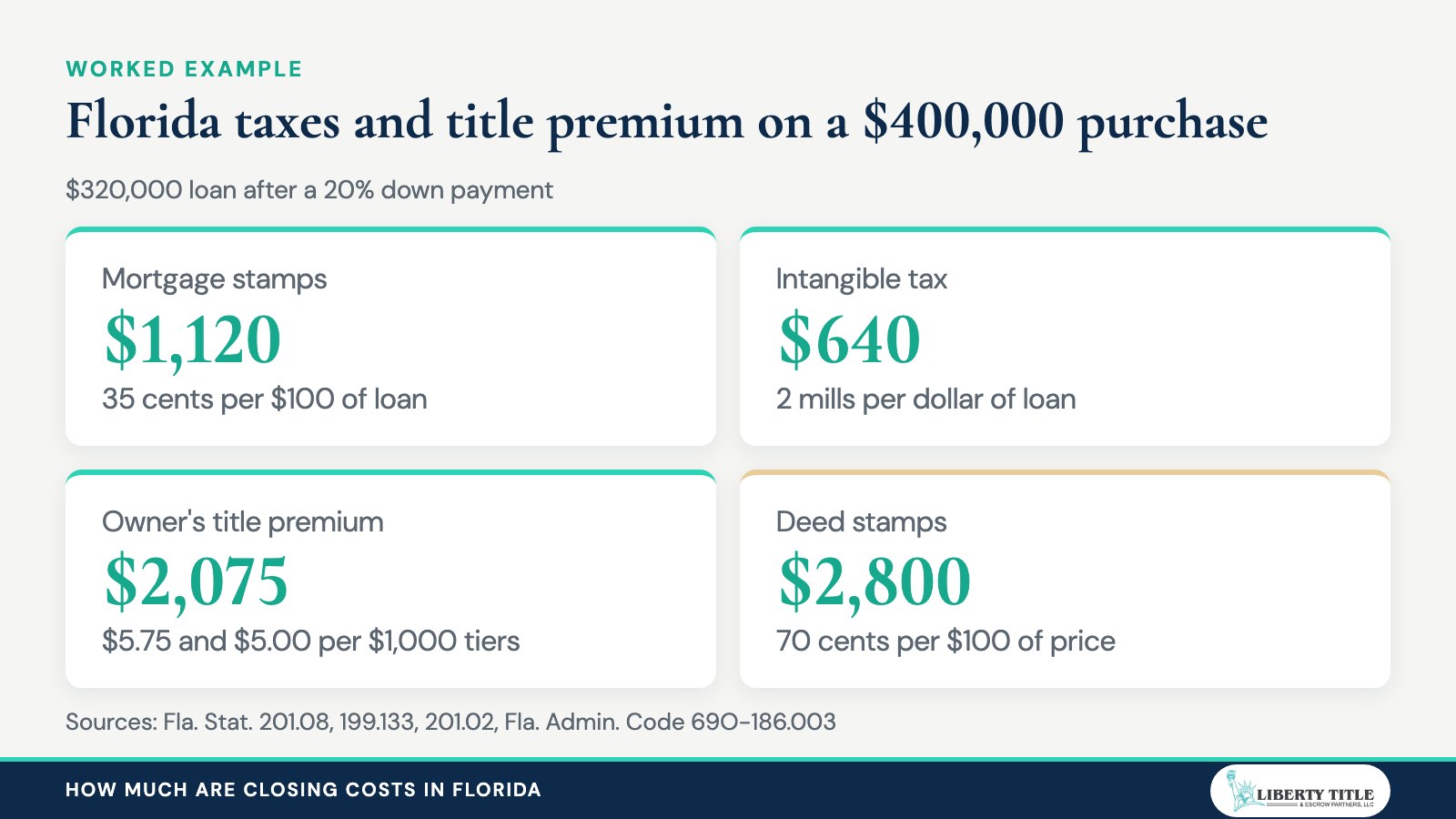
The graphic above prices four Florida charges on a $400,000 purchase with a $320,000 loan. The table below shows the math behind each amount.
| Charge | Rate | Applied to | Amount |
|---|---|---|---|
| Mortgage stamps | 35 cents per $100 | $320,000 loan | $1,120 |
| Intangible tax | 2 mills per $1 | $320,000 loan | $640 |
| Owner's title premium | $5.75 then $5.00 per $1,000 | $400,000 coverage | $2,075 |
| Deed stamps | 70 cents per $100 | $400,000 price | $2,800 |
The mortgage stamps, intangible tax, and owner's premium add up to $3,835 in this example. Deed stamps of $2,800 are a separate charge, and the purchase contract decides who pays each item. Our guide to owner's policy costs explains the payer question for the premium.
What Is Included in Closing Costs?
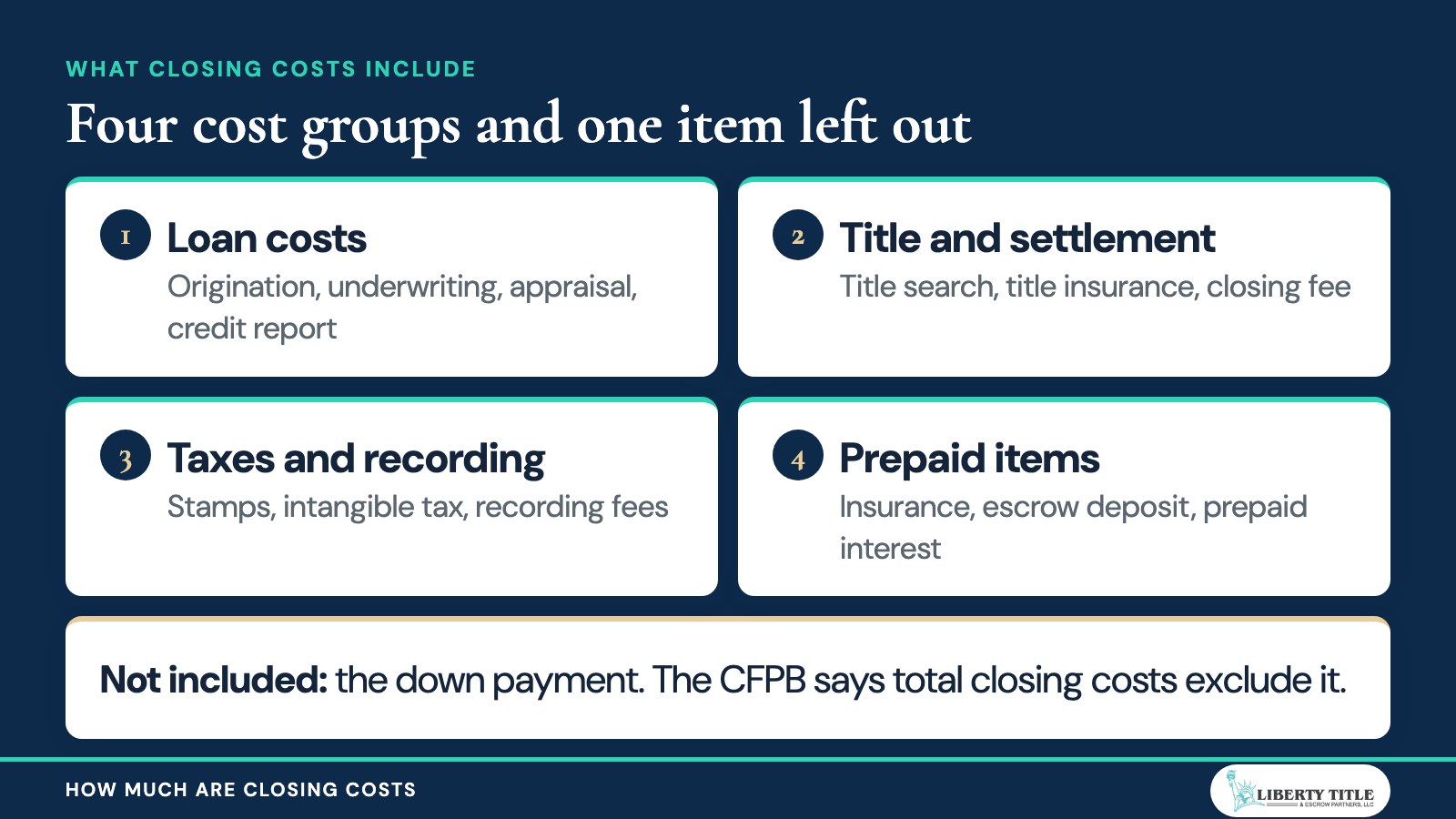
Closing costs include loan costs, title and settlement fees, taxes and recording charges, and prepaid items. The CFPB describes closing costs as upfront charges for getting a loan and transferring ownership. The Loan Estimate and Closing Disclosure divide them into loan costs and other costs.
- Loan costs: origination charges, underwriting, and the credit report, which Redfin prices at $10 to $100.
- Third-party services: an appraisal, which Redfin prices at $300 to $500, and a survey at $400 to $1,000.
- Title and settlement: the title search, title insurance, and the closing or settlement fee.
- Taxes and recording: documentary stamps, intangible tax, and county recording fees.
- Prepaid items: the first year of homeowner's insurance, an escrow deposit, and prepaid interest.
The graphic below sorts these charges into four groups. Title companies price their own piece of the bill, and our breakdown of title company fees covers that piece.
How Much Are Closing Costs for a Seller?
Closing costs for a seller run 1% to 3% of the sale price before agent compensation, according to Redfin. On a $400,000 sale, that range equals $4,000 to $12,000. Agent compensation comes on top of that figure.
Redfin notes that commissions have been negotiable since the 2024 National Association of Realtors (NAR) settlement. Florida deed stamps at 70 cents per $100 equal $2,800 on a $400,000 sale. Sellers can compare each charge against our settlement services scope.
Agents who represent sellers can pass a contract to the title team early. The title agent then prepares the seller figures that appear on the settlement statement. Listing agents can reach us through realtor services for a seller estimate.
What Factors Change Closing Costs?
Four factors change closing costs: the purchase price, the down payment, the loan type, and adjustments negotiated with the seller. Redfin lists those four drivers. A higher price raises every percentage-based charge.
The loan type adds its own fees. Redfin reports that the VA funding fee ranges from 0.5% to 3.3% of the loan amount. Some lenders also charge an application fee of upwards of $500, and a title search costs upwards of $200, according to Redfin.
Location matters as well. The LodeStar data shows state averages from 0.39% in South Dakota to the highest figures where transfer taxes are large. Florida buyers add mortgage stamps and intangible tax on the loan, so a larger loan raises both charges. A larger down payment shrinks the loan and lowers those two taxes.
Seller adjustments also move the total. A seller concession can cover part of a buyer's costs, though loan programs set limits. The next section turns these drivers into a saving plan.
How Much Should You Save for Closing Costs?
Save the high end of your 2% to 5% range for closing costs, because Redfin advises preparing for the higher figure. Closing costs can change late in the process. A title search can reveal a lien, and rates can move before a lock.
- Multiply the purchase price by 2% and by 5% to set a range.
- Request a Loan Estimate from several lenders and compare the closing cost totals.
- Add Florida mortgage stamps and intangible tax on the loan amount.
- Add the earnest money, which Redfin puts at about 1% to 3% of the price and credits toward cash to close.
- Match the Closing Disclosure to the Loan Estimate when it arrives three business days before closing.
The CFPB defines cash to close as the total amount paid at closing, in addition to money already paid. Buyers who have sent earnest money deposits see that credit on the Closing Disclosure. Questions about the final figures belong with your lender and title agent.
What Else Should You Know About Closing Costs?
Does the Down Payment Count as a Closing Cost?
No, the down payment is not a closing cost. The CFPB defines total closing costs as upfront costs excluding the down payment. Cash to close combines the two.
How Much Are Closing Costs on a Refinance?
A refinance carries its own lender, title, and government charges, so the total varies by loan. The Loan Estimate lists the estimated figure. Borrowers can review refinance costs with a title agent before choosing a lender.
Are There Closing Costs on a Home Equity Line or Reverse Mortgage?
Yes, both loans close with lender, title, and recording charges. The CFPB says lenders can charge certain fees on a home equity line of credit (HELOC). Our pages on equity line costs describe how that loan closes.
Both loan types record a new lien against the property, so a title search and recording step apply to each. A reverse mortgage follows a similar path with its own lender and title charges. Borrowers can review reverse mortgage closings with a title agent before signing.
Does Owner's Title Insurance Cost More on a Higher Price?
Yes, owner's title insurance costs more on a higher purchase price in Florida. The promulgated rate is $5.75 per $1,000 up to $100,000, per Florida Administrative Code 69O-186.003. Above $100,000, the rule adds $5.00 for each $1,000 up to $1 million. Endorsements and policy type change the final cost.
When Are Closing Costs Due?
Closing costs are due on closing day, when ownership transfers. The CFPB says lenders must provide the Closing Disclosure three business days before closing. Some charges, such as the appraisal, are paid earlier.
Is the Title Insurance Premium a One-Time Cost?
Yes, the owner's policy premium is paid once at closing. Our article on the one-time premium explains how long the coverage lasts.
Frequently Asked Questions
Are Closing Costs a Rip-Off?
No, closing costs pay for identifiable services and government taxes. The Loan Estimate itemizes each charge. Borrowers can request multiple Loan Estimates and ask lenders to explain any fee.
How Much Money Do You Need to Buy a House?
A buyer needs the down payment plus closing costs, which together make up cash to close. Closing costs run 2% to 5% of the price, according to Redfin. Earnest money paid earlier is credited toward the total.
Can Gift Money Pay for Closing Costs?
Yes, Redfin says gifts from friends and family can pay closing costs. Lenders set gift letter requirements and amount limits. Ask the lender before closing.
Is Earnest Money Part of Closing Costs?
No, earnest money is a deposit credited toward cash to close. Redfin puts the deposit at about 1% to 3% of the home's price. The deposit lowers the cash due at closing.
Can Closing Costs Change Before Closing?
Yes, closing costs can change at the last minute, according to Redfin. A title search can show a lien, or rates can rise before a lock. The CFPB advises asking the lender to explain significant changes.
Do Closing Costs Include the Title Search?
Yes, the title search is a closing cost. Redfin says to expect upwards of $200 for it. The search checks for liens, unpaid taxes, and other claims before ownership transfers.
Who Gives You the Closing Cost Estimate?
The lender gives the estimate on a Loan Estimate form. The CFPB says the form shows estimated closing costs and estimated cash to close. Buyers can request one from several lenders.
How Does Liberty Title Help Buyers and Sellers Review Closing Costs?
Liberty Title helps buyers, sellers, realtors, and lenders review the title and escrow side of the closing bill. Our team handles title searches, title insurance, and escrow, and we serve clients in English and Spanish. Working with the Liberty Title experts keeps the figures on the Closing Disclosure clear before closing day.
A Miami-based team can walk through the Florida taxes and premiums described above. Clients who want a file opened can place a title order online. The phone line is +1 (305) 530-8998.


You May Also Like

Do Sellers Pay Closing Costs and How Much


What a Warranty Deed Is and How It Protects the Buyer
How Much Closing Costs Are and What They Include
























How Long to Close After Title Search for Homebuyers

How To Safely Wire Money to a Title Company

What Documents Does a Title Company Need

How Much a Title Company Charges and What You Get
How Long a Title Company Can Hold Funds After Closing

How To Do a Title Search on Property Yourself

Title Insurance in Real Estate and How It Protects You
How Long a Title Search Takes and What Causes Delays
How a Title Search Works and What It Reveals

What a Title Company Does and Why It Matters at Closing

What Is Title Insurance and Why Do You Need It