


How Closing Costs Are Calculated Step by Step

Here is how closing costs are calculated: the closing agent adds every fee, and each fee follows its own formula. Lender fees use a percentage of the loan. Florida title premiums use a rate per $1,000, and taxes use a rate per $100. Buyers typically pay 2% to 5% of the price, according to Redfin. Sellers pay a separate set of fees at the same closing table.
Key Takeaways
- Closing costs are a sum of separate fees, and each fee has its own formula.
- Formulas use a percentage, a per-$1,000 rate, a flat amount, or a daily rate.
- Florida sets owner's title premiums by rule: $5.75 per $1,000 up to $100,000, then $5.00 per $1,000 to $1 million.
- Florida deed stamps cost 70 cents per $100, and mortgage stamps cost 35 cents per $100.
- Prepaid interest, escrow deposits, and prorations depend on the closing date, so the closing day changes the total.
- The Closing Disclosure shows the final numbers, and some fees can change from the Loan Estimate.
How Closing Costs Are Calculated on a House
Closing costs on a house are calculated by listing each fee, applying its own formula, and adding the results. Percentage fees, per-$1,000 rates, flat fees, and daily charges all appear on one settlement statement. Fannie Mae puts the usual total at 2% to 5% of the mortgage.
A closing agent applies each formula to the purchase price, the loan amount, or the closing date. Our residential closing team builds the settlement statement from those inputs. The table below shows how each fee type is calculated.
| Fee type | Calculation base | Formula |
|---|---|---|
| Lender origination fee | Loan amount | Loan amount x fee percentage |
| Discount points | Loan amount | 1 point = 1% of the loan |
| Owner's and lender's title premium | Policy amount | Rate per $1,000 of coverage, set by Florida rule |
| Florida deed stamps | Price | 70 cents per $100 |
| Florida mortgage stamps | Loan amount | 35 cents per $100 |
| Florida intangible tax | Loan amount | 2 mills per dollar |
| Recording fees | Page count | $5.00 first page, $4.00 each added page (maximum) |
| Prepaid interest | Loan, rate, closing date | Daily interest x days to month end |
| Taxes and HOA dues | Annual bill, closing date | Daily share x days owned |
The formulas fall into four groups, and each group needs a different input. Percentage fees come first because they start with the loan amount.
What Is the Step-by-Step Order for Calculating Closing Costs?
The step-by-step order for how closing costs are calculated starts with the price and loan amount and ends with cash to close. Six steps cover every fee in sequence, and each step feeds the next.
- Set the purchase price, down payment, and loan amount.
- Calculate lender fees and discount points from the loan amount.
- Calculate title premiums, stamps, and recording fees.
- Calculate prepaid interest from the closing date.
- Calculate escrow deposits and prorations for taxes, insurance, and HOA dues.
- Subtract the deposit and credits to reach cash to close.
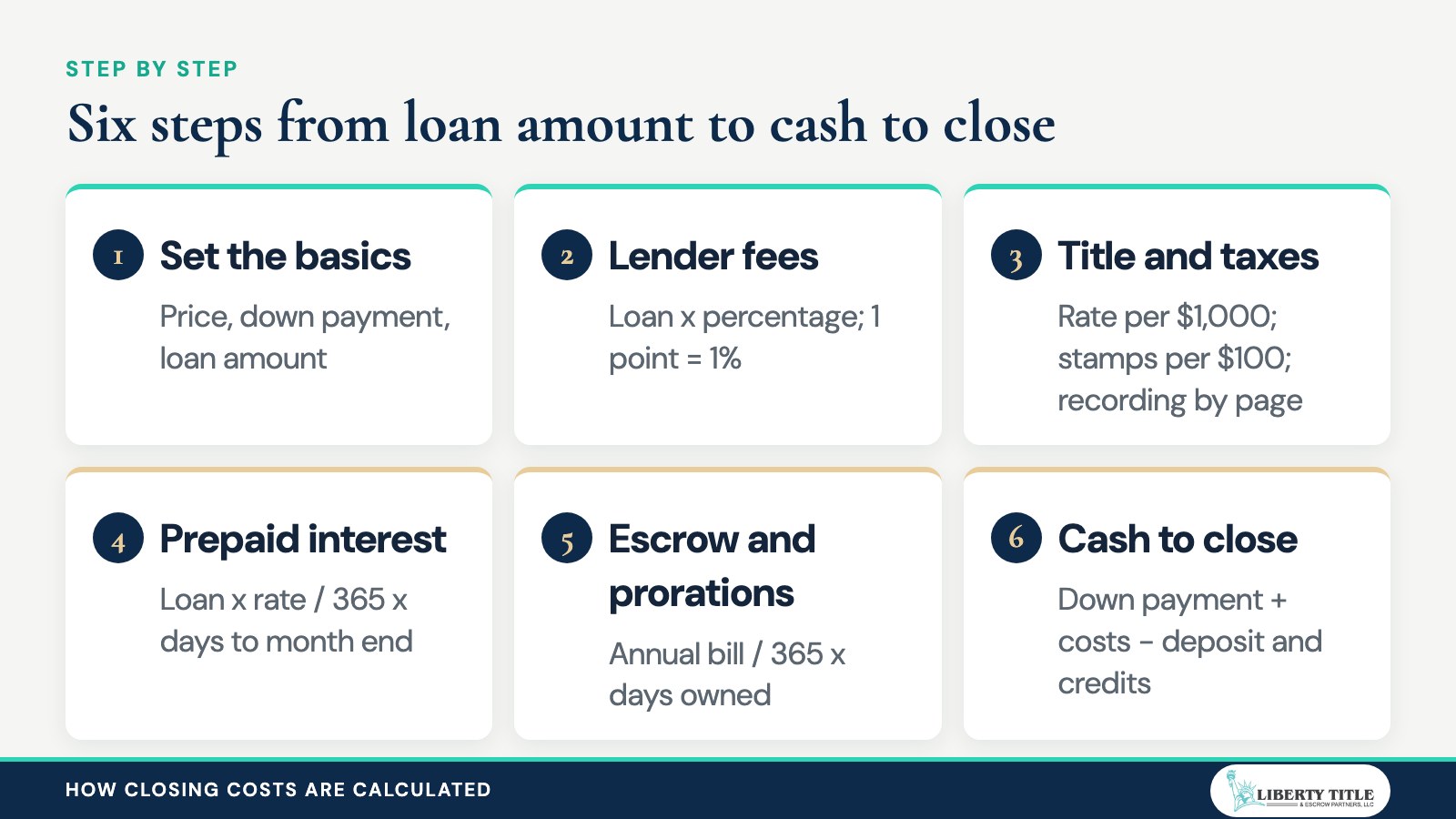
The graphic above shows the six steps as one chain. Every step except the last adds a cost, and the last step turns the total into the cash a buyer brings. Time matters here too, because the time to close affects interest and prorations.
How Are Lender Fees and Discount Points Calculated?
Lender fees are calculated as a percentage of the loan amount, and discount points follow the same rule. The Consumer Financial Protection Bureau (CFPB) says one point equals one percent of the loan amount. On a $520,000 loan, one point costs $5,200.
An origination fee works the same way. A hypothetical 0.75% origination charge on $520,000 equals $3,900, and two points equal $10,400. Lenders itemize origination charges differently, so the CFPB advises comparing the total on each Loan Estimate.
Points and origination are fees for the loan, while the next group covers the policy that protects title. Florida regulates that group by formula.
How Are Title Insurance Premiums Calculated in Florida?
Title insurance premiums in Florida are calculated by multiplying each $1,000 of coverage by a rate that the state sets. Florida Administrative Code 69O-186.003 lists the rates, so the same coverage amount produces the same premium at every licensed agent. Any fraction of $100 counts as a full $100.
Florida also sets a minimum premium of $100. A title insurance cost estimate applies these rates to a price. Policy type and prior policies change the rate, as the next sections show.
How Is Owner's Title Insurance Calculated in Florida?
Owner's title insurance in Florida is calculated at $5.75 per $1,000 up to $100,000. The next slice adds $5.00 per $1,000 up to $1 million, and higher tiers add $2.50 per $1,000 to $5 million. Rates stack tier by tier.
| Slice of coverage | Original rate | Reissue rate |
|---|---|---|
| Up to $100,000 | $5.75 | $3.30 |
| $100,000 to $1 million | Add $5.00 | Add $3.00 |
| $1 million to $5 million | Add $2.50 | Add $2.00 |
| $5 million to $10 million | Add $2.25 | Add $2.00 |
The rates in the table apply slice by slice. A $650,000 policy has $100,000 at $5.75 and $550,000 at $5.00. That math gives $575 plus $2,750, or $3,325.
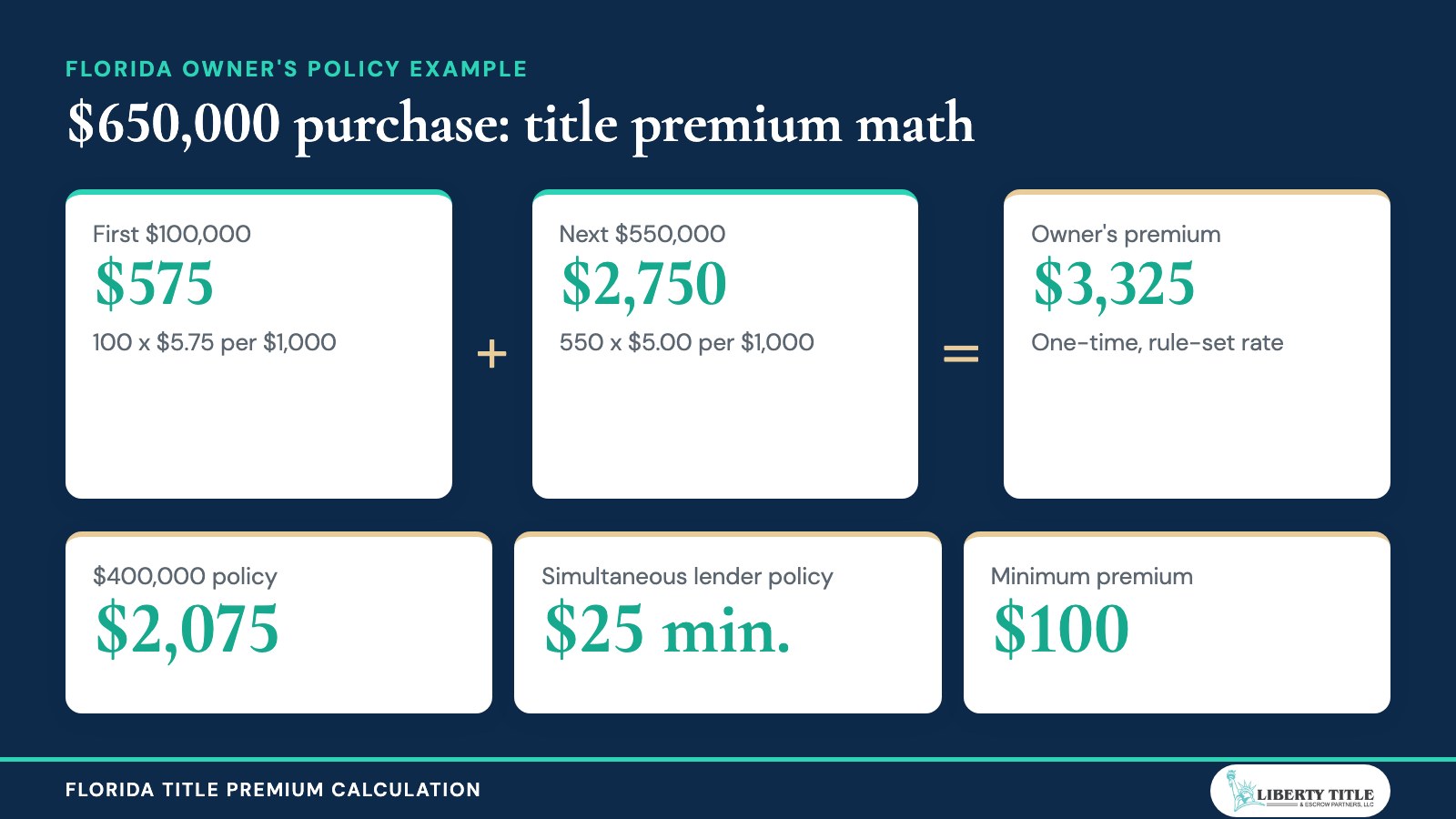
The graphic above lays out that $650,000 calculation. A policy above $1 million adds the $2.50 tier, so $1.5 million of coverage costs $575, $4,500, and $1,250, or $6,325. Florida buyers and sellers also follow an owner's policy custom that sets who pays for this coverage.
How Much Is Title Insurance on a $400,000 House?
Title insurance on a $400,000 house costs $2,075 for an owner's policy at the original Florida rate. The math is $575 for the first $100,000 plus $1,500 for the next $300,000. The result is a one-time premium of $2,075.
A reissue rate lowers the premium when the seller's prior policy qualifies. Owners pay a single premium rather than an annual bill. Total title charges can also include a search fee and settlement fee that sit outside the premium.
Is Title Insurance Based on Purchase Price or Loan Amount?
Title insurance is based on the amount of coverage. An owner's policy follows the purchase price, and a lender's policy follows the loan amount. The premium formula uses the amount of liability written. Each policy is priced from its own face amount.
The CFPB explains that a lender's policy protects the lender, not the buyer's equity. A cash buyer skips the lender's policy. Knowing title insurance protects each party explains why two premiums can appear.
What Are Reissue Rates, Minimum Premiums, and Simultaneous Issue Rates?
Reissue rates are lower title premiums, starting at $3.30 per $1,000 up to $100,000, for policies that follow a recent prior policy. The seller's owner's policy must be less than 3 years old, and the minimum premium is $100. A $450,000 policy costs $1,380 reissued, against $2,325 at original rates.
A lender's policy issued with an owner's policy uses the simultaneous issue rate. The mortgage policy costs a minimum of $25 for coverage up to the owner's policy amount. Coverage above that amount is priced at regular mortgage rates.
Refinances use the same rate rules. A refinance title policy may qualify for a reissue rate when the prior owner's policy meets the rule. A title agent confirms eligibility after the title search.
How Are Florida Documentary Stamp and Intangible Taxes Calculated?
The Florida documentary stamp tax is calculated at 70 cents per $100 of price on a deed. Mortgages pay 35 cents per $100 of debt. Fla. Stat. 201.02 sets the deed rate, and Section 201.08 sets the mortgage rate. Intangible tax is 2 mills per dollar of the mortgage, under Section 199.133.
On a $650,000 purchase, deed stamps equal $4,550. A $520,000 mortgage creates $1,820 in mortgage stamps and $1,040 in intangible tax. The purchase contract states which party pays each tax line, so both sides review it before closing.
| Tax | Base | Calculation | Amount |
|---|---|---|---|
| Deed stamps | $650,000 | $6,500 x $0.70 | $4,550 |
| Mortgage stamps | $520,000 | $5,200 x $0.35 | $1,820 |
| Intangible tax | $520,000 | $520,000 x 0.002 | $1,040 |
The table shows three tax lines with three different bases. Recording the documents adds the last government charge.
How Are Recording Fees Calculated?
Recording fees are calculated by page count, with maximum charges of $5.00 for the first page and $4.00 for each added page. Fla. Stat. 28.24 sets these amounts for the county clerk. A 3-page deed costs $13, and a 20-page mortgage costs $81.
The clerk records both documents after closing. Our guide explains when the deed recorded step happens and who handles it. Recording is a small line next to taxes and premiums.
How Is Prepaid Interest Calculated?
Prepaid interest is calculated as daily interest on the loan, from the closing date to the first payment period. The CFPB describes daily interest that accrues after the closing date. The daily amount is the loan times the rate, divided by 365.
A $520,000 loan at a hypothetical 6.25% accrues about $89.04 per day. A November 20 closing covers 11 days through November 30, so prepaid interest is $979.45 before rounding. A closing at the start of a month costs less, and some lenders use a 360-day year.
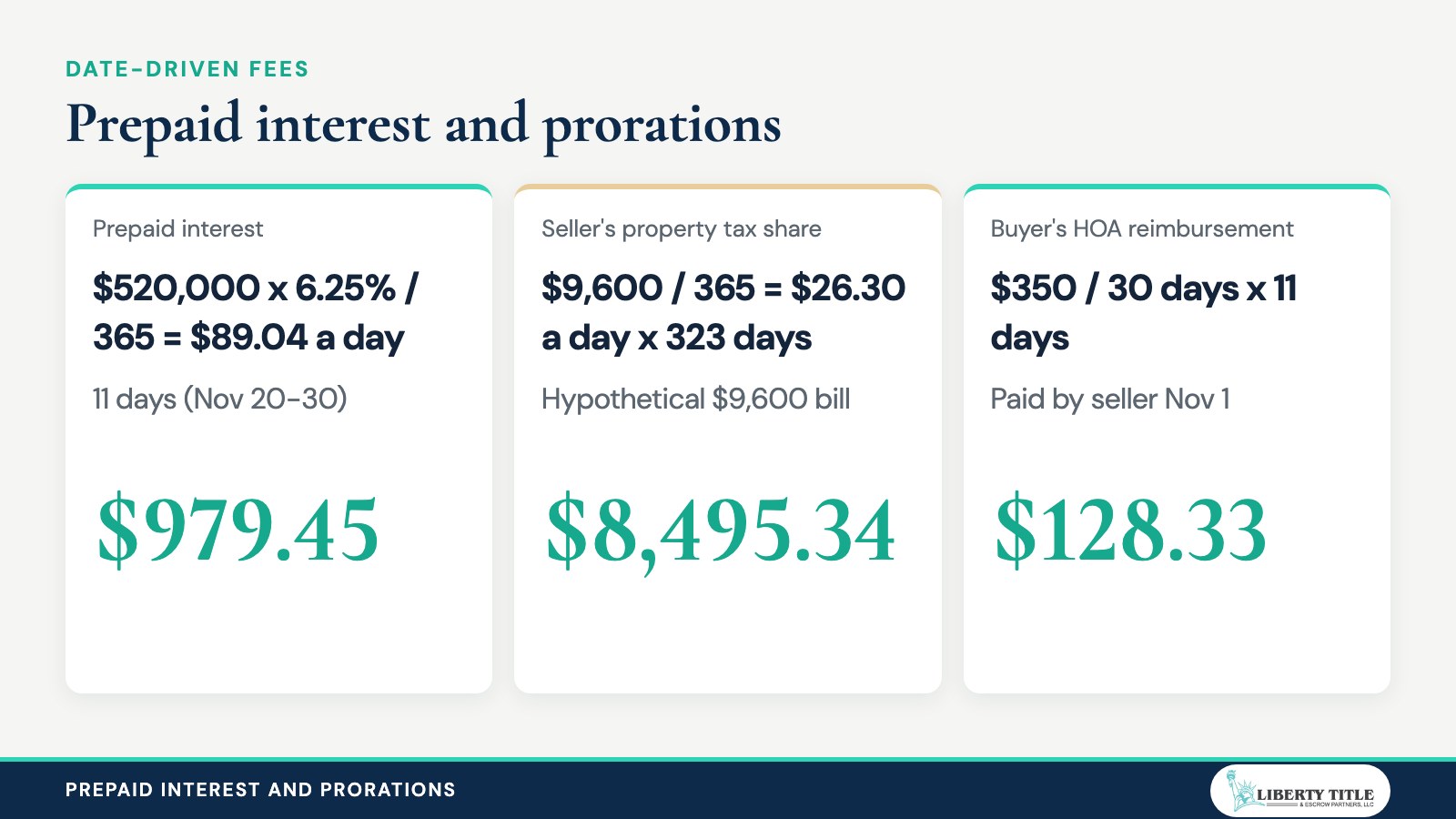
The graphic above pairs the interest formula with the proration formulas. Escrow deposits follow the same date-driven logic.
How Are Escrow Reserves Calculated?
Escrow reserves are calculated from the annual tax and insurance bills, with a lender cushion limited to one-sixth of the annual total. Federal rule 12 CFR 1024.17 sets that cap. One-sixth equals two months of payments.
Take $9,600 of taxes and $4,800 of insurance, which total $14,400 a year. The monthly escrow payment is $1,200, and the maximum cushion is $2,400. The CFPB adds that buyers usually pay the first 6 to 12 months of homeowner's insurance at or before closing.
Prepaid interest, insurance premiums, and escrow deposits can differ between the Loan Estimate and the Closing Disclosure. The CFPB says some fees can rise by any amount. The next section covers the tax prorations.
How Are Property Taxes Prorated at Closing?
Property taxes are prorated by dividing the annual bill by 365 and multiplying by the days each party owned the home. The result is a daily share for each owner. Prorated property taxes keep each side paying only for its own days.
Consider a hypothetical $9,600 annual bill, which has a daily share of about $26.30. A seller who owned 323 days of the year owes $8,495.34, credited to the buyer when the bill is unpaid. Florida county tax bills go out in November.
Fla. Stat. 197.162 sets the early-payment discount at 4% in November, 3% in December, 2% in January, and 1% in February. The contract decides the day-count method and how the discount is shared.
How Are HOA Dues and Other Prorations Calculated?
HOA dues are prorated by dividing the periodic charge by the days in the period. Multiply that daily share by the days each party owns the home. A $350 monthly assessment paid on November 1 leaves 11 of 30 days for the buyer. The buyer reimburses $128.33.
Florida also caps the HOA estoppel certificate fee at $250 with no delinquency, under Section 720.30851. Other prorations include rent and utilities. Each uses the same daily-share formula.
How Are Seller Closing Costs and Agent Commission Calculated?
Seller closing costs are calculated by multiplying the sale price by the commission rate, then adding stamps, title charges, and payoffs. Redfin puts seller costs at 1% to 3% of the price before agent compensation. A hypothetical 5% commission on $650,000 equals $32,500.
Commission rates are negotiated in the listing agreement, so no fixed formula applies. A seller net sheet lists these deductions before the contract is final. Agent partners can share that sheet, and the IRS says selling expenses reduce the amount realized.
How Is Cash to Close Calculated?
Cash to close is calculated as the down payment plus closing costs, minus the deposit, seller credits, and adjustments. The CFPB Loan Estimate uses that formula. Closing costs exclude the down payment, so the two amounts stay separate.
For example, a $650,000 purchase with 20% down has a $130,000 down payment. Add the fees from the steps above, then subtract the earnest money already paid. Learn title search charge fees, since the charge adds to the total when the buyer pays it.
Why Do Final Closing Costs Change From the Estimate?
Final closing costs change from the Loan Estimate because some fees are allowed to move. The CFPB says some fees can rise by any amount, some by 10 percent, and some not at all. Lenders must give the Loan Estimate within three business days of application.
The Closing Disclosure arrives three business days before closing. Compare it line by line against the Loan Estimate. A title agent, lender, or real estate attorney can explain any difference.
What Else Should You Know About Closing Cost Formulas?
How Much Does It Cost to Close on a $400,000 House?
Closing on a $400,000 house typically costs $8,000 to $20,000, according to Bankrate. That range is 2% to 5% of the loan amount. Actual totals depend on the fee formulas above.
How Much Does Closing Cost on a $250,000 House?
Closing on a $250,000 house costs about $5,000 to $12,500 at 2% to 5%. The calculation is $250,000 multiplied by 0.02 and by 0.05. Local fees and loan type move the result.
How Much Is a 20% Down Payment on a $300,000 House?
A 20% down payment on a $300,000 house is $60,000. The calculation is $300,000 multiplied by 0.20. Closing costs are paid on top of that amount.
Frequently Asked Questions
How Can I Calculate My Title Insurance Premium in Florida?
Multiply the first $100,000 of coverage by $5.75 per $1,000, then multiply each added $1,000 up to $1 million by $5.00. Add the results. Any fraction of $100 counts as a full $100, and the minimum is $100.
What Is the Average Cost of Title Insurance in Florida?
Florida sets the rate by formula, so cost follows the policy amount. An owner's policy on $400,000 costs $2,075 at the original rate. A reissue rate can lower that amount.
Do Discount Points Count as Closing Costs?
Yes, discount points are a closing cost paid to the lender at closing. Each point equals 1% of the loan amount. They appear in the lender fee section of the Closing Disclosure.
How Does Liberty Title Help Buyers and Sellers Check Closing Cost Math?
Liberty Title reviews each fee formula with buyers, sellers, and lenders before the closing table. We prepare settlement statements in English and Spanish, and our closing specialists apply Florida title rates, stamps, and prorations. Questions can go to +1 (305) 530-8998.
Compare the Closing Disclosure against the formulas above, and ask a title agent, lender, or tax advisor about any line. Our home loan closings service covers purchases and refinances in Florida.
Knowing how closing costs are calculated makes each settlement statement line easier to read. Lender fees come first and prorations come last. Our blog and service pages are available at LibertyTitle.us.


You May Also Like
How Closing Costs Are Calculated Step by Step


How to Estimate Closing Costs in Real Estate

Closing Costs When Buying a House and What to Expect
What a Quitclaim Deed Is and When to Use One

How to Calculate Closing Costs Before You Close

What Closing Costs Buyers Should Expect to Pay

What Is Included in Closing Costs for a Home Purchase

What Closing Costs Include for Both Buyers and Sellers

Who Pays Closing Costs in a Real Estate Transaction

Are There Closing Costs on a Home Equity Loan

Can You Roll Closing Costs into a Mortgage

Do Sellers Pay Closing Costs and How Much

What a Warranty Deed Is and How It Protects the Buyer

How Much Closing Costs Are and What They Include
























How Long to Close After Title Search for Homebuyers

How To Safely Wire Money to a Title Company

What Documents Does a Title Company Need

How Much a Title Company Charges and What You Get

How Long a Title Company Can Hold Funds After Closing

How To Do a Title Search on Property Yourself

Title Insurance in Real Estate and How It Protects You
How Long a Title Search Takes and What Causes Delays
How a Title Search Works and What It Reveals

What a Title Company Does and Why It Matters at Closing

What Is Title Insurance and Why Do You Need It