


Does a Warranty Deed Prove You Own the Property

Yes, a warranty deed proves ownership when the seller signs before two witnesses, a notary acknowledges it and the clerk records it. The recorded deed shows who holds title and gives public notice. It also lists the covenants the seller makes. The deed does not prove the title is free of defects. A title search and an owner's title insurance policy still matter.
Key Takeaways
- A signed, witnessed, delivered and recorded warranty deed is the main document that shows who owns a property.
- Florida requires two witnesses on the deed and an acknowledgment before the clerk will record it.
- An unrecorded deed is not good against later buyers or creditors who paid value and had no notice.
- A warranty deed does not prove a clean title, and the seller's promise depends on the seller's ability to pay.
- A title search and an owner's title insurance policy cover the risks the deed alone cannot.
Does a Warranty Deed Prove Ownership?
Yes, a warranty deed proves ownership once it is signed, delivered and recorded. The deed moves title from the grantor, who is the seller, to the grantee, who is the buyer. The recorded copy then sits in the public record for anyone to read.
A warranty deed also carries promises, called covenants, that the grantor owns the property and will defend the grantee against outside claims. Florida Statutes Section 689.02 sets a form. In that form, the grantor "does hereby fully warrant the title to said land". Our deed transfer closings put those documents in the right order.
Proof of ownership still has limits. The deed proves the transfer happened, not that every claim against the property is gone. The next sections show where those limits sit.
Does a Warranty Deed Prove Ownership in Florida?
Yes, a warranty deed proves ownership in Florida when it meets the state's signing, witnessing and recording rules. Section 689.01 requires a written instrument signed before two subscribing witnesses for a freehold or a term longer than 1 year. Section 689.03 treats a deed in statutory form as a warranty deed. Its full common-law covenants bind the grantor and heirs.
A deed must also be acknowledged before the clerk will record it. Section 695.03 says the signer must acknowledge the deed, or a subscribing witness must prove it. A Florida notary public or a court clerk can take the acknowledgment.
The clerk of the circuit court acts as the county recorder under Section 28.222. The clerk keeps every recorded instrument in one series called Official Records, with an alphabetical index. That index is the place to confirm a recording, as the next sections explain.
Does a Warranty Deed Transfer Ownership?
Yes, a warranty deed transfers ownership from the grantor to the grantee once the grantor delivers the signed deed. Recording then puts the transfer on public record. The deed names the parties, describes the land and states the covenants.
A special warranty deed works the same way for the transfer itself. Buyers who ask does a special warranty deed transfer ownership get a yes. The deed conveys the grantor's full interest. Its covenants cover only defects that arose during the grantor's ownership. A general warranty deed covers the property's entire history.
A quitclaim deed differs because it passes only whatever interest the grantor holds, with no covenants at all. Ownership therefore depends on both the deed type and the grantor's real title. Recording is the step that makes the transfer visible to everyone else.
Does a Warranty Deed Need to Be Recorded?
Yes, a warranty deed should be recorded. Section 695.01 says an unrecorded conveyance is not good against creditors or later purchasers who paid value and had no notice. Recording is what turns a private transfer into public notice. A buyer who skips it risks losing priority to a later claim.
Section 695.11 sets the moment of recording. An instrument counts as officially recorded when the clerk affixes the consecutive official register number. The clerk's index then lists the deed by the names of the parties.
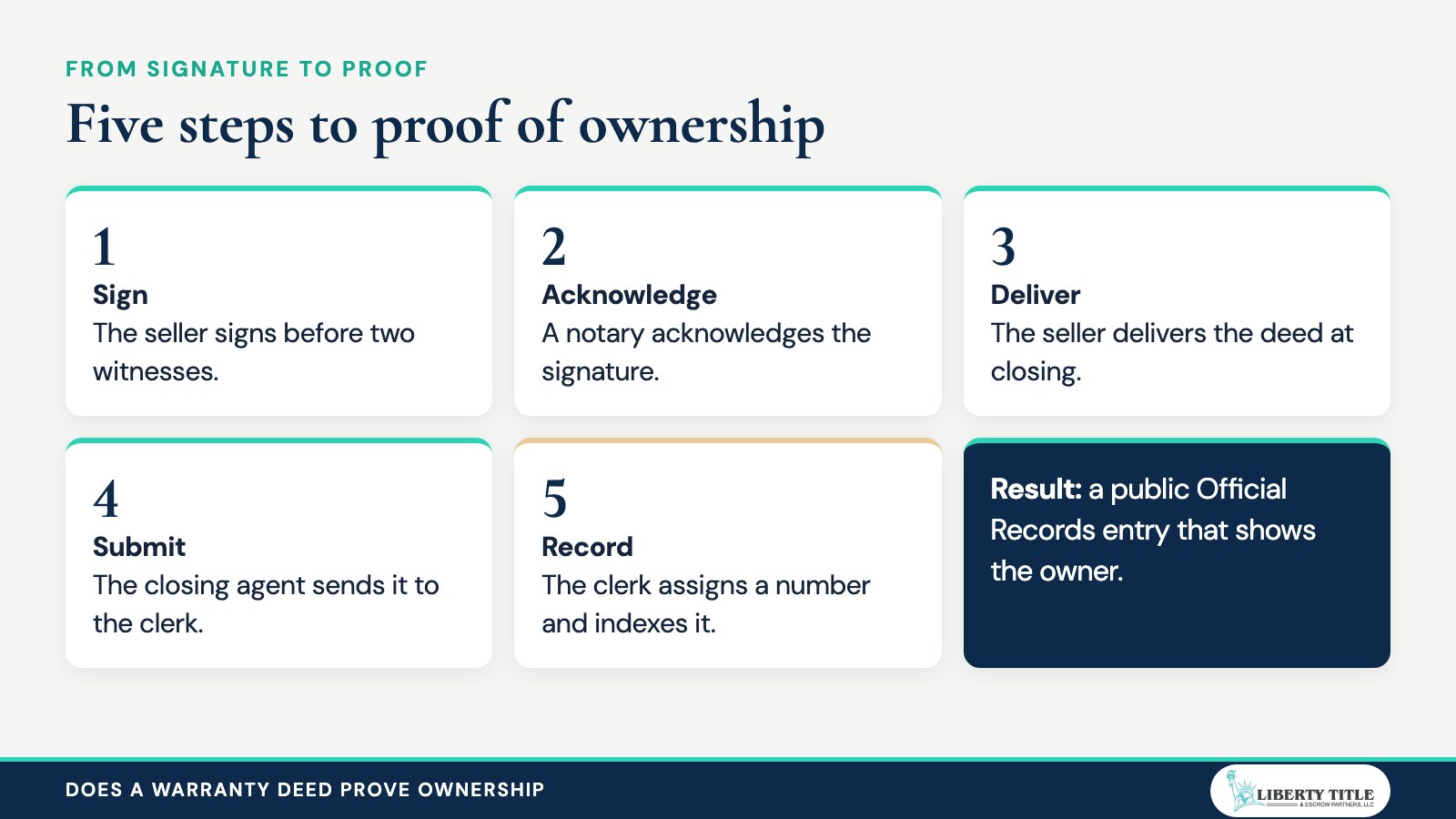
A deed moves from signature to public record in five steps.
- The seller signs the deed before two witnesses.
- A notary acknowledges the seller's signature.
- The seller delivers the deed to the buyer at closing.
- The closing agent sends the deed to the clerk with names and addresses beneath each signature.
- The clerk assigns an official register number and indexes the deed.
The graphic below shows the same five-step path from signature to Official Records.
Section 695.26 requires the names and addresses of the signers beneath their signatures, plus the preparer's name and address. Missing details can cause the clerk to reject a deed. The recording process usually runs through the title company after closing.
What Is the Difference Between a Deed and a Title?
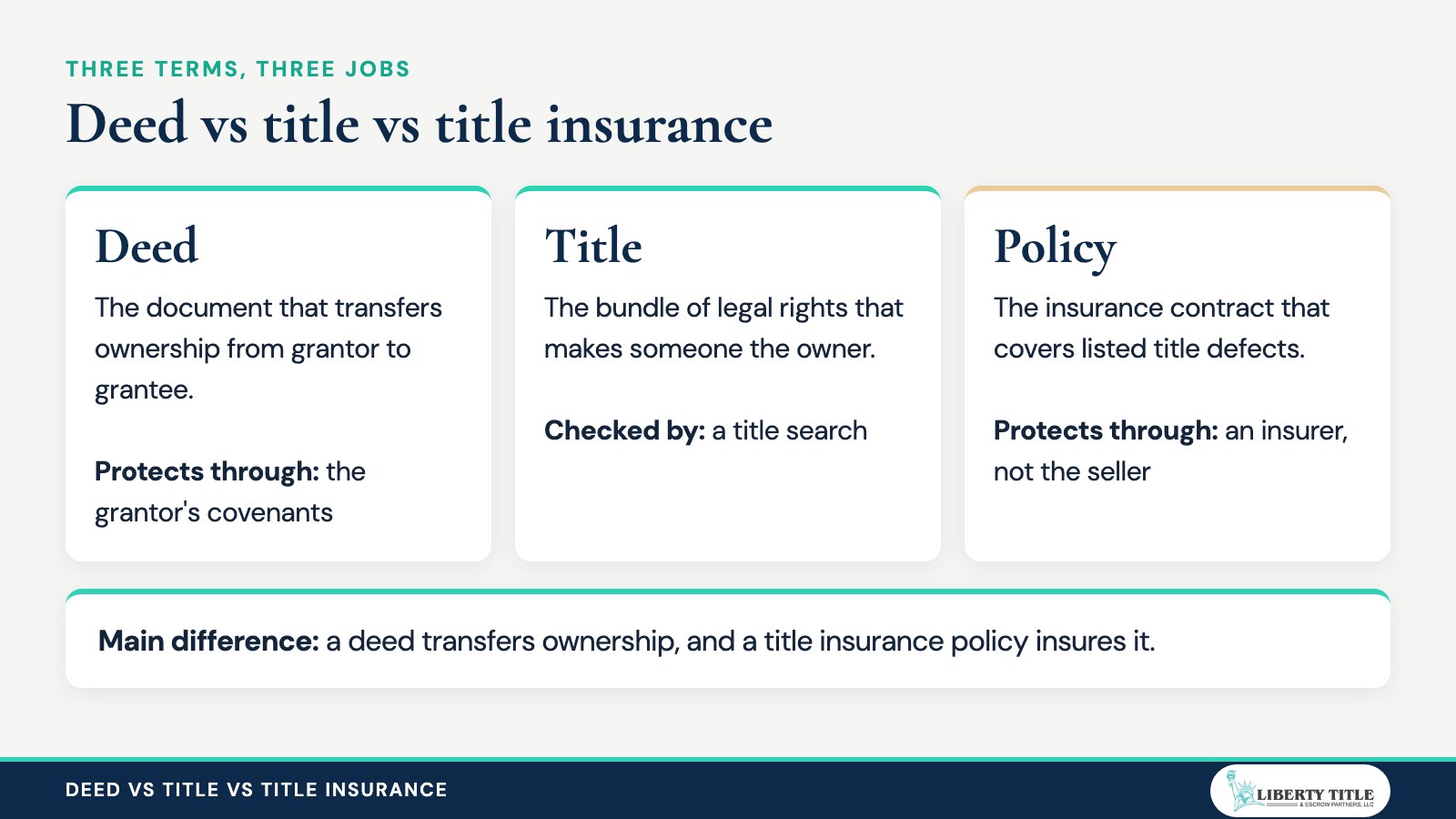
A deed is the written document that transfers ownership, and title is the legal bundle of ownership rights that the deed passes. People say "title" to mean ownership itself and "deed" to mean the paper. The two words describe different items.
A title search reads the title chain, which is the record of owners, liens and claims behind a property. A deed is only one link in that chain. The table below sets out how a deed, a title, a title insurance policy and a mortgage differ.
| Item | What It Is | What It Shows | Who It Protects |
|---|---|---|---|
| Warranty deed | Document that transfers ownership | The transfer from grantor to grantee | Grantee, through the grantor's covenants |
| Title | Bundle of legal ownership rights | Who holds the rights to the property | The owner of record |
| Title insurance policy | Insurance contract | Coverage for covered title defects | Owner or lender, depending on the policy |
| Mortgage | Lien that secures a loan | The lender's claim against the property | The lender |
The main difference is that a deed transfers ownership and a title insurance policy insures it. The graphic below compares the deed, the title and the policy side by side.
What Else Proves You Own a Property?
A recorded deed, a title search and an owner's policy together prove and protect ownership. A buyer who wonders does a warranty deed prove ownership should look at all of them. Each record answers a different question.
- The recorded deed in Official Records shows who received title and when.
- A title search shows liens, judgments and earlier owners behind the deed.
- An owner's title insurance policy shows coverage for covered title defects.
- The settlement statement from closing shows the sale price and the parties.
Section 712.02 adds a long-term layer for Florida owners. An estate vested of record for 30 years or more produces marketable record title, subject to the exceptions in the law. A buyer closing today needs a fresh records search instead of waiting 30 years.
Does a Warranty Deed Mean There Is No Mortgage?
No, a warranty deed does not mean there is no mortgage. The deed shows who owns the property, and a mortgage shows who holds a lien. The two documents are separate. Both can sit in Official Records against the same address.
A seller's covenant promises the property is free of undisclosed liens. A mortgage that the seller discloses and pays off at closing is released by the lender afterward. The title company confirms the payoff and handles removing liens that block the sale.
A buyer with a new loan signs a new mortgage on the same day as the deed. The deed names the buyer as owner, and the mortgage gives the lender a claim. Both documents are recorded together at closing.
Does the County Record Prove You Own a Property?
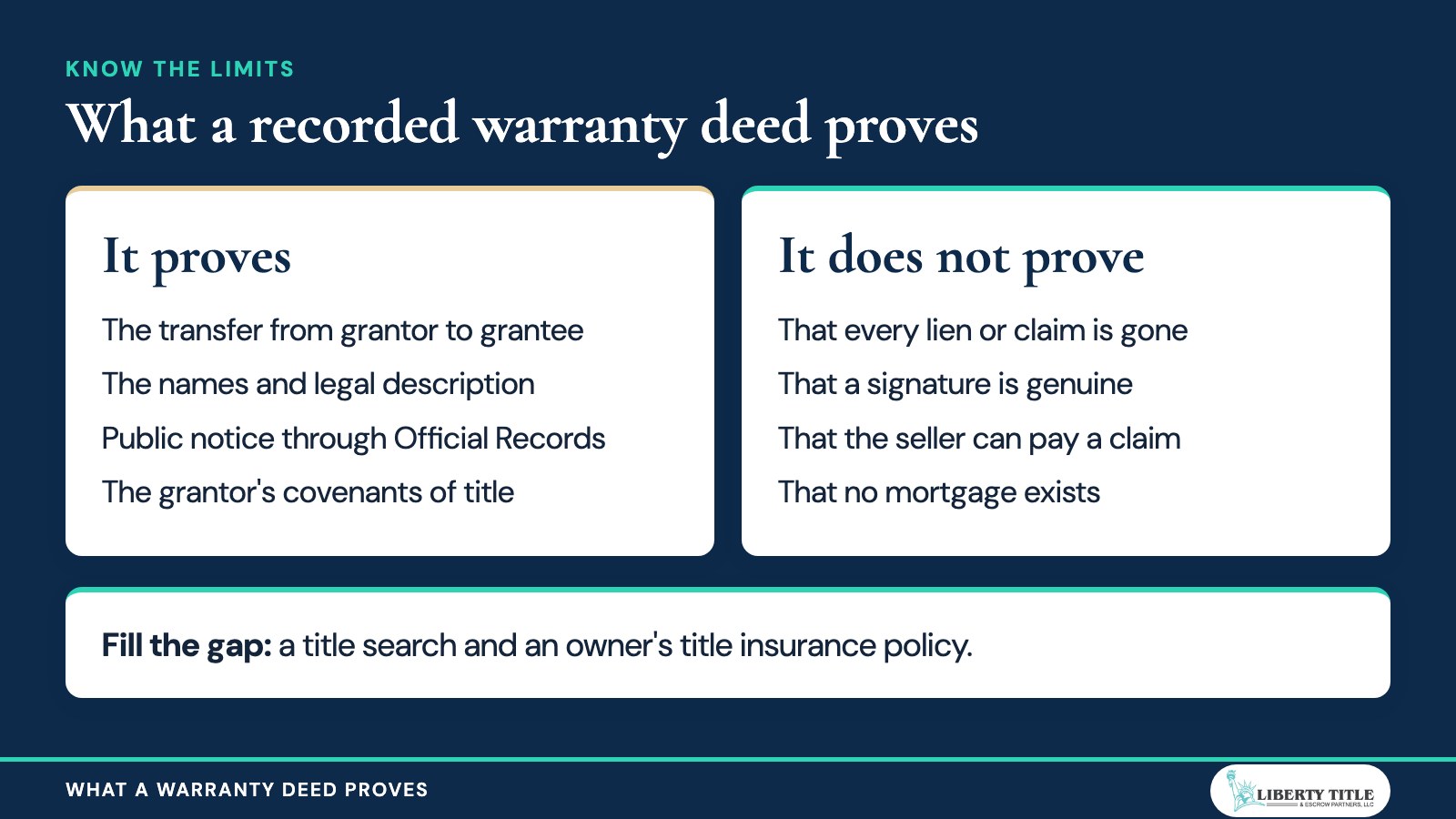
Yes, the county's Official Records prove that a deed was recorded, and recording gives public notice of the transfer. The clerk of the circuit court serves as county recorder, under Florida Statutes Section 28.222. A recording proves the transfer was filed, not that the title is free of defects.
A forged signature or an unknown heir can sit behind a clean recording. A court decides a contested deed, not the clerk. Title insurance responds to those hidden risks. Policies list covered title claims such as forged documents, undisclosed heirs and recording errors, subject to the policy terms and exclusions.
The graphic below sets out what a warranty deed proves and what it leaves open.
Does Title Insurance Prove Ownership?
No, title insurance does not prove ownership, because a policy pays for covered losses and does not transfer title. The deed shows who owns the property. The policy protects that owner against covered claims from before the purchase.
The Consumer Financial Protection Bureau (CFPB) says owner's title insurance protects the homeowner if someone sues over a pre-purchase claim. The CFPB also says lender's title insurance protects the lender, not the buyer's equity. A buyer needs the owner's policy for personal protection.
A title insurance policy sits beside the deed, not behind it. A deed gives a claim against the seller, and a policy gives a claim against an insurer. The policy covers risks the seller's promise cannot reach.
A buyer who closed without coverage should ask a title agent about an after-closing policy.
How Can You Check Who Owns a Property?
Search the county's Official Records by owner name to find the recorded deed that shows who owns a property. Section 28.222 requires the clerk to keep an alphabetical index of recorded instruments. The latest recorded deed in the chain shows the current owner of record.
A deed search shows the recorded transfer, but it does not show hidden defects. A full title search checks liens, judgments, taxes and gaps in the chain. A property records search done by yourself is a starting point, and a title agent completes it.
Realtors, lenders and buyers order that search before closing. Names, dates and legal descriptions must match across every document. A mismatch is the first sign of a problem.
How Do You Get a Copy of a Lost Warranty Deed?
Request a certified copy of the lost deed from the clerk of the circuit court in the county where the property sits. The recorded deed stays in Official Records even after the owner loses the paper copy. The clerk charges a fee set by law for copies.
The title company that handled the purchase also keeps closing records. Finding the original title company can lead to the closing file. The settlement statement lists the company and the date.
A lost paper deed does not cancel ownership. The recorded copy is the proof that counts. Owners in Miami-Dade County use the clerk's office there.
What Else Should You Know About Proving Property Ownership?
How Does a Title Agent Confirm Ownership Before Closing?
A title agent confirms ownership before closing with a title search of the Official Records and a title commitment. The search shows the vested owner, liens and judgments. Our real estate closings include that search and the review before a new deed is signed.
Can You Transfer a Deed Without a Lawyer?
Yes, an owner can sign and record a deed without a lawyer. Errors in the legal description or witnessing can cloud the title. A real estate attorney or title agent can review the draft before signing. The clerk checks form, not accuracy.
Does Paying Property Taxes Prove Ownership?
No, paying property taxes does not prove ownership, because a tax receipt shows a payment and not a transfer of title. The tax roll names the owner of record from the recorded deed. A buyer who needs proof should rely on the deed and a title search.
Does a Warranty Deed Cost Money to Record?
Yes, Section 28.24 sets maximum clerk charges of $5.00 for the first page and $4.00 for each additional page. Section 201.02 adds deed documentary stamp tax of 70 cents per $100 of consideration, so a $400,000 sale carries $2,800. A title cost estimate shows the full closing picture.
Frequently Asked Questions
What Does a Warranty Deed Look Like?
A warranty deed is a short document titled "Warranty Deed" that names the grantor and the grantee. It includes the price or consideration, the legal description and the covenant language. Signature lines, two witness lines and a notary block close the page.
What Is a Warranty Deed Used For?
A warranty deed is used to sell real estate with promises about the title. The grantor conveys the property and promises to defend the grantee against covered claims. Sales between unrelated parties are the standard use.
Can a Warranty Deed Be Wrong?
Yes, a warranty deed can contain a wrong name, a wrong legal description or a missing signature. A corrective deed or a court order can fix the error. Ask a title agent or real estate attorney before recording a fix.
How Do Two Buyers Hold Title on a Warranty Deed?
Two or more grantees take title as tenants in common unless the deed expressly provides survivorship. Tenants in common each own a share, and a share passes through the owner's estate. Spouses who want survivorship must state it in the deed.
How Does Liberty Title Help Owners Confirm Their Deed and Title?
Liberty Title is a title and escrow company that runs the title search, issues owner's policies and handles recording at closing. Our team serves buyers, sellers, realtors and lenders in English and Spanish. Each deed and policy gets checked against the public record.
The answer to does a warranty deed prove ownership comes from the deed, the record and the policy working together. Our Liberty Title agents review names, legal descriptions and liens before documents are signed. Property owners can call +1 (305) 530-8998 for general guidance.
Every case differs, so talk to your title agent, real estate attorney, lender or tax advisor about your own deed.


You May Also Like

How Closing Costs Are Calculated Step by Step


How to Estimate Closing Costs in Real Estate

Closing Costs When Buying a House and What to Expect
What a Quitclaim Deed Is and When to Use One
Does a Warranty Deed Prove You Own the Property

How to Calculate Closing Costs Before You Close

What Closing Costs Buyers Should Expect to Pay

What Is Included in Closing Costs for a Home Purchase

What Closing Costs Include for Both Buyers and Sellers

Who Pays Closing Costs in a Real Estate Transaction

Are There Closing Costs on a Home Equity Loan

Can You Roll Closing Costs into a Mortgage

Do Sellers Pay Closing Costs and How Much

What a Warranty Deed Is and How It Protects the Buyer

How Much Closing Costs Are and What They Include

























How Long to Close After Title Search for Homebuyers

How To Safely Wire Money to a Title Company

What Documents Does a Title Company Need

How Much a Title Company Charges and What You Get

How Long a Title Company Can Hold Funds After Closing

How To Do a Title Search on Property Yourself

Title Insurance in Real Estate and How It Protects You
How Long a Title Search Takes and What Causes Delays
How a Title Search Works and What It Reveals

What a Title Company Does and Why It Matters at Closing

What Is Title Insurance and Why Do You Need It