


Do Sellers Pay Closing Costs and How Much

Yes, sellers pay closing costs, and the settlement agent deducts them from the sale proceeds at closing. Seller closing costs include the agent commission, Florida's deed stamp tax of 70 cents per $100, any mortgage payoff, and prorated bills. A seller can also agree to cover part of the buyer's costs through seller concessions, which lenders cap by loan type.
Key Takeaways
- Sellers pay closing costs out of sale proceeds, so a seller with equity brings no cash to the table.
- Florida taxes a deed at 70 cents per $100 of price, so a $400,000 sale carries $2,800 in deed stamps.
- The listing agreement sets the commission, and the sales contract assigns the other fees.
- Seller concessions to a buyer are capped by loan type, from 2% to 9% of the price.
- A title agent produces the seller's settlement statement before closing day.
Do Sellers Pay Closing Costs When They Sell a House?
Sellers pay closing costs because a seller owes the costs of selling that the contract and local law assign. The settlement agent subtracts those costs from the seller's proceeds, so the seller receives a net figure after closing. Every figure appears on the settlement statement.
The seller's side of a sale has its own set of fees. Sellers handle the payoff of their loan, the transfer of the deed, and the release of liens. A title agent coordinates these steps through our closing for sellers and buyers alike, so the numbers reconcile at the table.
The buyer pays a different set of fees, mostly tied to the new loan. The next section lists the seller's costs one by one.
What Closing Costs Do Sellers Pay?
The closing costs sellers pay fall into six groups: commission, deed taxes, title charges, payoffs, prorations, and association fees. Each group appears as a line on the seller's settlement statement. The sales contract decides which party owes each item. The list below describes seller items, not a fixed rule.
- Agent commission, set in the listing agreement and negotiable between seller and brokerage.
- Documentary stamp tax on the deed, at 70 cents per $100 of price under Section 201.02.
- Owner's title insurance premium, when the contract assigns that cost to the seller.
- Payoff of the existing mortgage, home equity line, and any recorded liens.
- Prorated property taxes and association dues for the days the seller owned the home.
- Association estoppel certificate fee, when the home sits in an HOA or condominium.
The IRS treats commissions and legal fees as selling expenses in Publication 523. Selling expenses reduce the sale price when a seller figures the amount realized, which affects the tax result. A tax advisor can apply that rule to a specific sale.
These six groups apply across the country, but Florida adds its own tax rules, covered next.
Do Sellers Pay Closing Costs in Florida?
Sellers pay closing costs in Florida just as in other states. The state adds a deed stamp tax of 70 cents per $100 of consideration. Section 201.02 of the Florida Statutes sets that rate. The sales contract names the payer, and this guide counts the tax as a seller cost because the seller signs the deed.
Florida also promulgates title insurance premiums by rule. Florida Administrative Code 69O-186.003 sets the owner's policy rate at $5.75 per $1,000 up to $100,000 of liability. The rule adds $5.00 per $1,000 from $100,000 to $1 million. Florida sellers and buyers share the question of who pays that premium. Our guide on owner's title cost explains the answer.
Rate and custom together shape the dollar total, which the next section calculates.
How Much Do Sellers Pay in Closing Costs?
How much do sellers pay in closing costs depends on three numbers: the commission rate, the sale price, and the contract terms. On a $400,000 sale, deed stamps alone come to $2,800 and a promulgated owner's policy comes to $2,075. A 5% commission adds $20,000 in this illustration.
The table below shows that $400,000 example. The 5% commission is an assumed rate for the arithmetic, not a market rate, and each seller negotiates their own. Local costs vary by county, contract, and lender.
| Cost | How it is figured | Amount |
|---|---|---|
| Agent commission | 5% assumed rate x $400,000 | $20,000 |
| Deed stamp tax | $0.70 per $100 x 4,000 | $2,800 |
| Owner's title policy | $5.75 x 100 plus $5.00 x 300 per $1,000 | $2,075 |
| HOA estoppel certificate | Statutory cap with no delinquency | $250 |
| Total of these four lines | Sum of the rows above | $25,125 |
The four lines total $25,125, or 6.28% of the price. Payoffs, prorations, and repairs come on top, and they depend on the home.
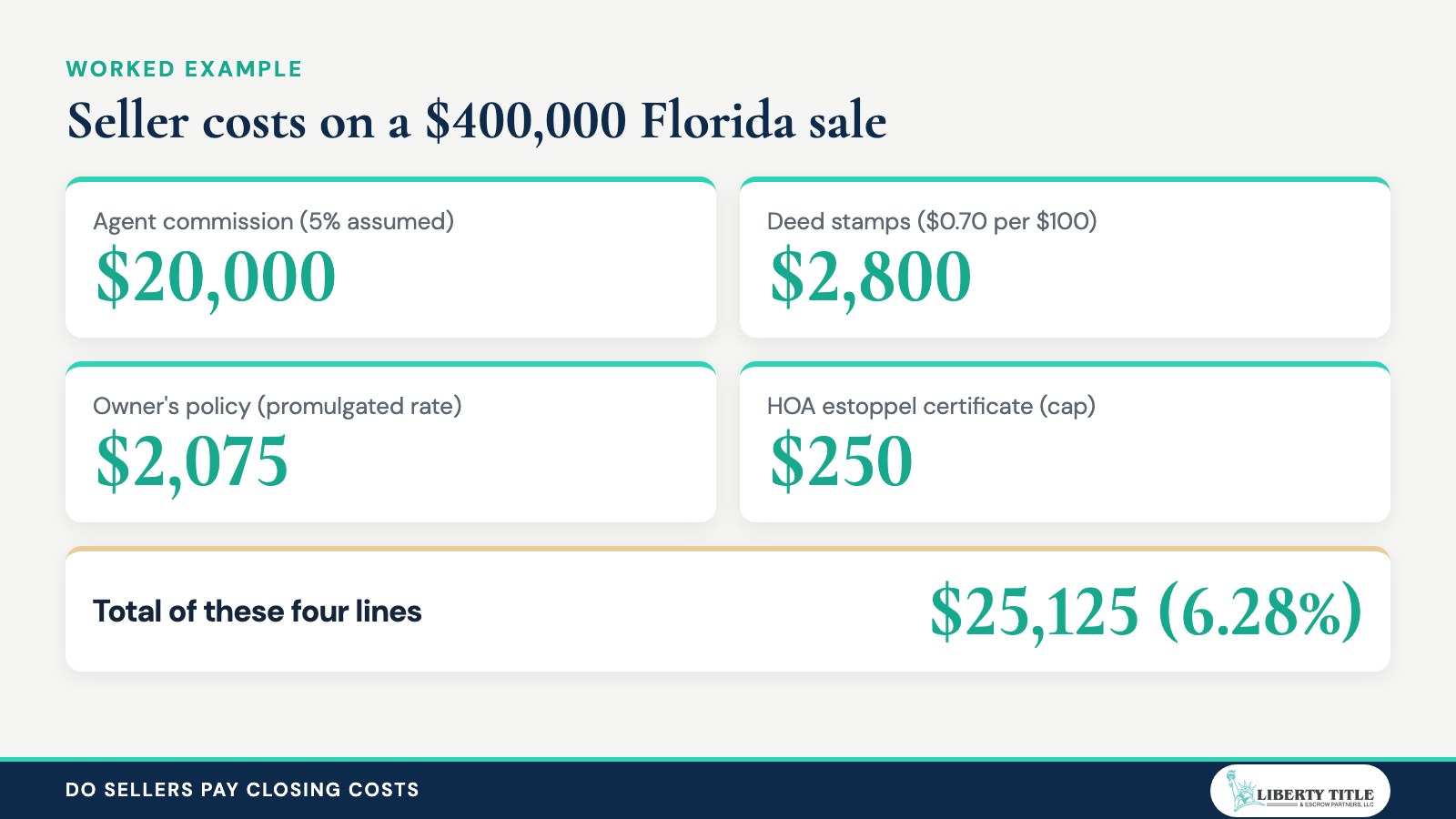
The graphic above shows the same $400,000 example as a set of callouts. The total only matters once the seller sees how the money moves, which comes next.
How Do Sellers Pay Closing Costs?
Sellers pay closing costs by having the settlement agent deduct them from the sale proceeds. The agent collects the buyer's funds, pays the seller's costs, and wires the remainder to the seller. A seller with equity therefore brings no cash to closing.
A seller with little equity can face a shortfall. The payoff and commission may exceed the proceeds, and the seller then brings the difference. Our residential sale closings team reviews the payoff figure early so no shortfall surprises the seller.
The deduction happens on closing day, so timing matters next.
When Do Sellers Pay Closing Costs?
Sellers pay closing costs on the closing date, when the settlement agent disburses funds. The seller signs the deed and settlement statement, and the costs leave the proceeds at that moment. Some items, such as the estoppel certificate, are ordered and paid earlier.
Two deadlines affect timing. A mortgagee must deliver a payoff letter within 10 days of the seller's written request under Section 701.04. An association must issue an estoppel certificate within 10 business days under Section 720.30851. Our article on seller documents lists what the title agent collects from a seller.
Some sellers also pay costs for the buyer, which raises the next question.
Why Would a Seller Pay Closing Costs for the Buyer?
A seller pays closing costs for the buyer to win an offer, close faster, or avoid a price cut. These payments are called seller concessions. They appear on the Closing Disclosure as a Seller Credit or Seller Paid line items. The Consumer Financial Protection Bureau (CFPB) describes both formats.
A 2025 Clever Real Estate survey of 783 sellers found 80% made concessions to buyers, averaging $5,277. The survey polled adults who sold between 2023 and 2025, so it reflects a small online sample. A concession lowers the seller's net, so sellers weigh it against a lower price. Some sellers also pay the buyer's owner's policy, and our article on seller title premiums covers the custom and its reasons.
Lenders cap concessions, and the caps vary by loan, as the next section shows.
Can a Seller Pay All of the Buyer's Closing Costs?
Yes, a seller can pay all of the buyer's closing costs only up to the loan program's concession cap. Fannie Mae limits seller contributions to 3%, 6%, or 9% of the price on a primary residence, depending on the loan-to-value ratio. The limit is 2% for an investment property.
The Federal Housing Administration (FHA) permits contributions of up to six percent of the sales price. The table below compares these caps and shows the dollar limit on a $400,000 price.
| Loan type | Cap on seller contributions | Dollar limit |
|---|---|---|
| Conventional, loan-to-value above 90% | 3% of price | $12,000 |
| Conventional, loan-to-value 75.01% to 90% | 6% of price | $24,000 |
| Conventional, loan-to-value 75% or less | 9% of price | $36,000 |
| Conventional investment property | 2% of price | $8,000 |
| FHA loan | Up to 6% of price | $24,000 |
The caps come from Fannie Mae's Selling Guide and a HUD notice. The lender applies them to the lower of price or appraisal. Buyers on buyer-side closings see the credit on their own Closing Disclosure. A cash buyer faces no lender cap.
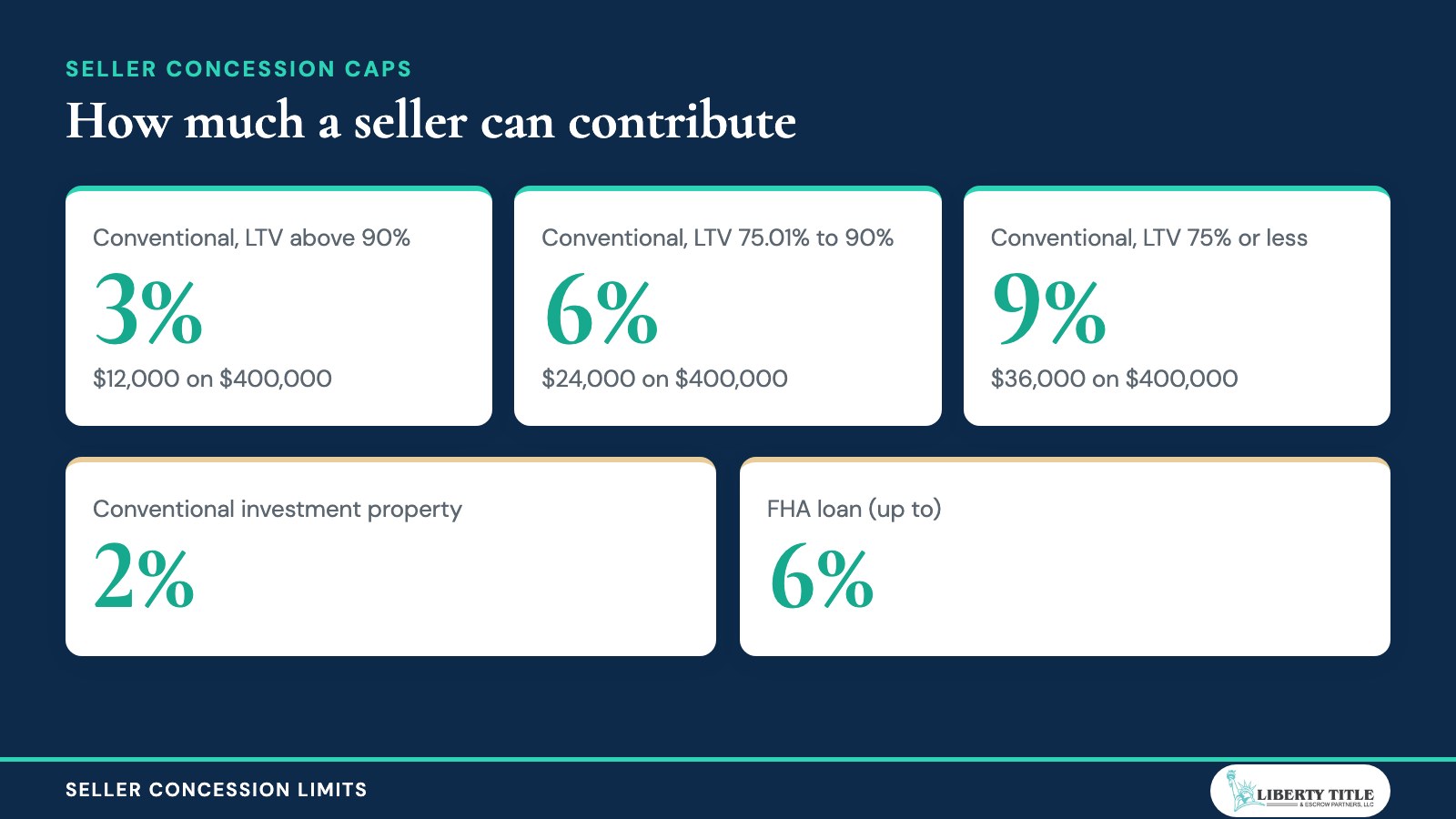
The graphic above shows each cap as a percentage of price. Buyers who want a credit must first ask, which the next section covers.
How to Get Sellers to Pay Closing Costs?
Ask for seller concessions in the written offer, stated as a dollar amount or a percentage of the price. The purchase contract then binds the seller to the credit if the deal closes. A buyer's agent can propose the amount alongside the price.
Three steps make the request clear:
- Confirm the concession cap for the buyer's loan type with the lender.
- State the credit in the offer as a fixed dollar amount.
- Compare the offer with a lower price and no credit, since each changes the seller's net.
The seller may counter with a higher price or a smaller credit. A buyer's agent and a title agent can model each version. Our realtor title support page explains how agents work with us.
What If the Seller Won't Pay Closing Costs?
A seller who won't pay closing costs for the buyer owes nothing extra, since the contract controls. No law forces a seller to give a credit. The buyer can pay the costs, ask for a lower price instead, or look at a lender credit.
A lender credit raises the interest rate on the loan, so the buyer weighs it against paying cash. A seller can also decline while still paying the seller's own costs. Our home closing team keeps the two sets of costs separate on each statement.
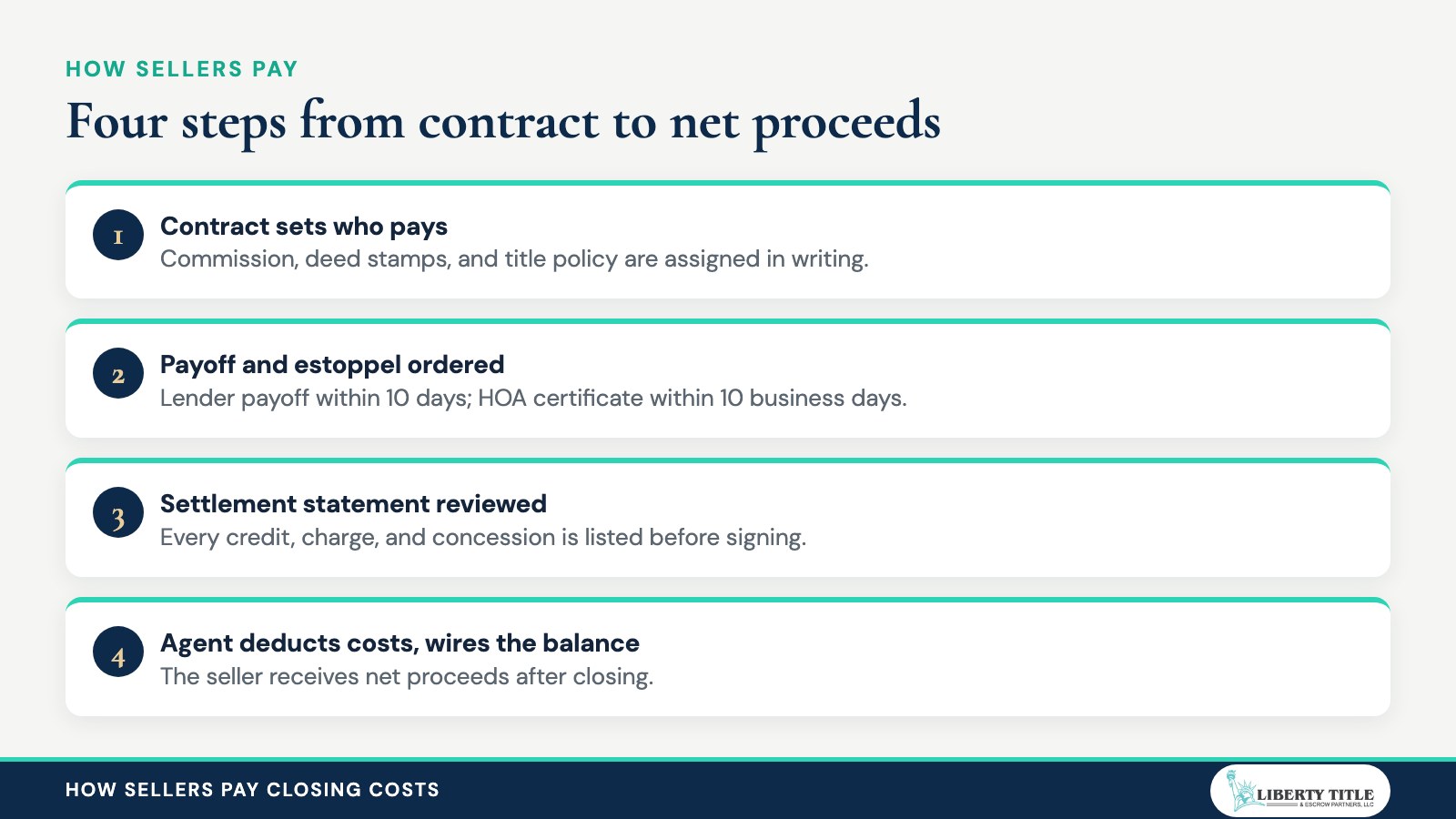
The graphic above walks through the payout steps from contract to wire. The grouped questions below cover related seller costs.
What Else Should Sellers Know About Closing Costs?
Do Sellers Pay Closing Costs Out of Pocket?
No, sellers pay closing costs out of proceeds when the sale leaves equity after the payoff. The settlement agent deducts each fee before wiring the balance. A seller with a large payoff may need to bring funds. Ask for an estimate early through our title insurance estimate tool.
Do Sellers Need a Title Company to Close?
A seller needs a closing agent to record the deed and distribute funds, though the agent type depends on the sale. Our guide to a seller title company covers the role.
Who Pays for the Title Search?
The sales contract assigns the title search cost to one party, so check the contract terms before closing.
Does the Seller Get a Closing Statement?
Yes, the seller receives a settlement statement listing every credit and charge. The statement shows the sale price, payoffs, fees, and net proceeds. Our settlement agent role article explains who prepares it.
Do Foreign Sellers Face Extra Withholding?
Yes, a foreign seller can face federal withholding. The IRS says the FIRPTA withholding rate generally is 15% of the amount realized. A tax advisor can confirm exemptions and reduced rates for a specific seller.
Do Closing Costs Lower the Seller's Taxes?
Selling expenses reduce the amount realized, according to IRS Publication 523. The publication lists commissions and legal fees as examples. A tax advisor can apply these rules to a specific sale.
Who Records the Deed After the Sale?
The closing agent records the deed with the county clerk after closing. The recording confirms the transfer and triggers deed tax payment. Our article on recorded deed covers the steps.
Frequently Asked Questions
Does a Seller Need a Payoff Letter Before Closing?
Yes, a seller with a mortgage needs a payoff letter before closing, so the closing agent knows the exact balance to pay. Under Florida Statutes Section 701.04, the mortgage holder must deliver that letter within 10 days of a written request. The payoff then comes out of the seller's proceeds.
Are Sellers Paying Closing Costs in 2026?
Sellers continue to make concessions in some sales. A Clever Real Estate survey of sellers from 2023 to 2025 found 80% made concessions averaging $5,277. Ask a listing agent for local figures.
Do Buyers or Sellers Pay Closing Costs?
Both pay closing costs, and each pays a different set. Buyers pay loan and lender-related fees, and sellers pay commission, deed stamps, and payoffs. The sales contract assigns the shared items.
Can a Buyer Pay the Seller's Closing Costs?
Yes, the contract can assign a seller cost to the buyer if both agree in writing. Such an arrangement changes the net amounts for each side. A real estate attorney can review the contract terms.
Can a Seller Pay Closing Costs with a Lender Credit?
A seller uses sale proceeds to pay seller costs, and lender credits belong to the buyer's loan. The two programs stay separate on the Closing Disclosure. A lender can explain the buyer's credits.
Is $20,000 in Closing Costs a Lot for a Seller?
The amount depends on the price, since commission scales with price. On a $400,000 sale, a 5% commission alone is $20,000 in this guide's illustration. Compare the full settlement statement rather than one number.
How Does Liberty Title Help Sellers Review Their Closing Costs?
Closing day runs smoothly when the numbers are settled early. Our Liberty Title closers prepare the settlement statement, order payoffs, and coordinate the deed. The team serves sellers, buyers, realtors, and lenders in English and Spanish from its Miami office. Call +1 (305) 530-8998 to ask about a file.
Closing costs for sellers follow the contract, state tax rules, and lender caps. Talk to your title agent, real estate attorney, lender, or tax advisor about a specific sale. We also review the title service fees that apply to a sale and explain each line.


You May Also Like
Do Sellers Pay Closing Costs and How Much


What a Warranty Deed Is and How It Protects the Buyer
How Much Closing Costs Are and What They Include






















How Long to Close After Title Search for Homebuyers

How To Safely Wire Money to a Title Company

What Documents Does a Title Company Need

How Much a Title Company Charges and What You Get
How Long a Title Company Can Hold Funds After Closing

How To Do a Title Search on Property Yourself

Title Insurance in Real Estate and How It Protects You
How Long a Title Search Takes and What Causes Delays
How a Title Search Works and What It Reveals

What a Title Company Does and Why It Matters at Closing

What Is Title Insurance and Why Do You Need It