


Closing Costs When Buying a House and What to Expect
Closing costs when buying a house run 2% to 5% of the price, according to Redfin. That equals $6,000 to $15,000 on a $300,000 home. The lender sends the estimate within three business days of your application. The final figures arrive three business days before closing. The down payment stays separate, and the buyer pays the remaining balance on closing day.
Key Takeaways
- Buyer closing costs run 2% to 5% of the purchase price, or $5,000 to $12,500 on a $250,000 home.
- The Loan Estimate arrives within three business days of your application, and the Closing Disclosure arrives three business days before closing.
- The Consumer Financial Protection Bureau (CFPB) lets some fees rise by any amount, some by 10 percent, and some not at all.
- Seller credits, lender credits, and assistance programs can lower the cash you bring to closing.
- Cash to close adds the down payment to the closing costs and subtracts your earnest money deposit.
What Are Closing Costs When Buying a House?
Closing costs when buying a house are the upfront fees and taxes a buyer pays to obtain the loan and transfer ownership. The CFPB defines the total as the upfront costs of the loan and the transaction, excluding your down payment. Those costs cover lender charges, title and settlement services, government taxes, and prepaid items.
The TILA-RESPA Integrated Disclosure (TRID) rule created two standard forms that itemize these costs, the Loan Estimate and the Closing Disclosure. The lender, the title agent, and the escrow officer each contribute figures to those forms. The buyer, the seller, and the real estate agents then review the totals before closing.
The title and escrow agent collects these funds, and buyers can review each line through our residential home buying services before signing. The next section puts a dollar range on those fees.
How Much Are Closing Costs When Buying a House?
Closing costs when buying a house run 2% to 5% of the purchase price, according to Redfin. That range equals $5,000 to $12,500 on a $250,000 home. On a $300,000 home, the same range equals $6,000 to $15,000.
The title, settlement, recording, and transfer-tax side is smaller. National Mortgage News reported that purchase closing costs from 2025 quotes average 1.04% of the sales price, or $4,528 nationally. That LodeStar sample excludes lender origination fees, points, and prepaid items, so the full total runs higher.
Florida law adds taxes to that total. The state taxes the deed at 70 cents per $100 of consideration under Florida Statutes Section 201.02. A mortgage adds documentary stamps of 35 cents per $100 of debt under Section 201.08. Intangible tax adds 2 mills per dollar under Section 199.133. Local costs vary by lender, loan type, and county. The next section shows who pays these amounts.
Who Pays Closing Costs When Buying a House?
The buyer pays the lender, appraisal, prepaid, and loan-related charges, and the purchase contract decides whether the seller covers any share. Zillow's 2025 housing trends report says buyers reported sellers agreed to pay some (23%) or all (44%) of their closing costs. A seller credit appears on the Closing Disclosure as a Seller Credit line.
The owner's title insurance premium is one line the contract assigns, as this breakdown of owner's policy payers in Florida shows. Next, the timeline shows when each payment falls due.
When Do You Pay Closing Costs on a House?
You pay closing costs on a house in five stages, and the main payment, cash to close, comes on closing day. The numbered steps below follow a financed purchase from contract to keys.
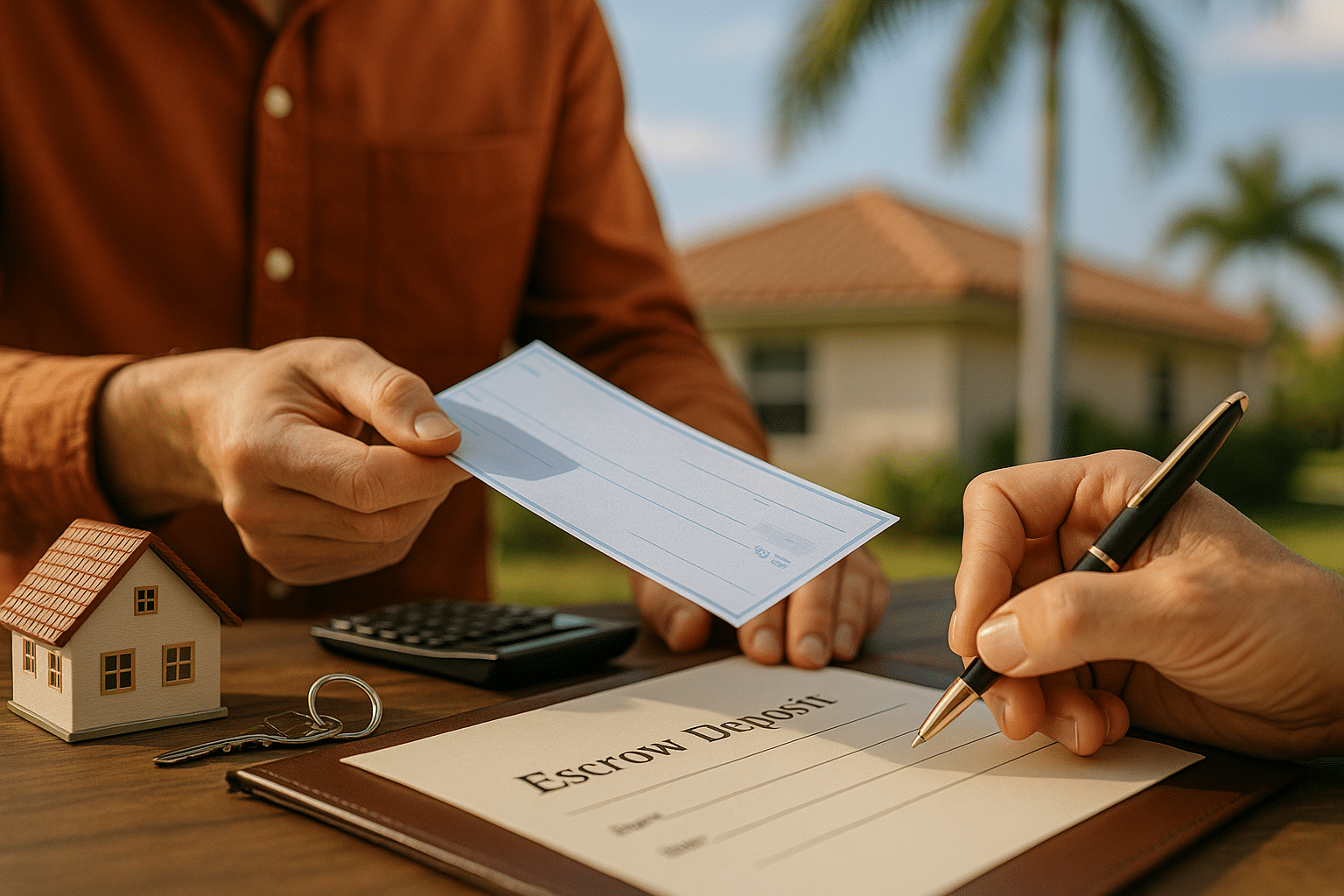
- Offer accepted: the buyer deposits earnest money, about 1% to 3% of the price, with the escrow agent.
- Application: the lender sends the Loan Estimate within three business days of receiving the application.
- Inspection and appraisal: the buyer pays each provider at the time of service, according to Zillow.
- Closing Disclosure: the lender delivers the final figures three business days before closing.
- Closing day: the buyer delivers cash to close by cashier's check or wire transfer.
Buyers also prepay certain items at closing, including interest, property insurance premiums, and initial escrow deposits. Prepaid interest covers the days between the closing date and the first loan payment period. A closing date late in the month shortens that stretch, which explains the date tip in the savings list below.
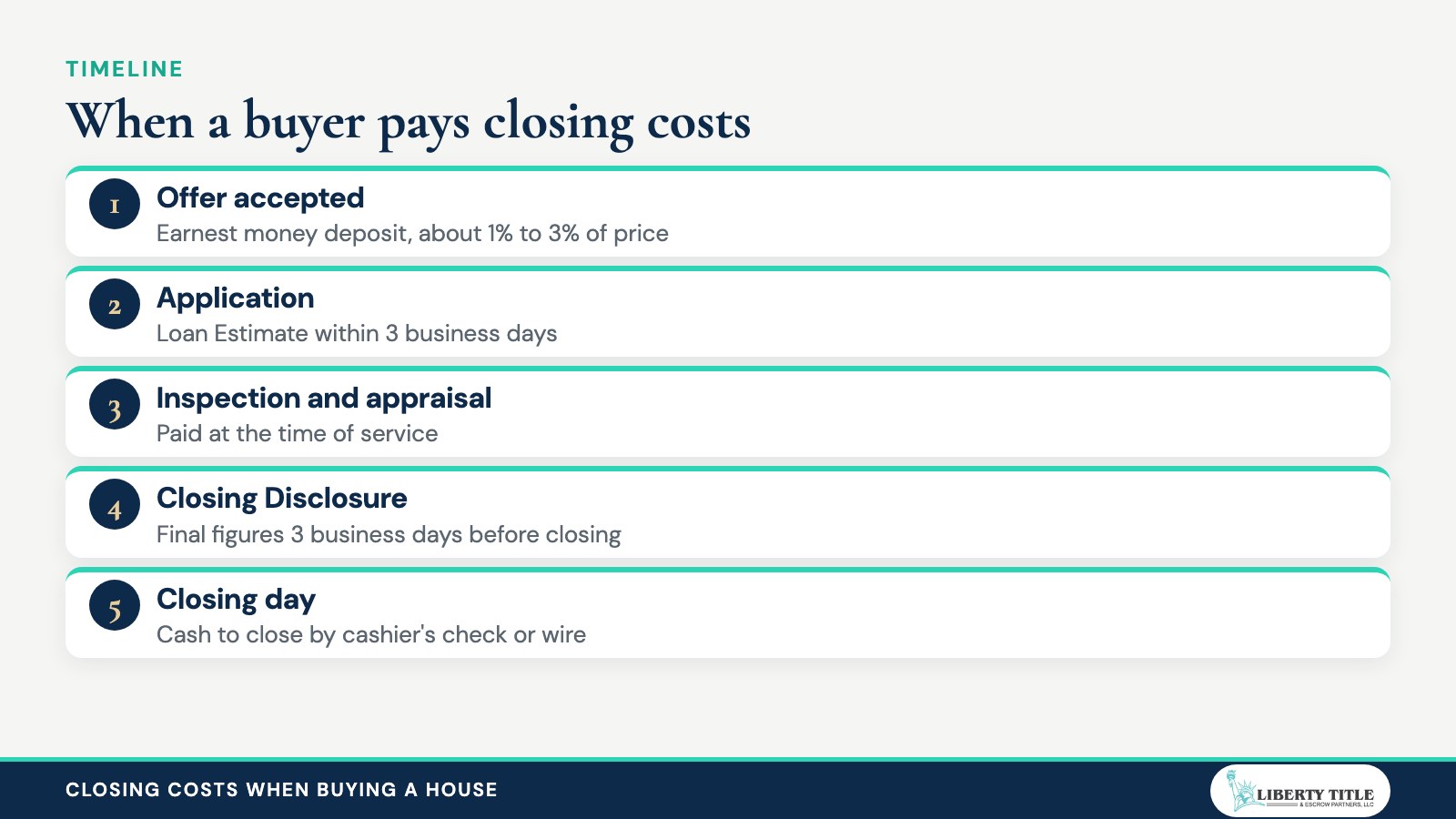
The graphic above shows the same five stages in order. Total time from contract to keys moves each payment, as this guide to closing time at a title company explains. The next section explains how to estimate the total before you apply.
How to Estimate Closing Costs When Buying a House
Estimate closing costs when buying a house by reading the Loan Estimate the lender sends after your application. The CFPB says all lenders must use the same standard form, which makes offers easy to compare. Request Loan Estimates from several lenders, as the CFPB advises.
Before applying, a buyer can apply the 2% to 5% range to the price for a rough figure. The free title cost estimate tool prices the title insurance line. The table below shows how the two federal forms differ.
| Feature | Loan Estimate | Closing Disclosure |
|---|---|---|
| Main difference | Estimates costs before approval | Confirms final costs before closing |
| Timing | Within three business days of application | Three business days before closing |
| Purpose | Compares lender offers | Confirms the loan terms match |
| Buyer action | Request one from several lenders | Compare each line with the estimate |
The Loan Estimate lists the loan terms, the projected payments, and the estimated cash to close on its first page. Pages two and three itemize lender charges, services the buyer may shop for, taxes, and prepaids. The lender has not approved the loan when this form arrives, so the buyer decides whether to move forward.
The Closing Disclosure should match the Loan Estimate, and the next section covers the limits when it does not.
Can Closing Costs Change Between the Loan Estimate and Closing?
Yes, closing costs can change between the Loan Estimate and closing, but the CFPB groups fees into three tolerance categories. Some fees can rise by any amount, some by up to 10 percent, and some not at all. The groups below follow the CFPB list.
- Any amount: prepaid interest, property insurance premiums, and initial escrow deposits.
- Up to 10 percent in total: recording fees and required services chosen from the lender's written list.
- No increase: fees paid to the lender or broker, and transfer taxes.
A change in circumstances, such as a new loan type or a different appraisal result, lifts these limits. The lender then issues a revised Loan Estimate.
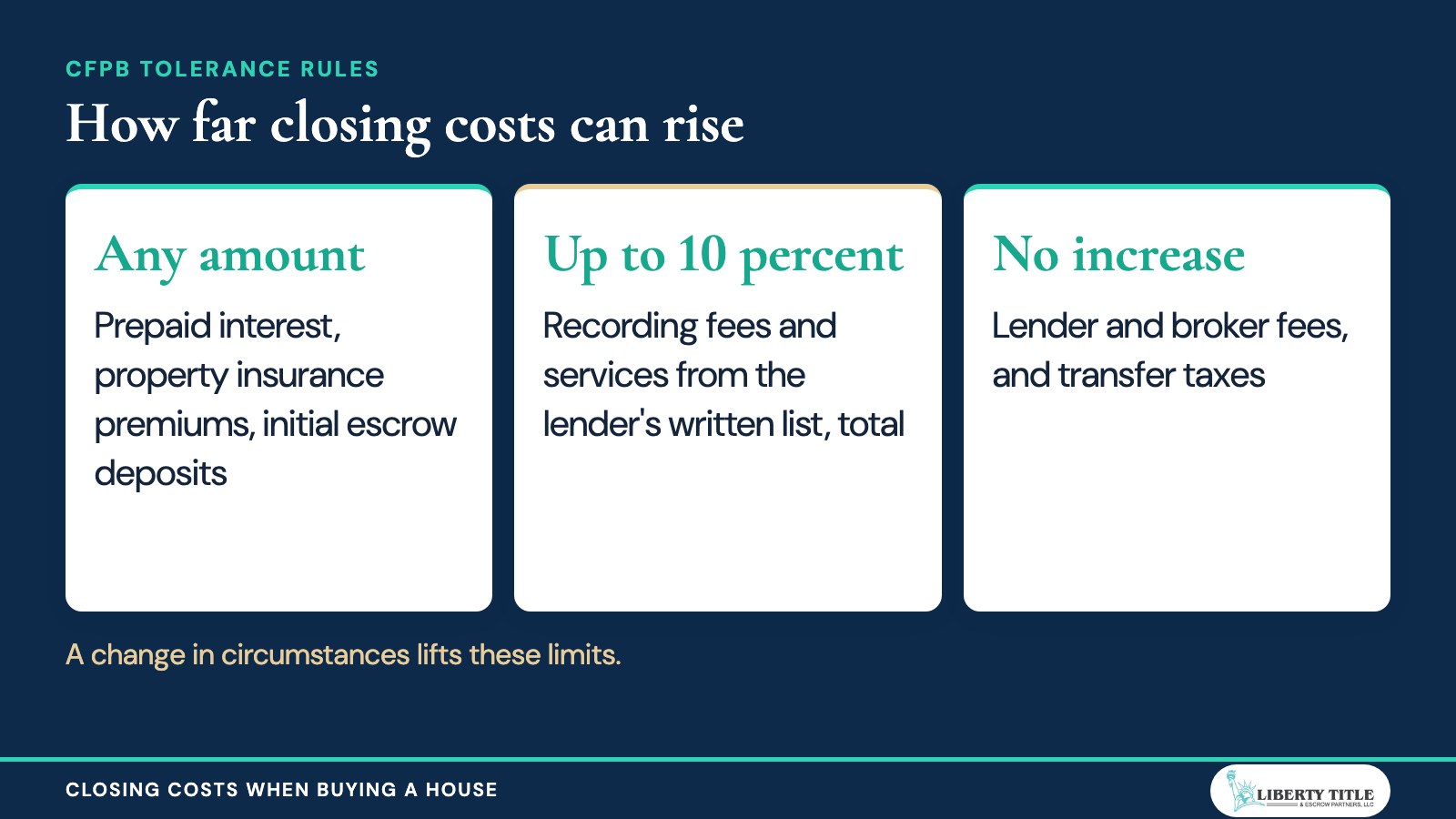
The graphic shows the three groups side by side. A buyer who spots a larger change should ask the lender to explain it before closing day. Next, the cash to close figure pulls everything into one payment.
How Do You Review the Closing Disclosure Before Closing Day?
Review the Closing Disclosure by comparing its Cash to Close figure with your most recent Loan Estimate. The CFPB says lenders must provide the form three business days before your scheduled closing. Use those days to resolve problems with the lender, the title agent, and the seller.
- Match the loan amount, interest rate, and monthly payment with the Loan Estimate.
- Compare the closing costs line by line with the estimate.
- Ask the lender to explain any significant change in a fee.
- Confirm the Cash to Close figure and ask the closing agent how to pay it.
The CFPB tells buyers to call the lender immediately when a figure does not match. A buyer who finds an error before closing day keeps time to fix it. The next section explains the payment itself.
What Is Cash to Close and How Do You Pay It?
Cash to close is the total amount you pay at closing, according to the CFPB, on top of money already paid. The figure adds the down payment to the closing costs and subtracts the earnest money deposit and any credits. The CFPB says buyers typically need a cashier's check or wire transfer for this amount.
A $300,000 home with 20% down needs a $60,000 down payment. Add $6,000 to $15,000 in closing costs, and the total is $66,000 to $75,000 before earnest money and credits. Buyers should confirm wire details by phone with the escrow agent, using the steps for safe wiring to a title company.
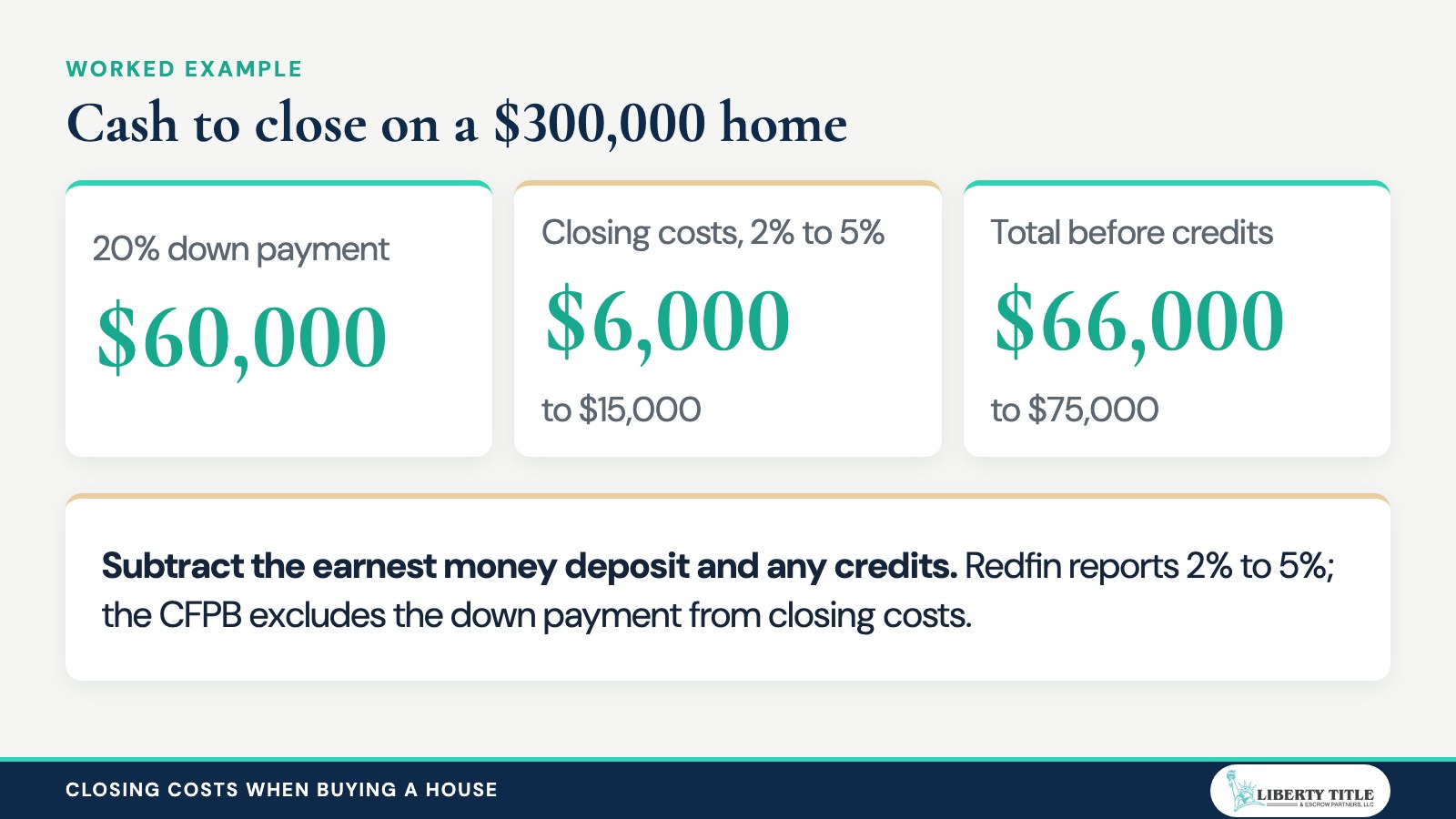
The graphic shows that example as a calculation card. Buyers who want a lower payment can look at ways to cut the total, starting with avoidance.
How to Avoid Closing Costs When Buying a House
Avoid closing costs when buying a house by shifting them to the seller or into the loan. Recording, title search, and appraisal charges remain in the transaction. A seller credit moves the cost to the seller. A lender credit moves it into the interest rate.
The CFPB says a no-closing-cost loan works in two ways. The lender charges a higher interest rate and gives a credit, or the lender adds the costs to the loan amount. Both methods raise what the buyer pays over time, so compare the monthly payment before choosing.
A buyer can also ask the seller to pay a share of the costs inside the purchase offer. The credit reduces cash to close, and the lender must accept it within the loan program limits. The next section lists ways to cut the total itself.
How to Lower Closing Costs When Buying a House
Lower closing costs when buying a house by comparing lenders, questioning lender fees, and pricing each outside service. The six actions below cut the total in different ways.
- Compare Loan Estimates from several lenders, since the CFPB says the form is standard.
- Ask each lender to reduce or waive its application and origination fees.
- Compare quotes for the inspection and the survey before booking.
- Negotiate a seller credit in the original offer.
- Pick a closing date late in the month to shorten the days of prepaid interest.
- Ask a state or local housing agency about down payment and closing cost assistance.
A buyer can price the survey, and this explanation of whether the title company orders a land survey for homebuyers covers it. Lender credits trade a lower upfront cost for a higher rate, according to the CFPB. Lender credits and points trade cost now against cost later. One point equals one percent of the loan amount, according to the CFPB. A seller credit has caps, and those caps come next.
How Much Can a Seller Contribute Toward Closing Costs?
A seller can contribute 3% to 9% of the price toward closing costs on a Fannie Mae loan. The limit is called an interested party contribution. Federal Housing Administration (FHA) and Department of Veterans Affairs (VA) loans set their own caps.
The table below lists the caps from Fannie Mae, the Department of Housing and Urban Development (HUD), and the VA.
| Loan type | Condition | Limit |
|---|---|---|
| Fannie Mae conventional | Loan-to-value above 90% | 3% |
| Fannie Mae conventional | Loan-to-value 75.01% to 90% | 6% |
| Fannie Mae conventional | Loan-to-value 75% or less | 9% |
| Fannie Mae investment property | All loan-to-value ratios | 2% |
| FHA | Percent of sales price | 6% |
| VA | Percent of reasonable value | 4% |
The buyer's real estate agent writes the credit into the contract, and the lender confirms the program limit. Talk to your lender about the cap for your loan.
What If You Cannot Afford Closing Costs?
A buyer who cannot afford closing costs can ask for a seller credit, a lender credit, or assistance funds. Redfin notes that gift money from friends and family can pay closing costs. Lenders set documentation rules for gifts, so ask about them early.
A lender credit lowers the upfront cost in exchange for a higher interest rate, according to the CFPB. State and local housing agencies run assistance programs with their own rules. A buyer should compare the payment impact of each option with a lender.
A buyer who sees a gap early has more room to negotiate, because the contract sets deadlines for each party. The next section answers shorter questions.
What Else Should You Know About Closing Costs When Buying a House?
Do Cash Buyers Pay Closing Costs?
Yes, cash buyers pay closing costs without the lender fees. Redfin says a cash buyer still pays property taxes, notary and recording fees, and local or state fees. Title and escrow services still apply, and our home closings cover those cash purchases as well.
Is Earnest Money a Closing Cost?
No, earnest money is not a closing cost, but it is credited toward cash to close. The deposit runs about 1% to 3% of the price, according to Redfin. A buyer who needs the deposit back can follow this guide to an earnest money refund from a title company.
What Do Closing Costs Include When Buying a House?
Closing costs include lender fees, title and settlement fees, government taxes, and prepaid items. Redfin lists an appraisal at $300 to $500, a credit report at $10 to $100, and a survey at $400 to $1,000. The closing agent also collects the documents needed from each party.
What Title Charges Appear on a Buyer's Closing Costs?
Title charges include the title search, the lender's policy, settlement fees, and the owner's policy. Florida Administrative Code 69O-186.003 sets the owner's premium at $5.75 per $1,000 up to $100,000. It adds $5.00 per $1,000 from $100,000 to $1 million. On a $400,000 price, that premium equals $2,075. Fee detail appears in this look at title company pricing.
Frequently Asked Questions
When Does a Lender Provide the Loan Estimate?
A lender must provide the Loan Estimate within three business days of a mortgage application, according to the CFPB. The form lists estimated closing costs and cash to close. Compare it with the Closing Disclosure before closing day.
How Much Are Closing Costs on a $250,000 House?
Closing costs on a $250,000 house run $5,000 to $12,500 at Redfin's 2% to 5% range. Local fees, taxes, and the loan type move the final figure.
How Much Are Closing Costs on a $300,000 House?
Closing costs on a $300,000 house run $6,000 to $15,000, according to Redfin. The down payment is a separate amount.
How Much Is 20% Down on a $300,000 House?
A 20% down payment on a $300,000 house is $60,000. The CFPB excludes the down payment from total closing costs.
Why Are There Closing Costs When Buying a House?
Closing costs exist because lenders, title agents, appraisers, and government offices each charge for a required service. The charges pay for the loan, the title work, the recording, and the taxes.
Can Closing Costs Be Rolled Into the Loan?
Yes, some loans add closing costs to the loan amount, according to the CFPB. That choice raises the balance and the payment, so compare it with a lender credit.
How Does Liberty Title Help Buyers Review Closing Costs?
Liberty Title helps buyers review closing costs by explaining each line of the settlement statement before the closing appointment. The team works in English and Spanish and handles title searches, title insurance, and escrow for residential purchases in Miami. Buyers can call +1 (305) 530-8998 with questions about a Closing Disclosure.
Buyers can start with Liberty Title Partners to learn how the title and escrow side of the purchase works. The team coordinates with the lender, the seller's side, and the real estate agents on closing day. Each party receives the figures that apply to its role.
The team handles the paperwork, the funds, and the recording. The service page for home purchase support lists each step for residential buyers, from the title search to the final recording.
Buyers with other questions about escrow, title insurance, closing documents, and wire steps can read short answers on the common questions page. These answers are general education. Talk to your title agent, real estate attorney, lender, or tax advisor about your own transaction.


You May Also Like
Closing Costs When Buying a House and What to Expect

What a Quitclaim Deed Is and When to Use One
How to Calculate Closing Costs Before You Close

What Is Included in Closing Costs for a Home Purchase

What Closing Costs Include for Both Buyers and Sellers

Who Pays Closing Costs in a Real Estate Transaction

Are There Closing Costs on a Home Equity Loan

Can You Roll Closing Costs into a Mortgage

Do Sellers Pay Closing Costs and How Much

What a Warranty Deed Is and How It Protects the Buyer
How Much Closing Costs Are and What They Include


















How Long to Close After Title Search for Homebuyers

How To Safely Wire Money to a Title Company

What Documents Does a Title Company Need

How Much a Title Company Charges and What You Get
How Long a Title Company Can Hold Funds After Closing

How To Do a Title Search on Property Yourself

Title Insurance in Real Estate and How It Protects You
How Long a Title Search Takes and What Causes Delays
How a Title Search Works and What It Reveals

What a Title Company Does and Why It Matters at Closing

What Is Title Insurance and Why Do You Need It