


Are There Closing Costs on a Home Equity Loan

Yes, lenders charge closing costs on home equity loans. Anyone asking "are there closing costs on a home equity loan" should budget 2% to 5% of the loan, per Achieve. That range equals $1,000 to $2,500 on a $50,000 loan. The fees cover the appraisal, origination, title search, credit report and recording. A no-closing-cost offer can carry a higher interest rate.
Key Takeaways
- Home equity loans typically carry closing costs of 2% to 5% of the loan amount.
- Common fees include origination, appraisal, title search, title insurance, credit report and recording.
- Florida adds documentary stamp tax of 35 cents per $100 and intangible tax of 2 mills.
- A no-closing-cost loan can shift fees into a higher rate or a repayment clause.
- Federal rules let a borrower cancel until midnight of the third business day on a primary home.
Are There Closing Costs on a Home Equity Loan?
Yes, there are closing costs on a home equity loan, typically 2% to 5% of the loan amount. Achieve, a lender education site, publishes that range, and CBS News gives $1,000 to $2,500 for a $50,000 loan. A home equity loan is a second mortgage that pays a lump sum, so the lender closes it like any mortgage.
A closing agent, such as a title and escrow company, handles the signing, the lien search and the recording. Liberty Title supports HELOC closings on the title and escrow side. Those fees are the next piece to price.
How Much Are Closing Costs on a Home Equity Loan?
Closing costs on a home equity loan run 2% to 5% of the loan amount, or $2,000 to $5,000 on $100,000. The table below applies Achieve's 2% to 5% range to four loan sizes.
| Loan amount | At 2% | At 5% |
|---|---|---|
| $25,000 | $500 | $1,250 |
| $50,000 | $1,000 | $2,500 |
| $100,000 | $2,000 | $5,000 |
| $250,000 | $5,000 | $12,500 |
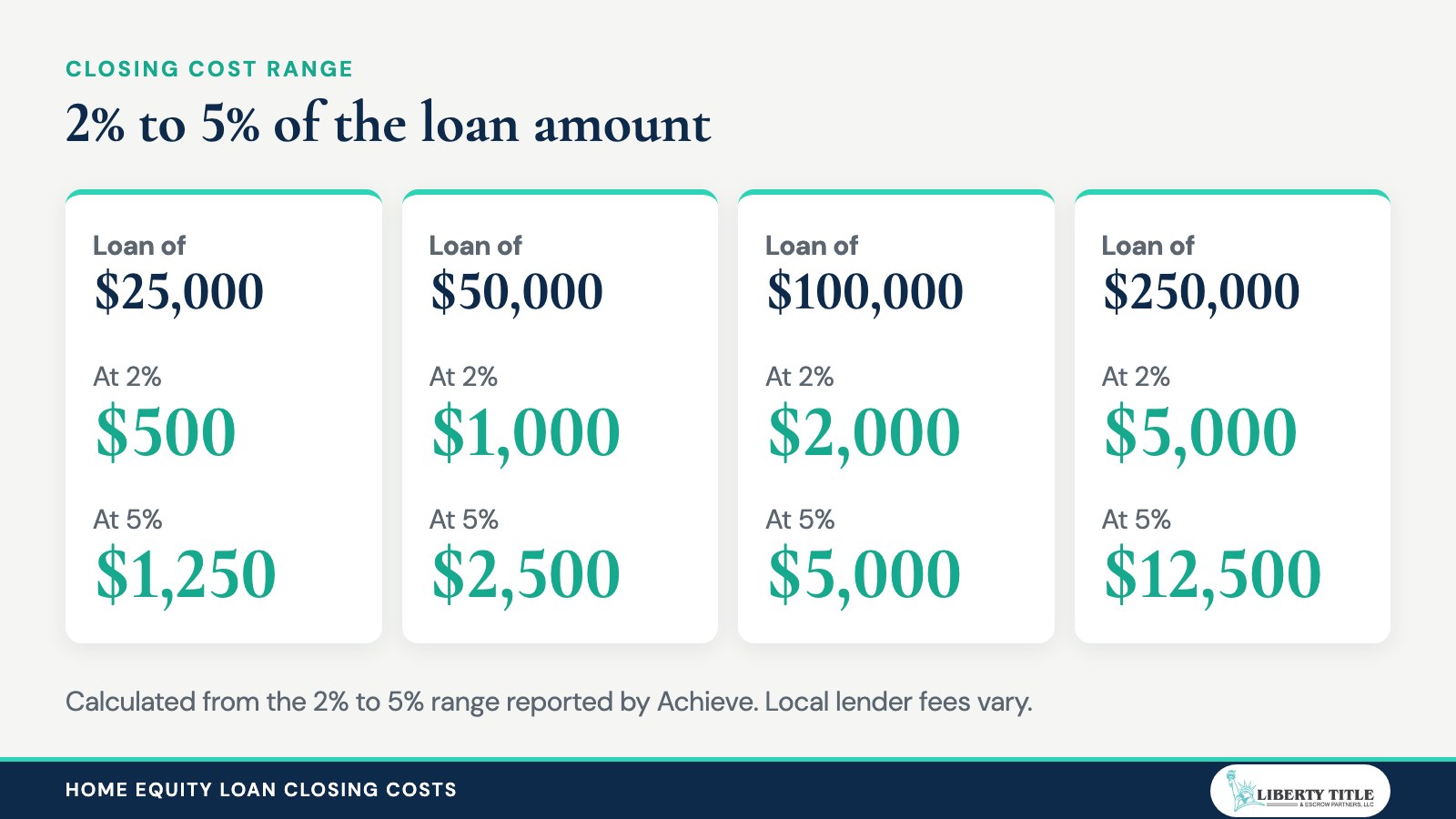
The graphic above charts the same 2% to 5% range for each loan size. The $50,000 row matches the $1,000 to $2,500 range that CBS News reports. CBS News adds that costs rise with the equity a borrower withdraws, and the fees behind that total come next.
What Fees Make Up Home Equity Loan Closing Costs?
Home equity loan closing costs include origination, appraisal, credit report, title search, title insurance, document, notary and recording fees. The table lists the ranges Achieve publishes for each fee.
| Fee | Typical range | What it covers |
|---|---|---|
| Origination | 1% to 5% of the loan | Lender processing and funding |
| Appraisal | $0 to $1,000 | Value of the home |
| Credit report | $30 to $100 | Borrower credit history |
| Title search | $75 to $200 | Ownership and lien check |
| Title insurance | 0.5% to 1% of the loan | Lender protection against title defects |
| Document or attorney | $100 to $500 | Loan paperwork preparation |
| Notary | $50 to $200 per notarization | Witnessing signatures |
| Recording | $20 to $100 | Filing the mortgage with the county |
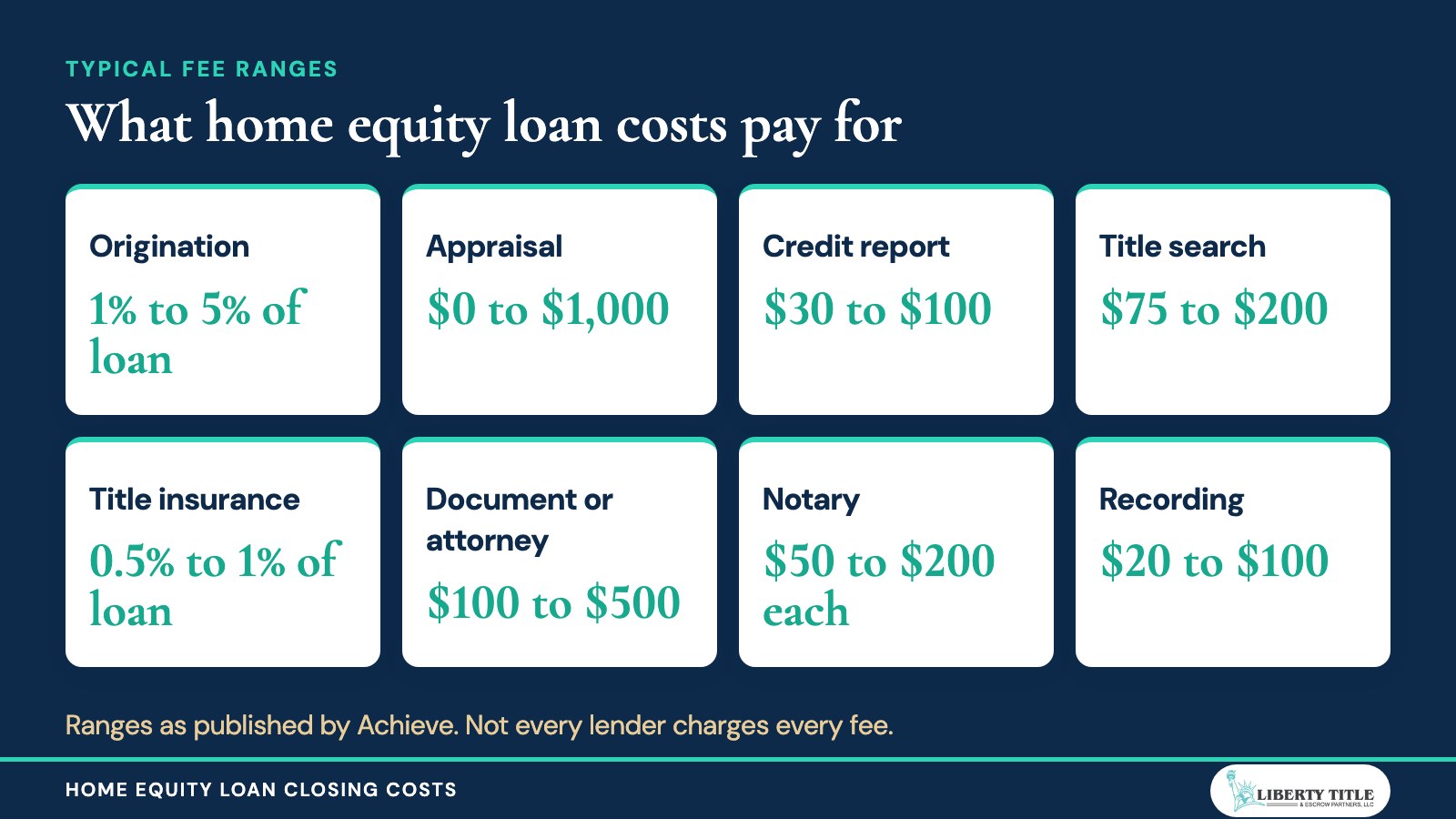
The graphic above shows the fee ranges at a glance. The appraisal range is wide because lenders price it differently. CBS News puts a full appraisal at $300 to $500. Achieve notes that an automated valuation model can reduce or remove the fee. Three groups collect these fees:
- The lender charges origination and document fees.
- Third parties, such as the appraiser, credit bureau and title agent, charge for their reports.
- The county clerk charges to record the mortgage.
Not every lender charges every fee, so a written fee list matters. The same fee list looks different on a credit line, which is the next question.
Do You Pay Closing Costs on a HELOC?
Yes, you pay closing costs on a HELOC, because the lender and third parties still charge to open the line. Regulation Z, the federal Truth in Lending rule, makes a HELOC lender itemize fees to open, use or maintain the plan. The lender must also give a good faith estimate of third-party fees.
A HELOC lender cannot impose a nonrefundable fee until three business days after the borrower receives the required disclosures and brochure. A borrower who walks away because a disclosed term changed may receive a refund of application fees. The table compares the two products.
| Item | Home equity loan | HELOC |
|---|---|---|
| Credit type | Closed-end credit | Open-end credit |
| Fee disclosure | Loan Estimate within 3 business days of application | Itemized lender fees plus a third-party fee estimate |
| Nonrefundable fees | Set by the lender's terms | None until 3 business days after disclosures |
| Right to cancel | Midnight of the third business day | Midnight of the third business day |
The comparison shows that both products carry fees and a cancellation window. Lenders vary on fees, so an applicant can ask the closing agent for a written fee list. Liberty Title provides HELOC title work for line-of-credit files. Taxes come next because Florida adds its own.
Which Florida Taxes Apply to a Home Equity Loan?
Florida charges documentary stamp tax and intangible tax on a home equity loan that a mortgage secures. Florida Statutes Section 201.08 sets documentary stamp tax at 35 cents per $100 of debt for notes and for mortgages. Tax on a note stops at $2,450.
Florida Statutes Section 199.133 imposes a one-time intangible tax of 2 mills on each dollar of a mortgage-secured note. Two mills equals 20 cents per $100. The table applies both rates to two loan sizes.
| Tax | Rate | On $50,000 | On $100,000 |
|---|---|---|---|
| Documentary stamp tax | 35 cents per $100 | $175 | $350 |
| Intangible tax | 2 mills | $100 | $200 |
The dollar amounts above are straight calculations from the statutory rates. A closing agent applies the statutes to the actual loan documents. Confirm tax treatment with a real estate attorney or tax advisor. Taxes join the title work on the next list.
Does a Home Equity Loan Need a Title Search and Title Insurance?
A home equity loan needs a title search because the lender takes a second lien and must see prior claims. Achieve describes the search as a check that you own the property and no one else has a legal claim. The title search steps cover public records, liens and ownership history.
Title insurance is the second item. Achieve says a lender may require a title policy, and it prices the cost at 0.5% to 1% of the loan amount. A lender's title policy protects the lender, not the owner.
The county clerk then records the new mortgage in the public record. The recording fee runs $20 to $100 by Achieve's figures, and the county sets its own schedule. Understanding the county recording step shows why the lien date matters. The payment timing is next.
When Do You Pay Closing Costs on a Home Equity Loan?
You pay closing costs on a home equity loan at closing, either in cash or rolled into the loan. The answer to "do you pay closing costs on a home equity loan" is yes, at the signing table. Achieve says a borrower might pay up front or roll the costs in, if the lender offers that option. Rolled-in costs raise the amount borrowed, so interest accrues on them.
Federal rules require the lender to send a Loan Estimate within three business days of the application. The form lists projected closing costs, the rate and the monthly payment. A typical closing runs in this order:
- Apply and receive the Loan Estimate.
- Order the appraisal, credit report and title search.
- Sign the note, mortgage and closing documents.
- Wait through the rescission period.
- Receive the funds after the lender confirms no cancellation.
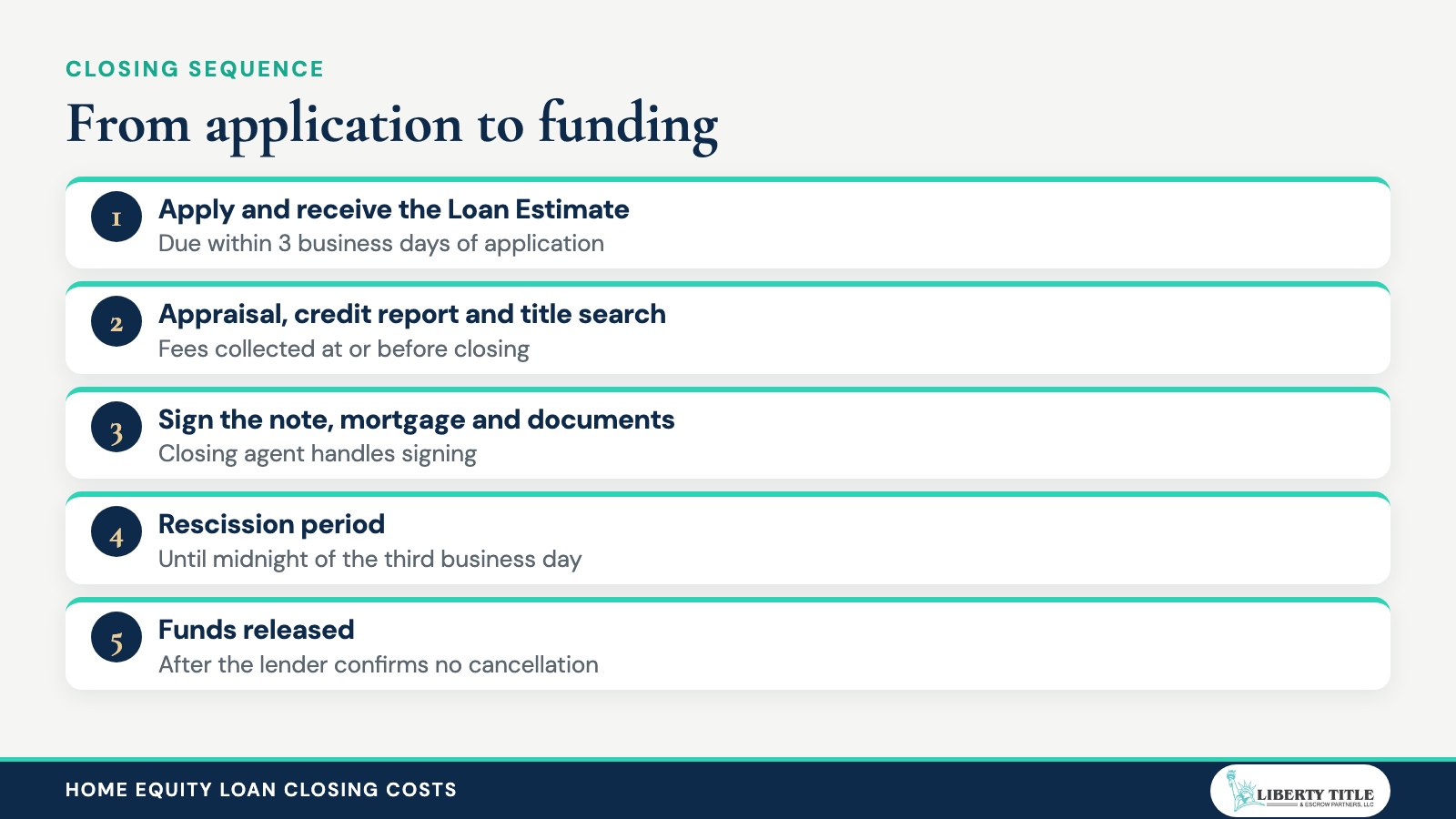
The graphic above lays out the closing steps in order. Regulation Z holds the money until the rescission period has expired, unless the borrower waives it. Lenders also request required documents early, such as ID and proof of ownership. Some lenders advertise a way to skip the fees entirely.
Can You Get a Home Equity Loan With No Closing Costs?
Yes, some lenders offer a home equity loan with no closing costs, but the lender recovers the money another way. CBS News says a no-closing-cost HELOC rolls costs into the line or has the lender cover them for a higher rate. The lender may also charge you for closing early.
Those repayment clauses are called clawbacks. CBS News reports that clawback periods typically range from three to five years. Lower adds that some home equity loans carry a prepayment penalty or a closing-cost reimbursement requirement in the first few years.
The rate trade-off has a break-even point. CBS News gives an example: a $50,000 line at a rate 0.5% higher costs $250 more per year. Against $3,000 in typical closing costs, break-even takes 12 years. A borrower planning to keep the loan that long gains little. Cancelling after signing is a separate right.
Can You Cancel a Home Equity Loan After Closing?
Yes, you can cancel a home equity loan on your primary home until midnight of the third business day after closing. Regulation Z, section 1026.23, sets the deadline at the last of three events. Those events are closing, delivery of the cancellation notice and delivery of the material disclosures.
The creditor must return any money or property within 20 calendar days after it receives the cancellation notice. A HELOC carries the same three-business-day right under Section 1026.15. The right covers a lien on the borrower's principal dwelling, so a borrower should confirm how it applies to a second home.
Fees paid during the process also matter after a cancellation. Talk to your lender or real estate attorney about which charges return. A few side questions follow.
What Else Should You Know About Home Equity Loan Closing Costs?
How Much Would a $250,000 Home Equity Loan Cost?
A $250,000 home equity loan would cost about $5,000 to $12,500 in closing costs at the 2% to 5% range. The figure is a calculation from Achieve's range, not a quote. A lender's Loan Estimate shows the actual amount, and a title cost calculator estimates the title portion.
Can You Roll Closing Costs Into a Home Equity Loan?
Yes, you can roll closing costs into a home equity loan when the lender allows it. Achieve notes the option exists only if the lender offers it. The borrower then pays interest on the added amount for the full term.
Who Pays the Title Search Fee on a Home Equity Loan?
The borrower pays the title search fee on a home equity loan as part of the closing costs. Achieve lists the fee at $75 to $200. The title search fee works differently in a sale, where buyer and seller customs apply.
Do Closing Costs Differ on a Cash-Out Refinance?
A cash-out refinance replaces the first mortgage, so its closing costs usually cover a full new loan. A home equity loan adds a second lien and leaves the first mortgage alone. Homeowners weigh both against cash-out refinances before choosing.
What Is the Cheapest Way To Borrow Against Home Equity?
The cheapest way to borrow against home equity is the offer with the lowest fees plus interest over your holding time. Compare Loan Estimates from several lenders side by side. Include any clawback clause in the math.
Frequently Asked Questions
Do Home Equity Loans Have Closing Costs?
Yes, home equity loans have closing costs at credit unions and banks alike. Achieve reports typical fees of 2% to 5% of the loan amount. Some lenders waive part of them.
How Much Are Closing Costs for a Home Equity Loan on $50,000?
Closing costs for a $50,000 home equity loan run $1,000 to $2,500, according to CBS News. The exact amount depends on the lender and the property. Florida taxes add to the total.
What Is the Downside of a Home Equity Loan?
The downside of a home equity loan is that your home secures the debt. A missed payment can put the home at risk. Closing costs and clawback clauses add to the cost of borrowing.
What Disqualifies You From Getting a Home Equity Loan?
Limited equity, weak credit history, low income or high existing debt can disqualify a borrower. Each lender sets its own standards. A lender explains its requirements at application.
Does a Home Equity Loan Have Closing Costs in Florida?
Yes, a home equity loan has closing costs in Florida, plus state documentary stamp tax and intangible tax. The state taxes follow Sections 201.08 and 199.133 of the Florida Statutes. A title agent can confirm the amounts.
Are There Closing Costs on Home Equity Loans From Credit Unions?
Yes, credit unions charge closing costs on home equity loans too, and the amounts vary by lender. Each lender publishes its own fee schedule. Compare the Loan Estimates before choosing.
How Does Liberty Title Help With Home Equity Closings?
Liberty Title is a title and escrow company that handles HELOC closings, title searches, title insurance and escrow for homeowners and lenders. Our team works in English and Spanish, and we prepare the title work a lender needs before signing. Anyone asking are there closing costs on a home equity loan can bring the Loan Estimate to us for a title review.
Homeowners can request an estimate for the title side of the loan. Our team explains each title fee before signing.
A home equity loan closing involves a lender, a closing agent, a county clerk and the borrower. Each one has a defined role in the file. We coordinate the title and escrow side and keep the lender updated through recording. Our residential closing services follow the same workflow for purchases and refinances.
Each loan file has its own terms, fees and deadlines. Talk to your title agent, lender, real estate attorney or tax advisor about your own loan. The Liberty Title office answers questions at +1 (305) 530-8998.


You May Also Like
Are There Closing Costs on a Home Equity Loan


Can You Roll Closing Costs into a Mortgage

Do Sellers Pay Closing Costs and How Much

What a Warranty Deed Is and How It Protects the Buyer

How Much Closing Costs Are and What They Include



























How Long to Close After Title Search for Homebuyers

How To Safely Wire Money to a Title Company

What Documents Does a Title Company Need

How Much a Title Company Charges and What You Get

How Long a Title Company Can Hold Funds After Closing

How To Do a Title Search on Property Yourself

Title Insurance in Real Estate and How It Protects You
How Long a Title Search Takes and What Causes Delays

How a Title Search Works and What It Reveals

What a Title Company Does and Why It Matters at Closing

What Is Title Insurance and Why Do You Need It