


What Closing Costs Buyers Should Expect to Pay

Closing costs for a buyer are the fees and prepaid items paid when a purchase closes, separate from the down payment. Redfin says buyers usually pay 2% to 5% of the purchase price, or $6,000 to $15,000 on a $300,000 home. Lender charges, title and escrow fees, government taxes and prepaids make up the total. Cash buyers pay less because no loan exists.
Key Takeaways
- Buyer closing costs usually run 2% to 5% of the purchase price, according to Redfin.
- Four groups make up the bill: lender fees, title and escrow fees, government fees, and prepaids.
- Cash buyers usually pay about 1% to 3% of the price because lender fees drop out.
- Florida adds documentary stamp tax and intangible tax on the mortgage.
- Buyers pay the cash-to-close amount by cashier's check or wire transfer.
What Are Closing Costs for a Buyer?
Closing costs for a buyer are the one-time fees and prepaid items due when the sale closes. Redfin says buyers usually pay 2% to 5% of the purchase price. These costs pay for the loan, the title work, government charges and the first bills of ownership.
The Consumer Financial Protection Bureau (CFPB) defines total closing costs as upfront loan and transaction costs, excluding your down payment. A buyer therefore budgets for closing costs and the down payment as two separate amounts. Title agents who provide buyer closing support can itemize each group for a specific contract.
Does a Buyer Pay Closing Costs?
Yes, a buyer pays closing costs on a purchase, although the contract can move some of them to the seller. A financed buyer pays lender fees, third-party charges and prepaid items. The purchase contract decides which side pays each remaining charge.
Zillow's 2025 Consumer Housing Trends Report shows buyers saying sellers agreed to pay some (23%) or all (44%) of closing costs. Loan programs cap these credits, such as 6% of the sales price for FHA loans under a 2023 HUD notice. Agents who use agent support from a title company can confirm those terms before the contract is signed. The size of the total depends on price, so the average comes next.
What Are the Average Closing Costs for a Buyer?
The average closing costs for a buyer fall between 2% and 5% of the purchase price, according to Redfin. A $300,000 home therefore carries $6,000 to $15,000 in buyer closing costs. Redfin notes the percentage varies by loan, lender and location.
The table below shows what 2%, 3% and 5% of the price equals at three common price points.
| Purchase price | 2% | 3% | 5% |
|---|---|---|---|
| $250,000 | $5,000 | $7,500 | $12,500 |
| $300,000 | $6,000 | $9,000 | $15,000 |
| $400,000 | $8,000 | $12,000 | $20,000 |
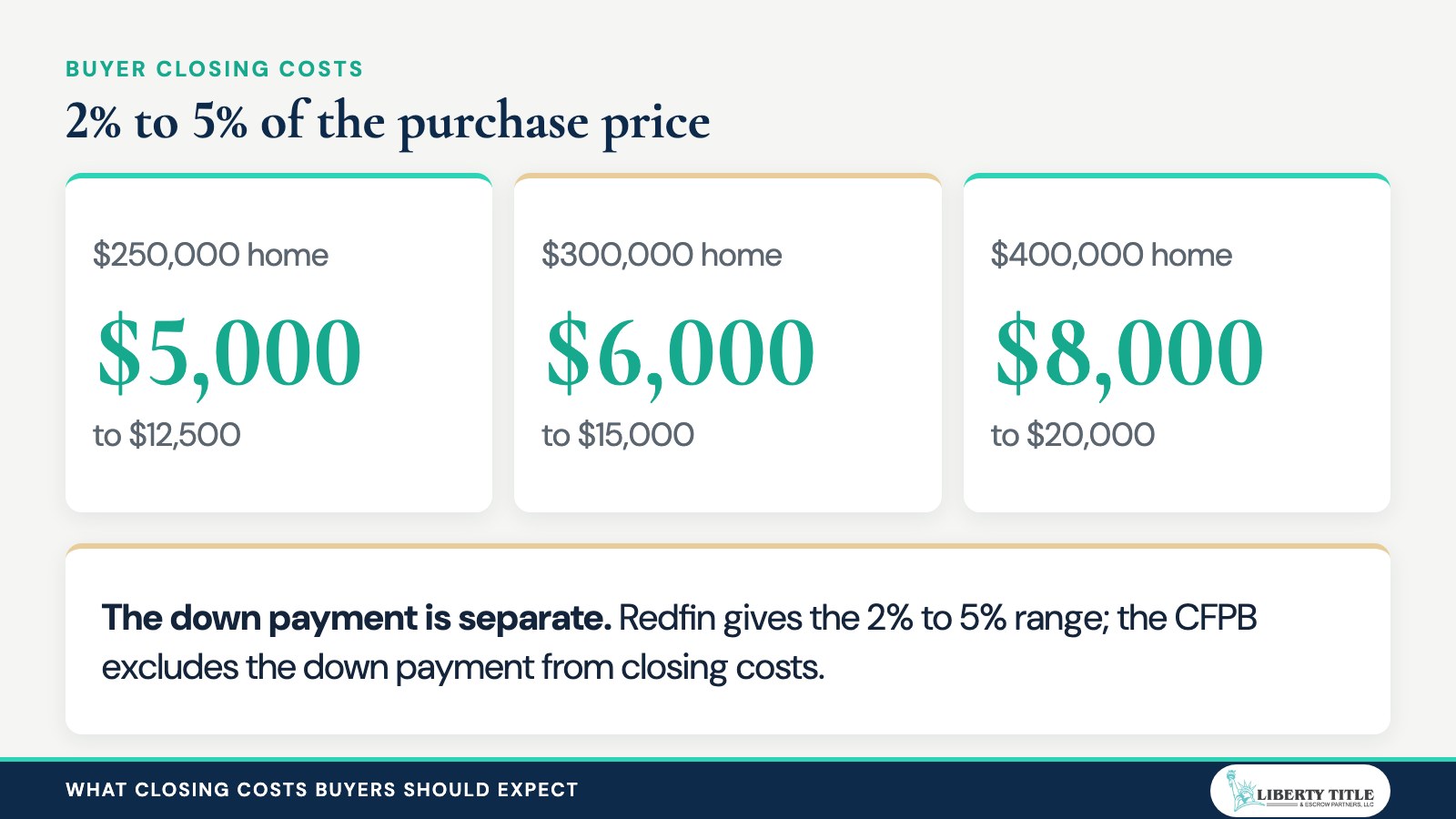
The graphic repeats those ranges for quick budgeting. A buyer should treat the high end as the planning number and the Loan Estimate as the confirmation. Each range splits into the same four groups, which the next section lists.
What Closing Costs Does the Buyer Pay at the Closing Table?
Buyer costs at the closing table fall into four groups: lender fees, title and escrow fees, government fees, and prepaids. Lender fees cover the cost of making the loan. The CFPB labels the first group Origination Charges, meaning upfront charges from the lender for making the loan.
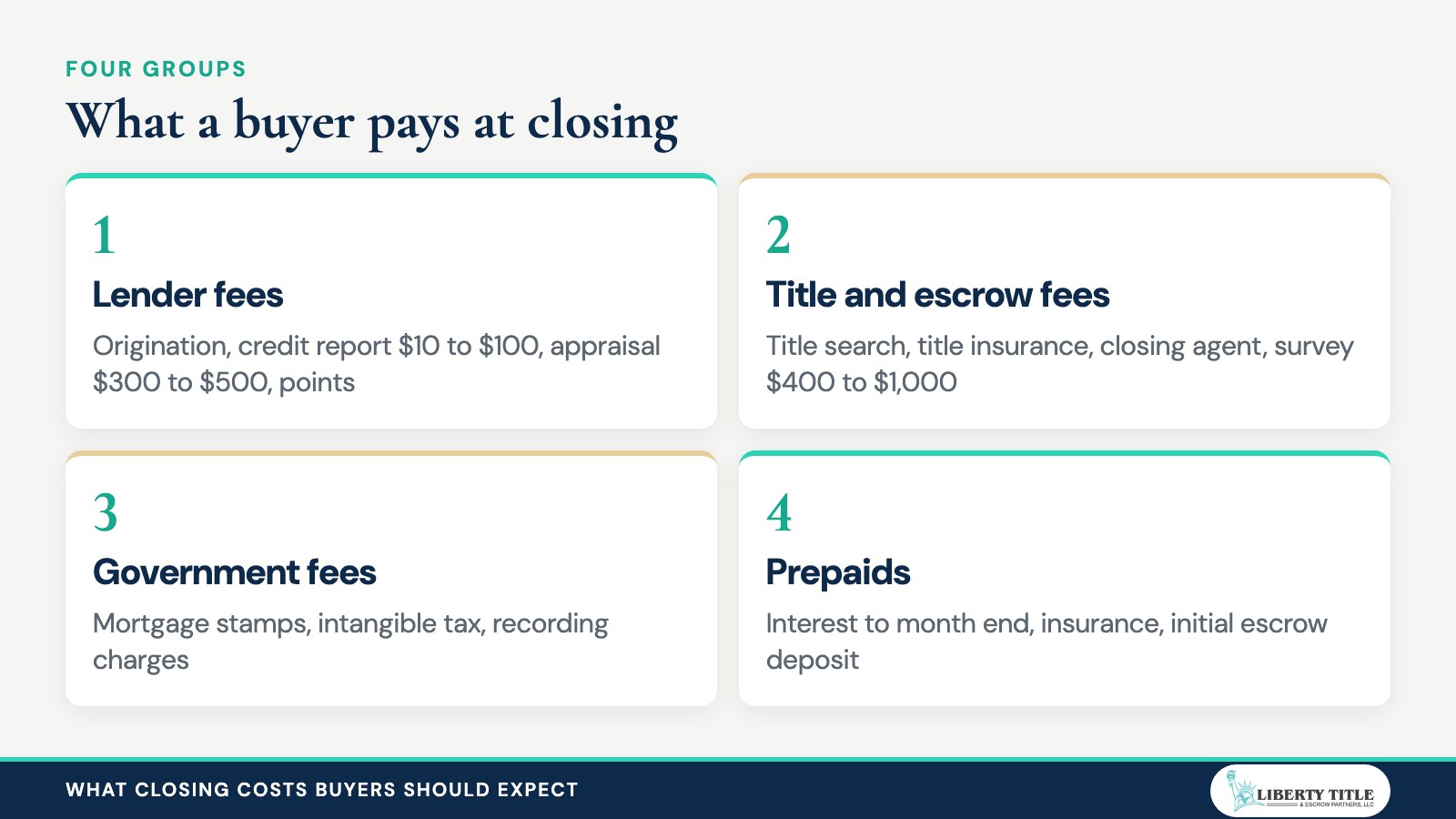
The graphic maps the four groups. Lender fees usually include these charges:
- Origination and processing charges, which vary by lender and appear on the Loan Estimate.
- Credit report fee, which Redfin puts at $10 to $100.
- Appraisal fee, which Redfin puts at $300 to $500.
- Discount points, a form of prepaid interest that lowers the interest rate, according to the Internal Revenue Service (IRS).
A lender must deliver the Loan Estimate within three business days of an application. Every lender uses the same standard form, so buyers can compare offers line by line. Title and escrow charges come from the title agent instead of the lender.
What Title and Escrow Fees Does a Buyer Pay?
A buyer pays title and escrow fees for the title search, title insurance and the closing agent's services. These fees go to the title agent, not the lender. The title search reviews public records for liens and unpaid taxes before the sale closes.
Redfin says a title search costs upwards of $200. The amount and the payer both vary, so the title search cost belongs on the contract checklist. The closing agent also charges a settlement or escrow fee for collecting and disbursing funds.
Title insurance comes in two policies. The CFPB says a lender's policy protects the lender. An owner's policy protects the homeowner after a claim from before the purchase. Florida sets the promulgated owner's rate at $5.75 per $1,000 up to $100,000, plus $5.00 per $1,000 from $100,000 to $1 million. The contract decides who pays, so the owner's policy cost is a negotiated item.
Redfin lists a survey at $400 to $1,000. Redfin says survey fees come due before closing, so the timing matters for cash planning. Buyers arrange ordering the survey as a separate step. Government charges form the next group of fees.
What Are the Closing Costs for a Buyer in Florida?
The closing costs for a buyer in Florida add state taxes, mainly documentary stamp tax and intangible tax on the mortgage. Florida Statutes Section 201.08 sets mortgage stamp tax at 35 cents per $100 of the debt. Section 199.133 adds a one-time intangible tax of 2 mills on each dollar secured.
Deed stamps run 70 cents per $100 of the price under Section 201.02, and the contract assigns that payer. The table shows each charge on a $400,000 purchase with a $320,000 loan.
| Charge | Rate or rule | Example amount |
|---|---|---|
| Mortgage documentary stamps | 35 cents per $100 of debt | $1,120 |
| Intangible tax | 2 mills per dollar of debt | $640 |
| Deed documentary stamps (contract assigns payer) | 70 cents per $100 of price | $2,800 |
| Owner's title premium | $5.75 per $1,000, then $5.00 per $1,000 above $100,000 | $2,075 |
County clerks also charge to record documents. Section 28.24 sets maximums of $5.00 for the first page and $4.00 for each added page. Local costs vary by county and page count. A cash buyer owes no mortgage stamps or intangible tax, and a full residential closing review confirms which taxes apply. Prepaid items add one more group to the total.
What Prepaid Items and Escrow Deposits Does a Buyer Pay?
A buyer pays prepaid items at closing to cover costs that build up after the sale, such as interest, insurance and taxes. Prepaids include interest on the loan between closing and the end of that month, according to the CFPB. The Closing Disclosure lists this group separately from fees.
The Initial Escrow Payment at Closing sets the starting balance of the escrow account. Redfin says escrow holds funds for mortgage insurance, home insurance and property taxes. The IRS excludes these escrow amounts from settlement costs because they pay future bills.
The CFPB places prepaid interest, insurance premiums and initial escrow deposits in the group that can increase by any amount before closing. Buyers should check these lines on the final Closing Disclosure. A cash buyer owes no lender escrow, which shapes the cash comparison next.
What Are Closing Costs for a Cash Buyer?
Closing costs for a cash buyer run about 1% to 3% of the purchase price, according to Redfin. A $400,000 cash purchase carries $4,000 to $12,000, compared with $8,000 to $20,000 at 2% to 5%. Lender fees drop out, while title, escrow, recording, survey and inspection costs remain.
IRS Publication 551 makes the same point. A fee for buying property must be paid even if you bought the property for cash. The table compares the two buyer types line by line.
| Cost item | Financed buyer | Cash buyer |
|---|---|---|
| Lender fees and points | Yes | No lender, no fees |
| Lender's title policy | Yes | No lender, no policy |
| Owner's title policy | Buyer's choice | Buyer's choice |
| Title search and escrow fee | Yes | Yes |
| Mortgage stamps and intangible tax | Yes | No mortgage, no tax |
| Appraisal | Lender requirement | Buyer's choice |
| Survey and inspection | Buyer's choice | Buyer's choice |
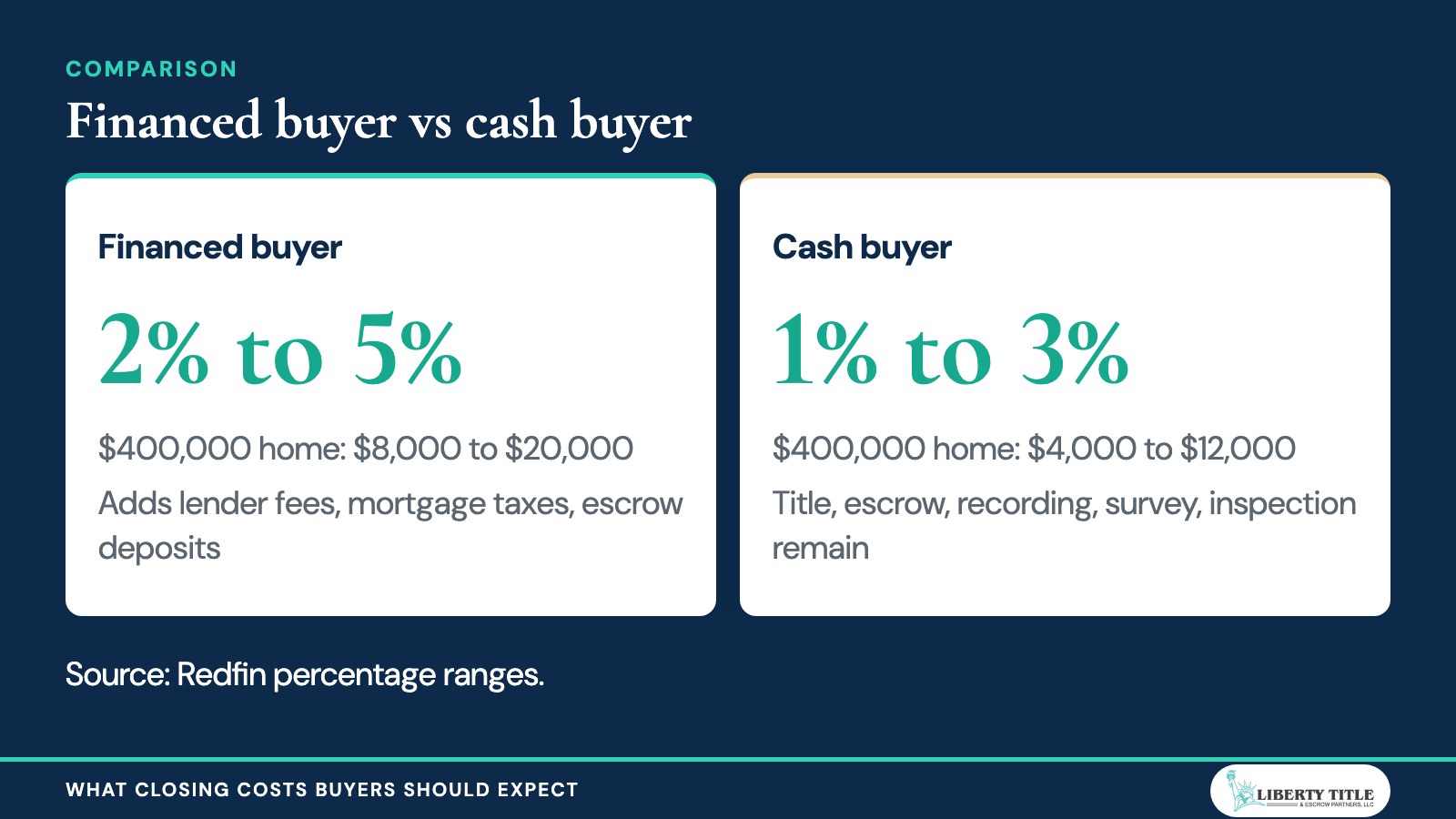
The graphic shows the two percentage ranges side by side. Cash buyers can place title orders early so the title search starts sooner. Both buyer types pay the final amount the same way, which the payment steps explain.
How Do You Pay Closing Costs as a Buyer?
Pay closing costs as a buyer with a cashier's check or wire transfer for the cash-to-close amount on your Closing Disclosure. The CFPB says buyers typically need one of those two methods. Cash to close is the actual amount due at closing, including the down payment.
Wire fraud targets this payment, so buyers should follow a verification routine. Wire transfers move funds quickly, and a wrong account number is hard to reverse. A guide to safely wiring funds explains how to confirm instructions with the title company. Five steps keep the payment on track:
- Receive the Closing Disclosure at least three business days before closing.
- Compare each line with the Loan Estimate.
- Confirm the cash-to-close figure with the closing agent.
- Call the title company at a number you already know to verify wire instructions.
- Send the wire or obtain the cashier's check before the closing appointment.
Buyers who follow these steps reach the closing table with the right amount, and a purchase closing team can confirm the figure. Tax questions come next, because some of these payments change the home's tax records.
Are Closing Costs Deductible for a Buyer?
No, a buyer does not deduct closing costs as a group. Some items add to the home's cost basis, and points may qualify. Cost basis is the starting figure used to measure a gain or loss later. IRS Publication 551 says basis includes settlement fees for buying property.
That list covers abstract fees, legal fees, recording fees, surveys, transfer taxes and owner's title insurance. Charges for getting a loan do not count, such as points, origination fees, credit reports and lender appraisals. IRS Topic 504 says points may be deductible as home mortgage interest when a buyer itemizes and meets the criteria.
Talk to a tax advisor about a specific return. Title agents cannot give tax advice, but they can supply the settlement statement that records each charge. The grouper below answers shorter questions buyers ask about these costs.
What Else Should a Buyer Know About Closing Costs?
Is 3% a Normal Closing Cost?
Yes, 3% falls inside the 2% to 5% range Redfin gives for buyers. On a $300,000 home, 3% equals $9,000. A closing estimate calculator from the title side can estimate the title portion of that total.
How Does a Buyer Send Earnest Money?
A buyer sends earnest money to the escrow agent named in the purchase contract. The deposit runs about 1% to 3% of the price, per Redfin. Buyers can learn about sending earnest money before the contract deadline.
How Early Does a Buyer Get the Closing Disclosure?
A buyer gets the Closing Disclosure at least three business days before closing, according to the CFPB. The form lists the final Total Closing Costs and Cash to Close. Compare it with the Loan Estimate line by line.
Do Inspections and Appraisals Count as Closing Costs?
No, inspections and appraisals are paid for at the time of service, according to Zillow. Redfin puts a home inspection at $300 to $500 and says it is not part of closing costs. These fees come due before the closing day.
Can a Buyer Lower Closing Costs?
Yes, a buyer can ask the seller for credits, compare lender fees on the Loan Estimate, or take lender credits. The CFPB says lender credits lower closing costs up front in exchange for a higher interest rate. Each option shifts cost rather than removing it.
How Does a Buyer Get a Closing Cost Estimate?
A buyer gets a closing cost estimate from the Loan Estimate, which arrives within three business days of an application. The title agent can add an estimate of title charges before the lender's final numbers. Common questions about those charges appear in the closing FAQs.
Frequently Asked Questions
What Are Closing Costs for a Buyer on a $250,000 House?
Closing costs on a $250,000 house run $5,000 to $12,500 at the 2% to 5% range Redfin gives. A cash buyer at 1% to 3% would pay $2,500 to $7,500. Actual amounts depend on the lender, loan and location.
What Are Closing Costs for a Buyer Compared With a Down Payment?
No, a closing cost is not a down payment. The CFPB treats the down payment as separate from total closing costs. Both amounts are paid as part of the cash to close.
Who Pays Closing Costs in a Cash Sale?
The cash buyer pays the buyer-side closing costs, such as title, escrow, recording and survey charges. The contract can still assign certain charges to the seller. Talk to a title agent or real estate attorney about the specific contract.
Does a Cash Buyer Need Title Insurance?
A cash buyer has no lender, so no lender's policy applies. The owner's policy remains the buyer's choice, and it protects the homeowner after a claim from before the purchase. A title agent can quote the premium.
When Do Buyers Pay Closing Costs?
Buyers pay closing costs on closing day, although inspection and survey fees come due earlier. Redfin notes that unpaid closing costs are settled at closing. The Closing Disclosure shows the final cash-to-close amount.
How Does Liberty Title Help Buyers Check Their Closing Costs?
Liberty Title helps buyers review closing costs by matching the title and escrow charges to the Closing Disclosure. We handle residential purchase closings in English and Spanish. Our team explains each title and escrow line before the closing appointment.
Buyers and agents can ask Liberty Title officers to explain the title search, owner's policy and recording charges for a Miami purchase. Call +1 (305) 530-8998 to talk through a file. Lender fees and loan terms stay with the lender.


You May Also Like
Closing Costs When Buying a House and What to Expect

What a Quitclaim Deed Is and When to Use One
How to Calculate Closing Costs Before You Close
What Closing Costs Buyers Should Expect to Pay

What Is Included in Closing Costs for a Home Purchase

What Closing Costs Include for Both Buyers and Sellers

Who Pays Closing Costs in a Real Estate Transaction

Are There Closing Costs on a Home Equity Loan

Can You Roll Closing Costs into a Mortgage

Do Sellers Pay Closing Costs and How Much

What a Warranty Deed Is and How It Protects the Buyer
How Much Closing Costs Are and What They Include




















How Long to Close After Title Search for Homebuyers

How To Safely Wire Money to a Title Company

What Documents Does a Title Company Need

How Much a Title Company Charges and What You Get
How Long a Title Company Can Hold Funds After Closing

How To Do a Title Search on Property Yourself

Title Insurance in Real Estate and How It Protects You
How Long a Title Search Takes and What Causes Delays
How a Title Search Works and What It Reveals

What a Title Company Does and Why It Matters at Closing

What Is Title Insurance and Why Do You Need It