


Can You Roll Closing Costs into a Mortgage

Yes, you can roll closing costs into a mortgage on a refinance, but a purchase loan works differently. Fannie Mae lets a limited cash-out refinance finance closing costs, points, and prepaid items. A purchase loan does not add them, because loan-to-value uses the lower of price or appraisal. Bankrate puts closing costs at 2% to 5% of the loan, or $8,000 to $20,000 on $400,000.
Key Takeaways
- A conventional limited cash-out refinance can finance closing costs, points, and prepaid items, per the Fannie Mae Selling Guide.
- A purchase loan does not add closing costs, because Fannie Mae measures LTV against the lower of price or appraisal.
- VA purchase loans finance only the funding fee, and VA caps seller concessions at 4% of reasonable value.
- The CFPB says a no-closing-cost loan covers costs with a higher rate or a larger loan balance.
- Florida taxes the full note, so each rolled-in $100 adds 35 cents in documentary stamp tax and 20 cents in intangible tax.
Can You Roll Closing Costs into a Mortgage?
Yes, you can roll closing costs into a mortgage when you refinance, while a purchase loan follows different rules. The Consumer Financial Protection Bureau (CFPB) defines closing costs as the upfront costs of getting your loan and transferring ownership. A refinance replaces the old loan, so the new balance can carry those costs.
A lender sets the limit with loan-to-value (LTV), which divides the loan amount by the property value. Borrowers closing a refinance can ask the lender how much equity room the new balance leaves. The phrase "can you roll closing costs into a mortgage" has one answer for refinances and another for purchases. The next sections split the refinance rules, the purchase rules, and the loan-program limits.
What Closing Costs Can Be Rolled into Mortgage Financing?
A conventional limited cash-out refinance can finance closing costs, points, and prepaid items, according to the Fannie Mae Selling Guide. Fannie Mae buys and guarantees many conventional loans, so lenders follow its refinance rules. The program decides which line items qualify.
The CFPB lists the fees a borrower may see on a loan. The list below shows the fee types a refinance balance can cover under the Fannie Mae rule.
- Lender fees, such as origination and underwriting charges.
- Discount points, where one point equals one percent of the loan amount, or $3,000 on a $300,000 loan.
- Appraisal and tax service fees listed by the CFPB.
- Title insurance and government taxes, such as recording charges.
- Prepaid items, which the CFPB lists as property taxes, homeowners insurance, and interest.
Each item rolls in only when the program allows it. Purchase loans draw a tighter line, which the next section shows.
Which Closing Costs Cannot Be Rolled into a Purchase Mortgage?
On a VA purchase or construction loan, the buyer must pay every fee except the VA funding fee when the loan closes. The U.S. Department of Veterans Affairs (VA) states that the buyer pays all other fees and charges at closing. Appraisal, title insurance, and recording fees therefore come from cash or credits.
Conventional purchase loans follow the same logic through LTV. The loan amount cannot rise above the lower of the sales price or the appraised value in the Fannie Mae formula. A refinance sits under different rules, which the next section covers.
Can Closing Costs Be Rolled into a Mortgage Refinance?
Yes, a limited cash-out refinance lets the borrower finance closing costs, points, and prepaid items into the new first mortgage. The Fannie Mae Selling Guide names that use next to paying off the existing first mortgage. The new loan must still stay inside the lender's LTV limit.
Fannie Mae also caps cash back on this refinance type at the greater of 1% of the new loan amount or $2,000. A borrower who wants more cash than that cap moves into a cash-out refinance. The steps below show how the costs get added.
How to Roll Closing Costs into Mortgage Refinance Loans
Roll closing costs into a refinance by asking the lender for a loan amount that includes them. Then check the figure on the paperwork. Five steps cover the process.
- Request a Loan Estimate, the form that lists closing costs and cash to close.
- Ask the lender whether the refinance program lets the balance include closing costs.
- Compare the new balance with the home's appraised value to check LTV.
- Compare the rolled-in option with a lender credit and with paying cash.
- Review the Closing Disclosure, the final cost form, before you sign.
The title and escrow steps in a mortgage refinance include paying off the old lien and recording the new one. Those steps run the same way whether the costs are rolled in or paid in cash. The purchase side needs a separate answer.
Can You Roll Closing Costs into a Purchase Mortgage?
No, a purchase mortgage does not add closing costs to the loan amount. Fannie Mae measures LTV against the lower of the sales price or the appraised value. The loan follows the price, so extra costs do not stack on top. Buyers cover costs through other routes.
Three routes exist: seller concessions, lender credits, and a no-closing-cost loan. A seller credit lowers the cash the buyer brings to home purchases at closing, and the contract sets the amount. Fannie Mae also notes that fees a seller pays by local custom fall outside its concession limits.
In Florida, the payer of the owner's title premium is a contract topic worth settling early. Seller credit limits depend on the loan type, which the next two sections compare.
Can I Roll Closing Costs into My Conventional Mortgage?
Yes on a conventional refinance, and only through seller credits capped at 3%, 6%, or 9% on a conventional purchase. Fannie Mae sets the cap by LTV for a principal residence or second home. Investment properties carry a 2% cap at every LTV.
The table below shows the Fannie Mae interested party contribution limits from the Selling Guide.
| Property use | LTV or CLTV ratio | Maximum contribution |
|---|---|---|
| Principal residence or second home | Greater than 90% | 3% |
| Principal residence or second home | 75.01% to 90% | 6% |
| Principal residence or second home | 75% or less | 9% |
| Investment property | All ratios | 2% |
Fannie Mae calculates each cap on the lower of the sales price or appraised value. The credit also cannot exceed the borrower's own closing costs. Amounts above the cap reduce the sales price used for LTV, so the loan program comes next.
Can You Roll Closing Costs into an FHA or VA Mortgage?
Yes, but on a purchase only the upfront insurance premium or the funding fee rolls into the loan. The Federal Reserve Bank of New York notes that FHA lets borrowers finance the upfront mortgage insurance premium. VA likewise lets a buyer finance only the VA funding fee on a purchase or construction loan.
VA caps seller concessions at 4% of the home's reasonable value. The VA interest rate reduction refinance loan (IRRRL) funding fee is 0.50 percent of the total loan amount. The rate comes from 38 CFR 36.4313. FHA sets its own seller-credit cap, so confirm the current figure with the lender.
What Is a No Closing Cost Mortgage?
A no closing cost mortgage is a loan where a credit or larger balance pays the costs. The costs still exist. The CFPB explains two paths. One path charges a higher rate in exchange for a lender credit, and the other adds costs to the loan amount.
The table below compares the three ways to cover closing costs on a refinance.
| Option | How the costs get paid | Effect over time |
|---|---|---|
| Pay at closing | Cash at the closing table | No change to the loan balance or rate |
| Roll into the loan | A larger loan balance | Higher payments and less equity |
| Lender credit | A higher interest rate | More interest paid over time |
The CFPB states that lender credits lower closing costs up front in exchange for a higher interest rate. The graphic below shows the same three options side by side.
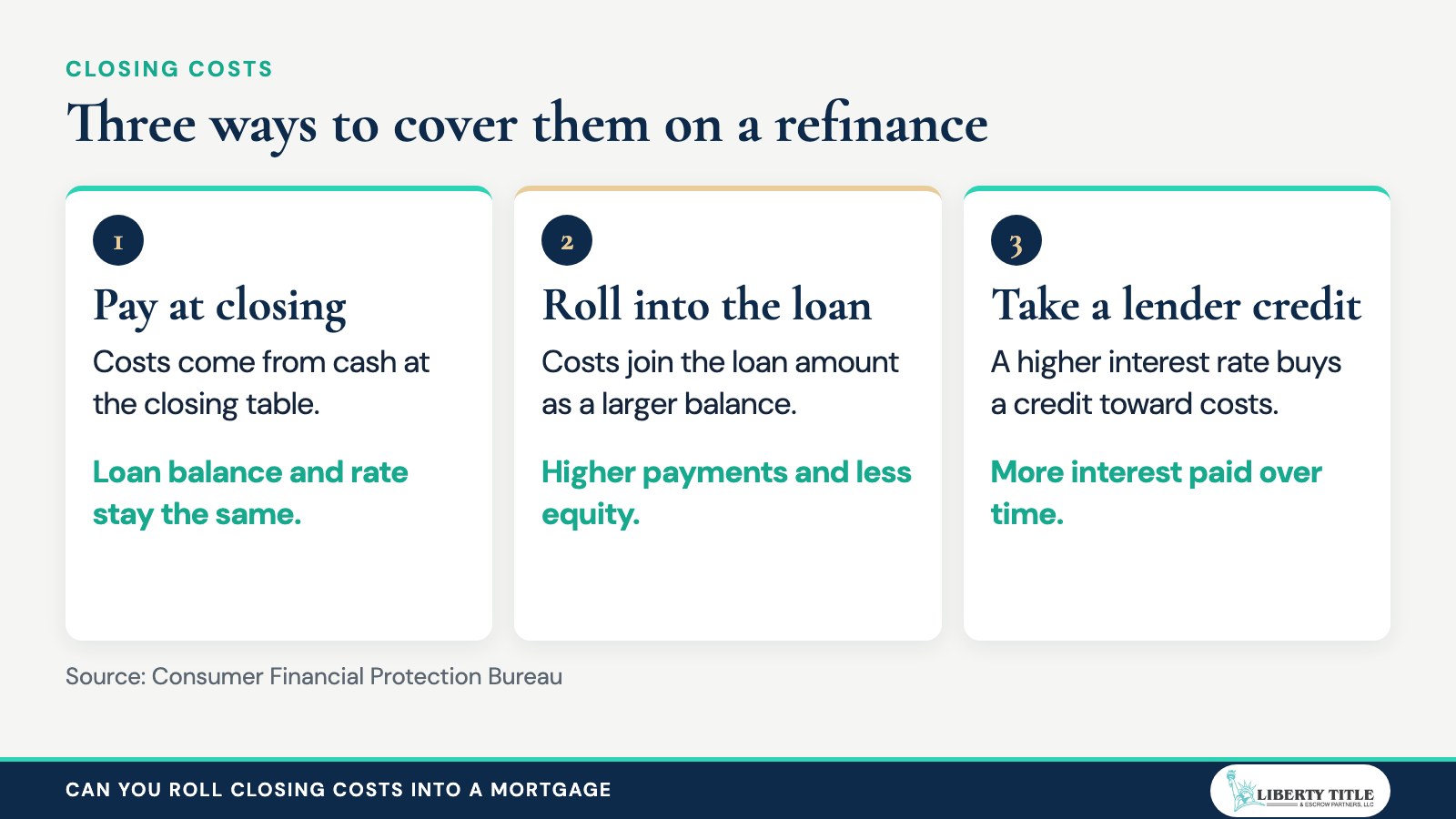
Each option moves cost to a different place. The choice depends on cash on hand and time in the home.
Should You Roll Closing Costs into Your Mortgage?
Rolling closing costs into your mortgage trades cash today for interest later. The CFPB says a larger loan raises monthly payments and reduces the equity you build. The same agency says points suit a borrower who keeps the loan for a long time.
A borrower who plans a short stay weighs the extra balance against the cash saved. A borrower who plans a long stay weighs years of added interest. A lender, tax advisor, or real estate attorney can run the numbers for one specific loan.
Total cost depends on the size of the bill, so the next section looks at typical amounts.
How Much Are Closing Costs on a $400,000 Mortgage?
Closing costs on a $400,000 mortgage run $8,000 to $20,000, using Bankrate's range of 2% to 5% of the loan. Local costs vary with the loan type, the property, and the lender. The range covers lender fees, points, and prepaids.
A 2025 LodeStar report in the same Bankrate article puts the average purchase closing cost total at $4,528 nationally. That figure equals about 1% of a $433,632 average sales price. LodeStar leaves out origination fees, commissions, points, and prepaids.
Any amount rolled in raises the balance, which changes the LTV ratio.
How Does Rolling In Closing Costs Change Loan-to-Value?
Rolling in closing costs raises the loan-to-value ratio, because the balance grows while the home value stays the same. A home appraised at $400,000 with a $300,000 balance sits at 75% LTV. Adding $6,000 of costs makes the balance $306,000, or 76.5% LTV.
The $6,000 figure equals 2% of the $300,000 balance, the low end of the Bankrate range. Fannie Mae uses the same method, dividing the loan amount by the property value. The graphic below walks through this example and the Florida tax on the added amount.
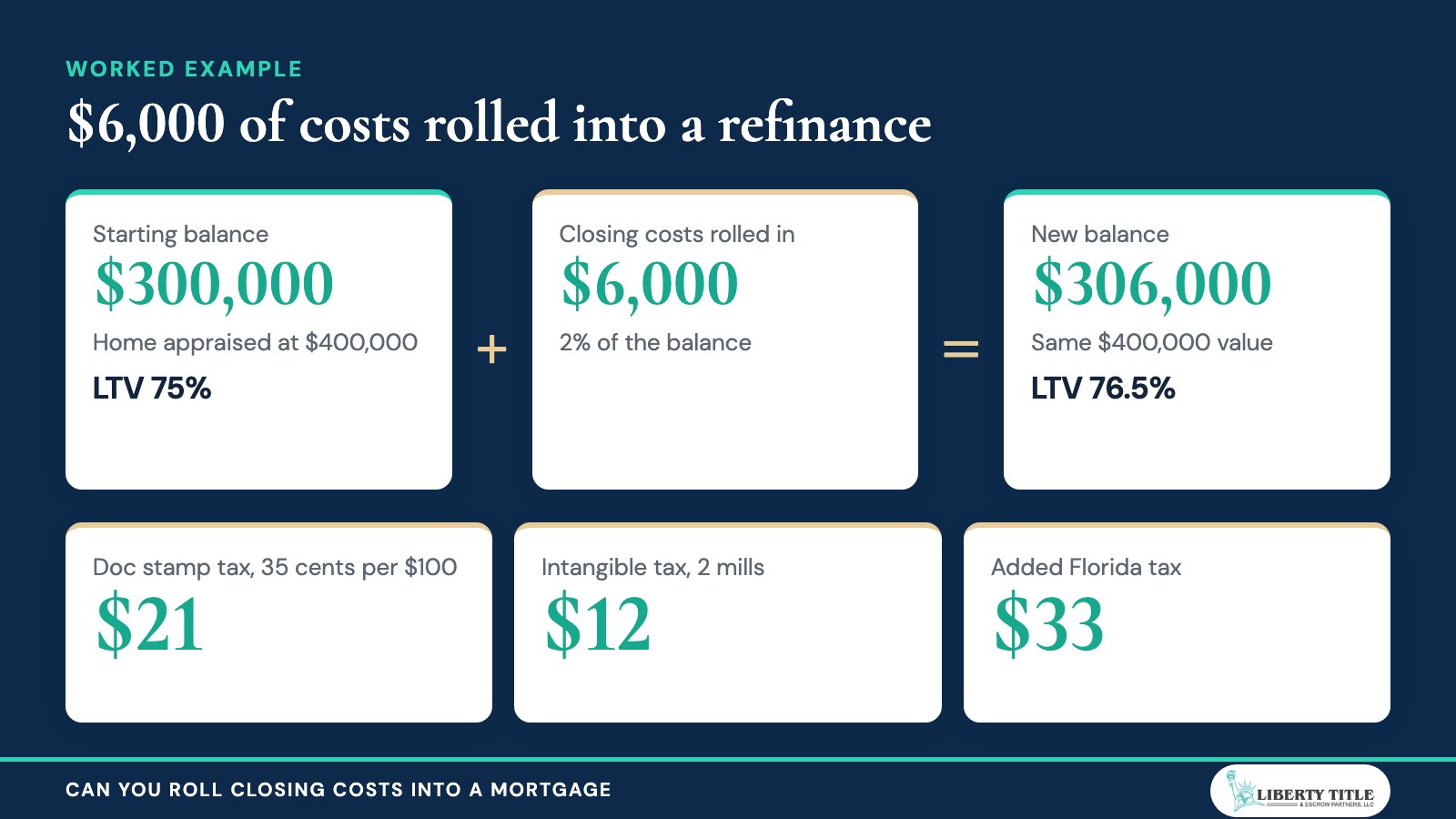
The example is an illustration, not a quote. Florida adds a tax layer to every rolled-in dollar.
How Much Do Florida Taxes Add When Costs Roll into the Loan?
Florida taxes add 55 cents for every $100 rolled into the note. The total is 35 cents of documentary stamp tax plus 20 cents of intangible tax. Section 201.08 of the Florida Statutes sets the stamp tax at 35 cents on each $100 of the debt. Section 199.133 sets the one-time intangible tax at 2 mills on each dollar.
On the $6,000 example, the stamp tax is $21 and the intangible tax is $12. The total added tax is $33. Section 201.08 also caps the stamp tax on a promissory note at $2,450.
Taxes are one more reason to compare the rolled-in cost with other options. Some borrowers cannot cover any of the costs, which raises a different question.
What If You Can't Afford Closing Costs?
When you cannot afford closing costs, a seller credit, a lender credit, or a larger refinance balance can cover them. The CFPB says a seller credit usually means a higher purchase price. A lender credit usually means a larger loan or a higher rate. Each route moves the cost, so none removes it.
A buyer can also ask the lender for a fee review on the Loan Estimate. The graphic below sets the credit limits by loan type next to the refinance rule.
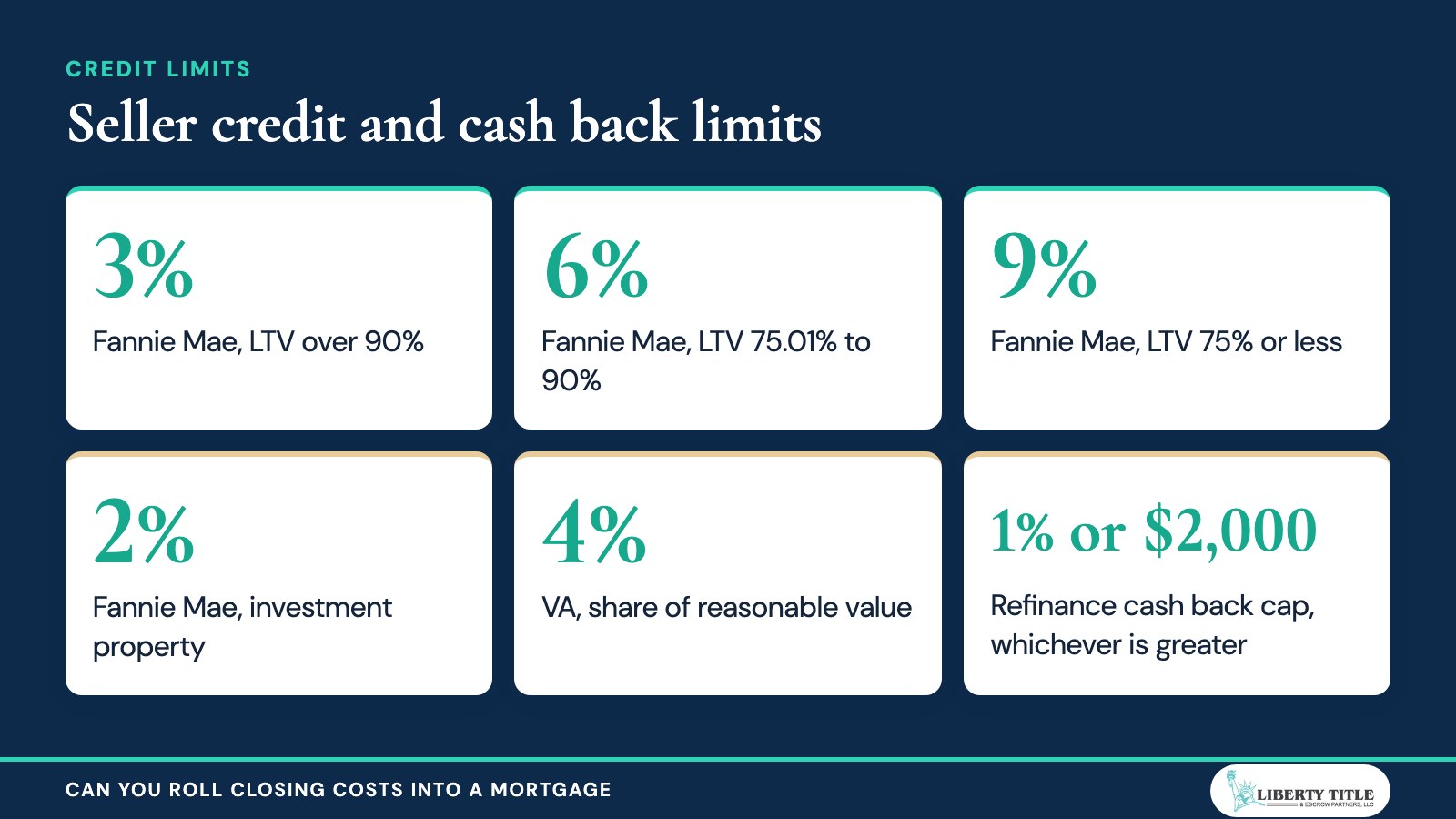
Extra questions come up at this stage, and the section below answers the short ones.
What Else Should You Know About Rolling Closing Costs?
Can You Add Closing Costs to a Mortgage Loan?
Yes, you can add closing costs to a mortgage loan on a refinance that allows it. Estimate your title fees with a free calculator before choosing the amount to add. The lender confirms the final balance.
Can You Wrap Closing Costs into Mortgage Loans?
Yes, wrapping closing costs into a mortgage means the same as rolling them in. The cost joins the balance and earns interest. Compare title charges and lender fees line by line before agreeing to a bigger balance.
Do Prepaid Items Go into the Escrow Account?
Prepaid items such as property taxes and homeowners insurance fund an escrow account at closing, as the CFPB's list of prepaids shows. Fannie Mae allows those items to be financed on a limited cash-out refinance. Learn how escrow accounts differ from the title company role before closing.
Who Shows Rolled-In Costs on the Settlement Statement?
The settlement agent prepares the settlement statement that shows the loan amount, each cost, and the cash to close. The CFPB describes cash to close as the amount paid at closing in addition to money already paid. Ask the settlement agent to walk through every line.
How Do You Send Cash to Close Safely?
Cash to close is typically paid by cashier's check or wire transfer, per the CFPB. Verify wire instructions by phone with a known number before sending funds. Follow a guide to wire safely and never act on emailed changes.
What Paperwork Does a Refinance Closing Need?
A refinance closing needs the loan documents, identification, and the Closing Disclosure. The title side adds a payoff statement and the new mortgage. Review the closing paperwork list ahead of time.
Is a HELOC the Same as a Refinance?
No, a home equity line of credit adds a second loan instead of replacing the first mortgage. The Fannie Mae rule above applies to a new first mortgage. Ask each lender how it treats fees on a home equity line.
Frequently Asked Questions
Are Closing Costs Part of the Mortgage?
Closing costs are separate from the mortgage unless you roll them in on a refinance. The CFPB lists them as upfront costs of getting the loan and transferring ownership. A buyer generally pays them at closing.
Can a Limited Cash-Out Refinance Include Closing Costs?
Yes, a limited cash-out refinance can finance closing costs, points and prepaid items under Fannie Mae rules. Cash back to the borrower is capped at the greater of 1% or $2,000. A lender confirms eligibility for a specific loan.
Can Closing Costs Be Waived?
A lender credit can offset closing costs, but the cost does not vanish. The CFPB says the credit comes with a higher interest rate. The borrower pays through the rate instead of cash.
Does Rolling Closing Costs into the Mortgage Change the Rate?
Rolling costs into the balance enlarges the loan, while a lender credit raises the rate. The CFPB describes these as two separate ways to avoid cash at closing. The loan estimate shows which path a lender uses.
Can Seller Credits Exceed Your Closing Costs?
No, Fannie Mae requires financing concessions to be equal to or less than the borrower's closing costs. Amounts above the cap count as sales concessions. The sales price used for LTV drops by that excess.
Can You Use Seller Credits on an Investment Property?
Yes, but Fannie Mae caps interested party contributions at 2% for an investment property at every LTV. The cap uses the lower of the sales price or appraised value. A lender confirms the number for each loan.
How Does Liberty Title Help Borrowers Review Rolled-In Closing Costs?
Liberty Title helps borrowers read the settlement statement line by line, from title charges to the final loan amount. We support residential closings, title searches, title insurance, and escrow in English and Spanish. Our refinance title work covers the lien payoff and recording steps for a refinance.
Anyone asking can you roll closing costs into a mortgage should review the numbers with a lender first. Questions about rolled-in costs belong with your lender, tax advisor, or real estate attorney. Our office in Miami answers closing process questions at +1 (305) 530-8998. Borrowers can reach the Liberty Title team before closing day.


You May Also Like
Can You Roll Closing Costs into a Mortgage


Do Sellers Pay Closing Costs and How Much

What a Warranty Deed Is and How It Protects the Buyer

How Much Closing Costs Are and What They Include


























How Long to Close After Title Search for Homebuyers

How To Safely Wire Money to a Title Company

What Documents Does a Title Company Need

How Much a Title Company Charges and What You Get

How Long a Title Company Can Hold Funds After Closing

How To Do a Title Search on Property Yourself

Title Insurance in Real Estate and How It Protects You
How Long a Title Search Takes and What Causes Delays

How a Title Search Works and What It Reveals

What a Title Company Does and Why It Matters at Closing

What Is Title Insurance and Why Do You Need It